
Table of Contents
Contest
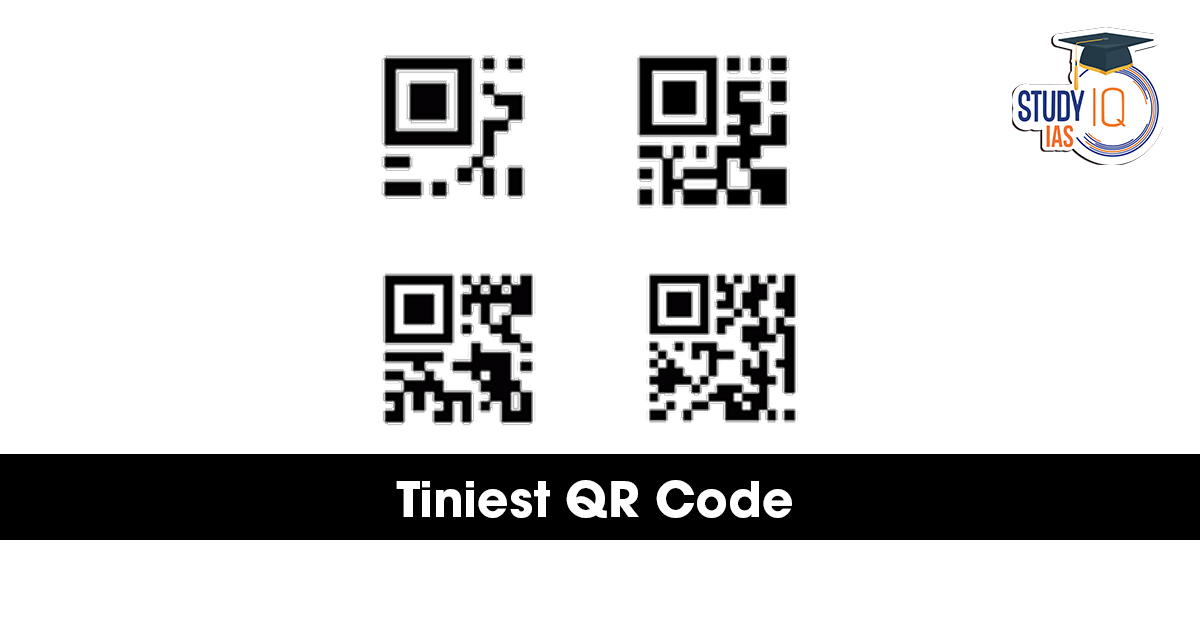
- Researchers have created the world’s smallest QR code — measuring just 2 square micrometres. It represents a new approach to solving one of the digital age’s biggest challenges: data rot.
About the innovation
- Record Miniaturisation: Researchers created a 2 square micrometre QR code — smaller than a bacterium — securing a Guinness World Record.
- Ultra-Fine Pixel Structure: Each pixel in the 29 × 29 QR grid measures only 49 nanometres, about ten times smaller than the wavelength of visible light. This makes it invisible to standard optical microscopes, requiring electron microscopy for verification.
- Proof of Concept: Demonstrates the feasibility of encoding digital information at atomic-scale precision for ultra-dense storage.
It aims to solve the following problem in the storage systems
The Problem: Data Rot and Fragile Storage Media
- Limited Lifespan of Current Storage: Hard drives and magnetic tapes typically last only 10–30 years and degrade over time, risking permanent data loss.
- Energy and Maintenance Burden: They require continuous electricity, cooling, and periodic data migration, increasing costs and carbon footprint.
- Archival Risk: Scientific, legal, and cultural records face long-term vulnerability due to dependence on unstable electronic media.
|
Technology Used: Focused Ion Beam (FIB) Milling |
| IInstead of printing ink or altering magnetic states, the researchers used a focused ion beam—essentially a stream of charged atoms—to carve data directly into the material with nanometre precision.
● Material Preparation: A glass substrate was coated with a 15-nanometre layer of chromium nitride, a highly durable ceramic. The ion beam etched microscopic patterns into this thin film. ● Permanent Physical Encoding: Because the data is physically carved into the ceramic rather than stored electronically, it cannot be erased by electromagnetic interference or power loss. |
Storage Density Potential
- High Information Density: The technique achieves about 130 bits per square micrometre, which allows substantial storage capacity in a very small physical space.
- Scalable Capacity: An A4-sized ceramic sheet could theoretically store over 2 terabytes of data, making it suitable for large archival repositories.
- Durability vs Density Trade-off: While modern hard drives offer higher density, ceramic storage prioritises extreme longevity over frequent rewriting or rapid access.
|
Read More Notes |
|
| Environment Notes | Art and Culture Notes |
| Science and Tech | History Notes |
| Geography Notes | Indian Polity Notes |
| General Knowledge | International Relation |
|
Explore StudyIQ Courses |
|
 Rupture Across the Durand Line: Rising T...
 Why Berbera Port Matters: Israel’s Rec...
 Coconut Cultivation in India: Climate Re...











 WhatsApp





