
Table of Contents
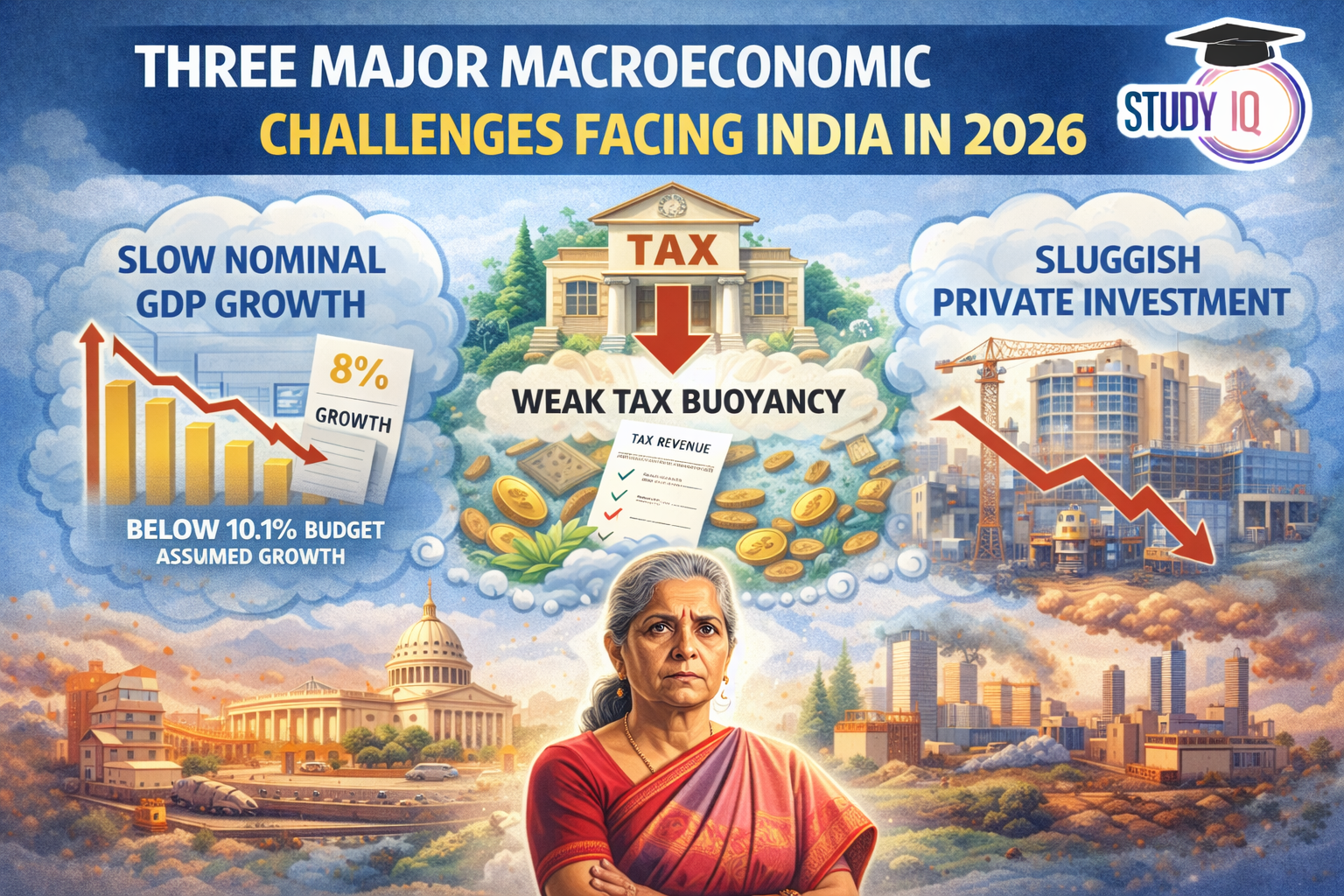
As India enters 2026, its macroeconomic fundamentals present a mixed picture. While the economy remains among the fastest-growing globally in real terms, headline growth masks deeper structural stresses. Slowing nominal GDP growth, weakening tax buoyancy, and persistently subdued private corporate investment together constrain fiscal policy, limit growth momentum, and complicate long-term development planning.
These challenges are particularly relevant in the context of the Union Budget 2026–27, which must balance fiscal prudence with the need to sustain growth, employment, and social welfare.
1. Weak Nominal GDP Growth: The Core Fiscal Constraint
Why Nominal GDP Matters More Than Real GDP
Nominal GDP measures the total value of goods and services at current prices. For fiscal policy, it is more important than real GDP because it determines:
-
Tax revenue potential
-
Fiscal deficit ratios
-
Government borrowing capacity
-
Expenditure planning
A slowdown in nominal GDP directly tightens fiscal space.
The Deceleration Trend
-
India’s nominal GDP growth has declined from double-digit levels in the past to around 8% in FY26.
-
This is significantly lower than the 10–11% growth assumed in earlier Budgets.
-
The slowdown reflects:
-
Moderating real growth
-
Lower inflation compared to earlier years
-
Macroeconomic Implications
-
Revenue projections fall short of Budget assumptions
-
Greater pressure to:
-
Increase borrowing, or
-
Curtail expenditure
-
Crowding-Out Risk
Higher government borrowing to compensate for revenue shortfalls can:
-
Push up interest rates
-
Reduce availability of credit for households and businesses
-
Further weaken private investment
Thus, weak nominal GDP growth acts as a binding macroeconomic constraint.
2. Weak Tax Buoyancy: Erosion of Revenue Elasticity
Understanding Tax Buoyancy
Tax buoyancy indicates how strongly tax revenues respond to GDP growth.
-
Buoyancy = 1 → tax growth matches GDP growth
-
Budgets typically assume buoyancy above 1 to fund higher spending
Current Reality
-
Budget assumptions: tax buoyancy around 1.1
-
Actual outcome: buoyancy closer to 0.6
This means tax revenues are growing at barely half the expected pace relative to GDP.
Reasons for Weak Buoyancy
-
Corporate tax rate reductions since 2019
-
GST rate rationalisation and exemptions
-
Slower growth in discretionary consumption
-
Compliance and enforcement limitations in certain sectors
Fiscal Consequences
-
Persistent revenue underperformance
-
Reduced ability to fund:
-
Capital expenditure
-
Welfare schemes
-
Health and education spending
-
Weak tax buoyancy limits the government’s capacity to use fiscal policy as a growth stabiliser.
3. Subdued Private Corporate Investment: The Growth Bottleneck
Policy Push Since 2019
To revive private investment, the government implemented:
-
Sharp corporate tax cuts
-
Higher public capital expenditure
-
Production Linked Incentive (PLI) schemes
-
Demand-side measures such as income-tax relief
Persisting Investment Weakness
Despite these efforts:
-
Private corporate investment remains below pre-pandemic (FY19) levels
-
Capacity utilisation is uneven across sectors
-
Firms remain cautious due to uncertain demand prospects
Demand-Side Constraints
-
Consumption growth is uneven, especially in rural and lower-income segments
-
Weak sales expectations discourage capacity expansion
External Sector Pressures
-
Declining foreign capital inflows
-
Global risk aversion and tighter financial conditions
-
Depreciation pressure on the rupee
Together, these factors weaken investor confidence and delay the investment cycle.
Interlinkages Among the Three Challenges
These challenges are mutually reinforcing:
-
Weak private investment → slower growth
-
Slower growth → weaker nominal GDP
-
Lower nominal GDP → poor tax performance
-
Weak tax buoyancy → constrained public spending
-
Reduced public spending → limited demand stimulus
This creates a low-growth–low-revenue trap, making macroeconomic management more complex.
Potential Growth and the Medium-Term Outlook
Potential vs Actual Growth
-
Potential growth is the maximum sustainable growth rate without triggering inflation.
-
Determined by capital formation, labour force participation, and productivity gains.
Positive Signals
Recent assessments suggest India’s potential growth has improved to around 7%, supported by:
-
Manufacturing and logistics reforms
-
PLI schemes
-
Labour law consolidation
-
Digitalisation and skilling initiatives
Risks to Realisation
-
Global economic slowdown
-
Geopolitical tensions
-
Financial market volatility
Unless private investment revives and demand strengthens, potential growth may remain under-utilised.
Way Forward: Strategic Policy Priorities
-
Revive Nominal Growth: Support demand while maintaining price stability
-
Improve Tax Efficiency: Focus on compliance, base-broadening, and dispute resolution rather than rate hikes
-
Crowd-In Private Investment: Stable policy regime, faster clearances, and targeted public capex
-
Protect Fiscal Credibility: Avoid excessive borrowing while prioritising high-multiplier spending
-
Strengthen External Stability: Manage capital flows and currency pressures prudently
Conclusion
India’s macroeconomic challenge in 2026 is not one of crisis but of constraint. Weak nominal GDP growth, low tax buoyancy, and hesitant private investment together restrict fiscal ambition and growth potential. The policy challenge lies in breaking this cycle—by restoring demand confidence, improving revenue responsiveness, and translating structural reforms into sustained private investment. How effectively these issues are addressed will determine whether India can convert its demographic and reform advantages into durable, high-quality growth.
|
Read More Notes |
|
| Environment Notes | Art and Culture Notes |
| Science and Tech | History Notes |
| Geography Notes | Indian Polity Notes |
| General Knowledge | International Relation |
|
Explore StudyIQ Courses |
|
 Bharat Audyogik Vikas Yojana (BHAVYA Sch...
 NavIC Satellite Clock Failures: Causes, ...
 Rare Earth Elements (REE) Sites in India...











 WhatsApp





