
Table of Contents
Context
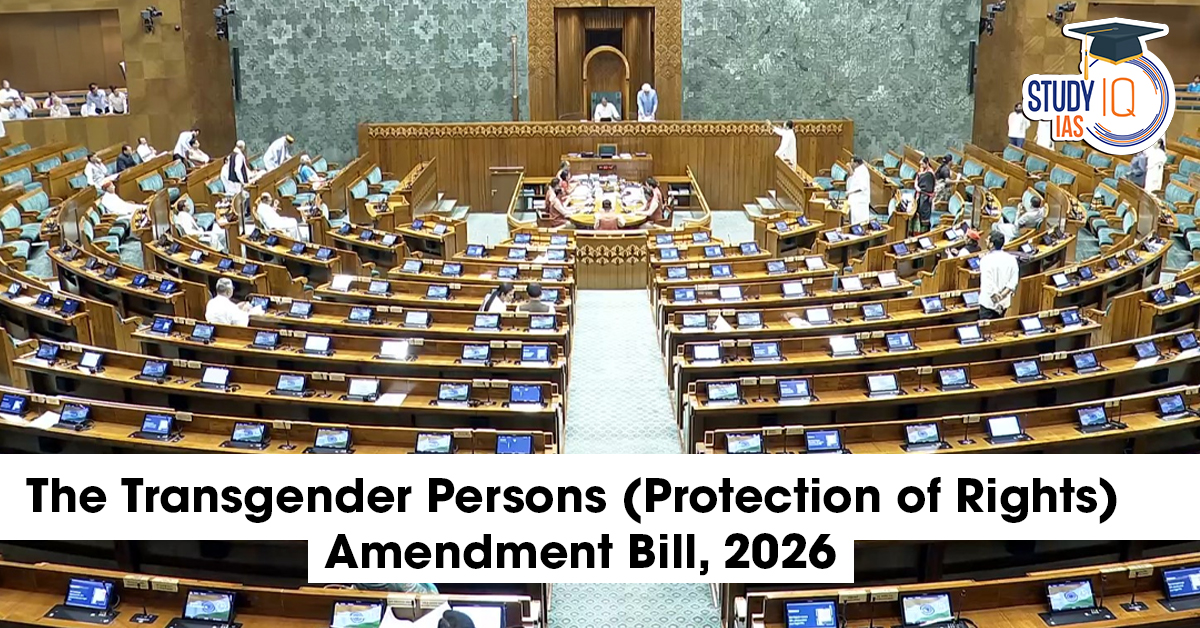
The Union Government has introduced a Bill in the Lok Sabha proposing amendments to the Transgender Persons (Protection of Rights) Act, 2019. The proposed legislation seeks to alter the definition of a transgender person and reconsider the existing recognition of self-perceived gender identity.
Key features of the Transgender Persons Bill, 2026
- Purpose of the bill: The Transgender Persons (Protection of Rights) Amendment Bill, 2026 aims to modify provisions of the 2019 legislation, which was enacted to prevent discrimination against transgender individuals and promote their welfare.
- The 2019 Act was enacted in response to the landmark Supreme Court judgment in NALSA v. Union of India, which recognised transgender persons as a distinct “third gender” and affirmed the right to determine one’s own gender identity under Article 21 of the Constitution.
- Removal of Self-Perceived Gender Identity: The Bill proposes deleting Section 4(2) of the 2019 Act, which currently acknowledges an individual’s right to identify their gender based on personal perception.
- Revised Definition of “Transgender Person”: The amendment introduces a narrower definition that includes:
- Socio-cultural identities such as hijra, kinner, aravani, jogta, and eunuch
- Individuals with intersex variations
- Persons with congenital biological differences in sexual characteristics
- Under the proposal, individuals identifying purely through gender self-identification or gender fluidity would not fall within the definition.
- Inclusion of Persons Subjected to Forced Gender Alteration: The definition would also cover individuals compelled to assume a transgender identity through practices such as mutilation, castration, hormonal intervention, or coercion.
- Establishment of a Medical Authority: The Bill introduces a medical board—headed by a Chief Medical Officer—to examine applications related to gender certification.
- Changes in Certification Process: Instead of the earlier system where certificates were issued directly, District Magistrates would now evaluate the recommendations of the medical authority before issuing transgender identity certificates.
- Revision of Certificates After Surgery: Individuals undergoing Sex Reassignment Surgery (SRS) would be required to apply for an updated gender certificate. Under the earlier law, such revisions were optional.
- Reporting Obligation for Hospitals: Hospitals performing SRS procedures would be required to report these cases to the District Magistrate.
- Name Change in Official Records: The Bill introduces a provision allowing transgender persons to modify their first name in official documents, provided they satisfy the criteria under the revised definition.
- Expanded Penal Provisions: The amendment strengthens criminal provisions with graded punishments—including imprisonment and fines of up to ₹5 lakh—for offences such as:
- Denying access to public places
- Imposing forced labour
- Expelling transgender individuals from their homes
Government Initiatives for Transgender Empowerment
| Government Initiatives for Transgender Empowerment |
| ● SMILE Scheme: The Support for Marginalized Individuals for Livelihood and Enterprise (SMILE) scheme provides rehabilitation assistance and medical coverage for procedures such as SRS.
● National Portal for Transgender Persons: An online platform enabling transgender individuals to apply for identity cards and certificates without direct interaction with government offices. ● Garima Greh: Government-supported shelter homes offering accommodation, food, counselling, and skill development opportunities to transgender persons in vulnerable situations. ● Inclusive Education: Teacher training modules developed by National Council of Educational Research and Training aim to promote awareness of gender diversity and inclusivity in schools. |
Associated challenges with the Bill
- Impact on Bodily Autonomy: Mandatory verification by a medical board could compel individuals to undergo intrusive examinations to establish their identity.
- Conflict with Judicial Precedent: Critics argue that the proposed amendments contradict the principles laid down in NALSA v. Union of India, which emphasised the right to self-determination of gender identity and rejected compulsory medical procedures.
- Exclusion of Diverse Gender Identities: By prioritising congenital variations and certain traditional socio-cultural identities, the Bill may leave out people who identify as gender-fluid or genderqueer.
- Administrative Delays: Giving District Magistrates the authority to seek additional medical verification could lengthen the already complex process of obtaining official documentation.
- Reinforcement of Social Stigma: The government’s argument that gender identity should not be a matter of personal choice has been criticised for reinforcing the notion that transgender identity is acquired rather than inherent.
Way Forward
- Community Engagement: Policymakers should conduct nationwide consultations with transgender communities to ensure that legislation reflects lived experiences and practical realities.
- Alignment with Judicial Principles: Reinstating the right to self-identification would help ensure consistency with constitutional principles recognised by the Supreme Court.
- Inclusive Medical Boards: If medical boards remain part of the process, they should include psychologists and representatives from the transgender community rather than only medical surgeons.
- Reservation in Education and Employment: Policy efforts could prioritise horizontal reservations in education and public employment, as suggested in various judicial discussions.
- Simplified Documentation Process: Allowing certification through self-declared affidavits could reduce bureaucratic delays, corruption, and harassment.
|
Read More Notes |
|
| Environment Notes | Art and Culture Notes |
| Science and Tech | History Notes |
| Geography Notes | Indian Polity Notes |
| General Knowledge | International Relation |
|
Explore StudyIQ Courses |
|
 WASH (Water, Sanitation, and Hygiene) Se...
 Vairamuthu Wins Jnanpith Award 2026: Tam...
 Assam Peace Settlement with Hmar and Kuk...







 WhatsApp





