
Table of Contents
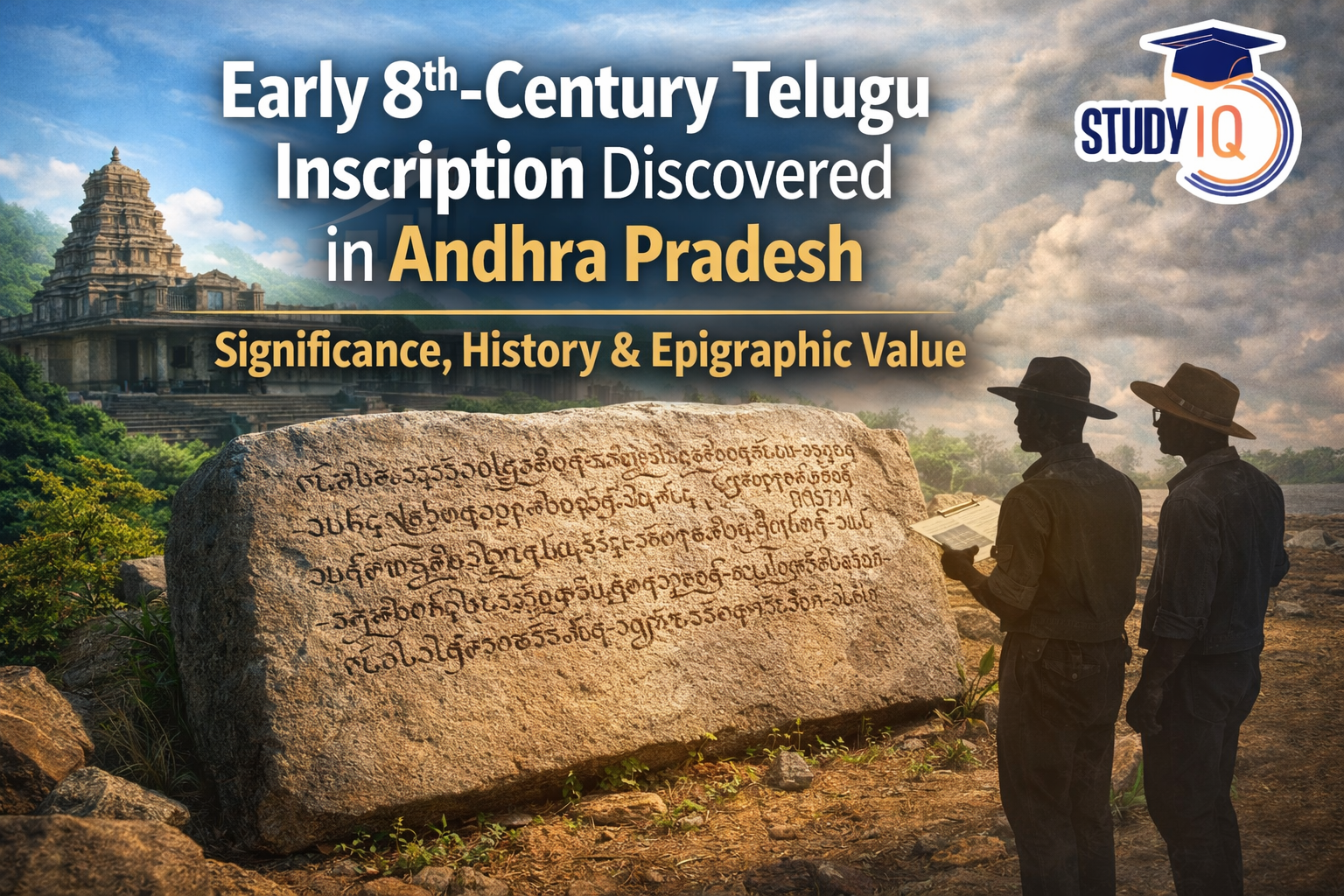
The recent discovery of an early 8th-century Telugu inscription at Pitikayagulla in Andhra Pradesh has drawn significant attention from historians and epigraphists. This finding is being hailed as one of the earliest known Telugu inscriptions in the region and is a crucial milestone in tracing the evolution of the Telugu language and script.
Located near the historic Pitikesvara temple, the inscription provides valuable evidence of early medieval administrative practices, the growing independence of Telugu from Prakrit and Sanskrit traditions, and the important role played by artisans in public infrastructure.
Context of the Discovery
The inscription was found engraved on a stone slab erected in front of the Pitikesvara temple at Pitikayagulla. Based on palaeographic analysis, scholars have dated it to the early 8th century CE, placing it among the oldest Telugu inscriptions known so far.
Epigraphists have interpreted the content as referring to the construction of a new embankment (nava katta), which suggests an organized approach to water management and public works during that period.
Key Highlights of the Inscription
-
Dating:
The inscription belongs to the early 8th century CE, making it one of the earliest Telugu inscriptions identified in Andhra Pradesh. -
Location:
Engraved on a stone slab in front of the historic Pitikesvara temple at Pitikayagulla. -
Subject Matter:
It records the construction of a new embankment (nava katta), pointing to irrigation and water conservation efforts. -
Attribution:
The work is attributed to Pranimilli Achari, identified as a sculptor or craftsman. -
Role of Artisans:
This highlights that artisans were not merely craftsmen but also active contributors to public infrastructure and social development.
Linguistic and Script Significance
One of the most important aspects of this discovery is its linguistic value:
-
The inscription is written in early Telugu using a transitional script.
-
It reflects the gradual shift from Prakrit and Sanskrit influences toward an independent Telugu linguistic identity.
-
It represents a bridge between:
-
Earlier Brahmi-based inscriptions, and
-
Later, more standardized and evolved Telugu epigraphic records.
-
This transitional script helps scholars understand how Telugu emerged as a distinct written language during the early medieval period.
Insights into Governance and Society
The inscription provides a window into the socio-political life of early medieval Andhra Pradesh:
-
Local Administration:
The record suggests organized governance structures capable of planning and executing public works like embankments. -
Land and Water Management:
The mention of a nava katta indicates the importance of irrigation, agriculture, and water regulation. -
Social Organisation:
Naming a craftsman like Pranimilli Achari shows social recognition of skilled artisans and their contributions. -
Community Participation:
Such projects likely involved cooperation between rulers, local authorities, and professional guilds.
Historical Importance of the Discovery
This inscription is significant for multiple reasons:
-
Chronological Bridge:
It fills a critical gap between early Brahmi inscriptions and later mature Telugu inscriptions. -
Development of Telugu Epigraphy:
It helps trace the step-by-step evolution of Telugu script and language. -
Cultural Identity:
It strengthens evidence that Telugu was emerging as a strong regional language by the 8th century CE. -
Understanding Early Medieval Andhra:
It sheds light on infrastructure development, governance systems, and social hierarchies.
Why This Discovery Matters for Indian History
The Pitikayagulla inscription is not just a linguistic artifact but a historical document that connects language, culture, administration, and economy. It shows how regional languages like Telugu evolved alongside growing local governance systems and increasing societal complexity in early medieval India.
For students of history, archaeology, and UPSC aspirants, this discovery is especially important as it touches on:
-
Indian epigraphy
-
Regional language development
-
Temple-centered settlements
-
Early medieval administration
-
Artisans and social structure
|
Read More Notes |
|
| Environment Notes | Art and Culture Notes |
| Science and Tech | History Notes |
| Geography Notes | Indian Polity Notes |
| General Knowledge | International Relation |
|
Explore StudyIQ Courses |
|
 Supreme Court Upholds the Right to Die w...
 GDP Growth vs Employment Reality: Unders...
 Bill to Codify IPS Deputation in CAPFs: ...











 WhatsApp





