
Table of Contents
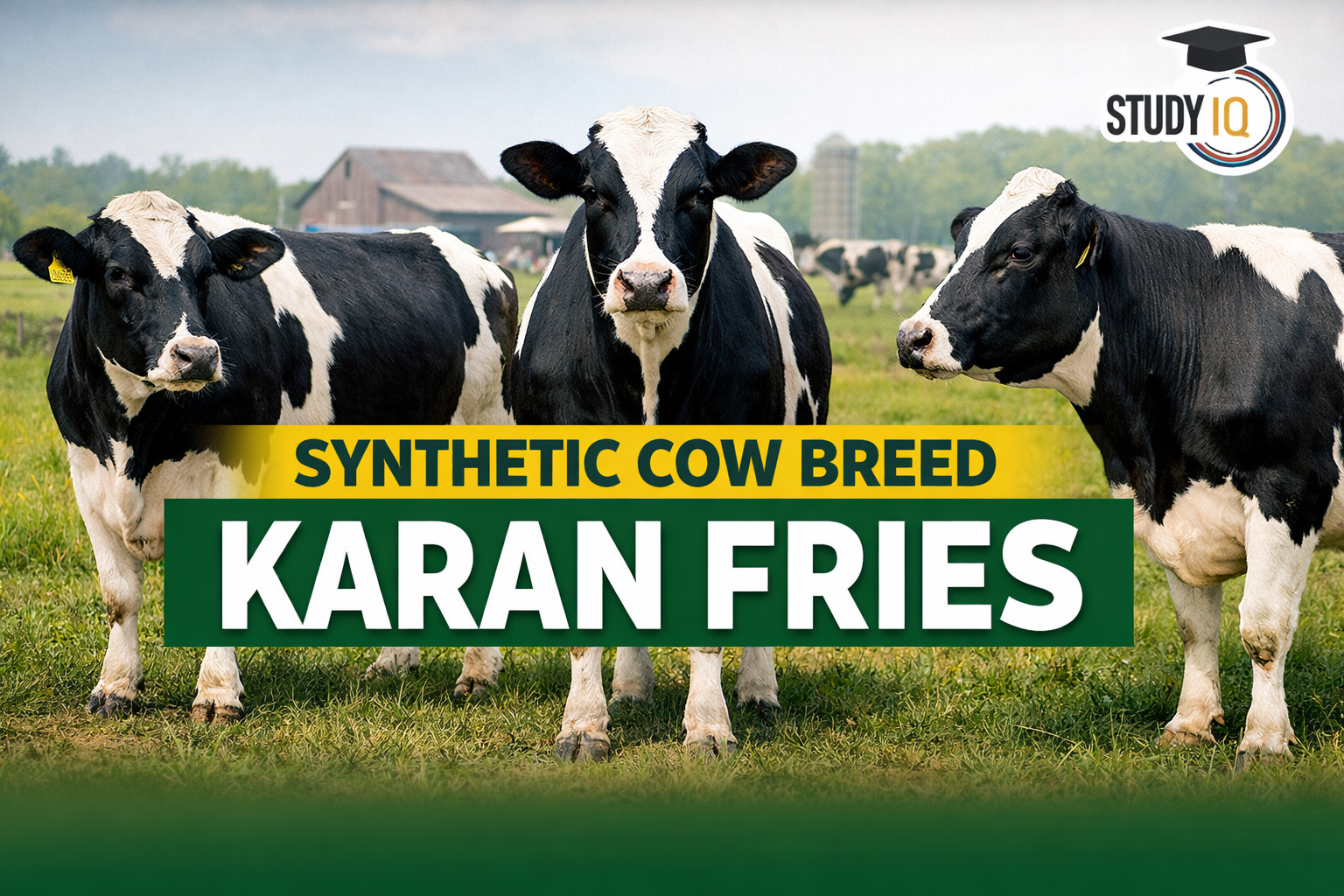
Context: At an event organised by the ICAR–National Bureau of Animal Genetic Resources (ICAR-NBAGR), Union Agriculture Minister Shivraj Singh Chauhan presented the registration certificate for Karan Fries—an indigenously developed, high milk-yielding synthetic cow breed known for both productivity and hardiness. In total, 16 new livestock/poultry breeds and varieties were registered, taking India’s total number of registered livestock and poultry breeds to 246.
About Karan Fries Cow Breed
- Type: Synthetic (stabilised crossbred) dairy cattle breed
- Developed by: National Dairy Research Institute (NDRI), Karnal (Haryana)
- Breeding programme: Developed through crossbreeding of:
- Exotic Holstein Friesian (HF) bulls (globally recognised for high milk yield), and
- Indigenous Tharparkar zebu cows (known for hardiness, heat tolerance, and resilience)
Key Features of Karan Fries Cow Breed
1) Milk Production Potential
- Average yield: ~3,550 kg per lactation (approx. 10 months)
- Performance of best animals:
- Up to 19 kg/day (commonly reported best specimens)
- Peak yield: 46.5 kg/day
- Comparative productivity (general reference points):
- Many indigenous cattle breeds: ~3–4 kg/day, usually 1,000–2,000 kg per lactation
- Exotic breeds (under favourable management): ~8.12–9 kg/day
- Karan Fries: nearly twice the milk potential of most indigenous breeds in India (on average)
2) Physical and Adaptive Traits
- Coat colour: Typically black and white
- Hump: Absent
- Climate suitability: Strong adaptability to hot and humid subtropical conditions
3) Present Status and Distribution
- Currently reared largely by farmers in Haryana districts including: Karnal, Kurukshetra, Panipat, Kaithal, Jind and Yamuna Nagar
Significance of Development of Karan Fries
- Demonstrates strong genetic potential under Indian management conditions.
- Achieved breed stabilisation after:
- Several generations of inbreeding (breeding within the population),
- Continuous genetic monitoring, and
- Scientific selection for stable traits.
- Why stabilisation matters:
Breed stabilisation indicates that Karan Fries has moved beyond the limited variability of early crossbred generations (e.g., F1) and has become well-adapted to Indian agro-climatic conditions—making it a potential foundation stock for systematic crossbred cattle improvement across regions.
Other new Livestock Varieties Registered
1) Synthetic/Composite Cattle Breed
- Vrindavani: A high-yielding synthetic cattle breed developed by the Indian Veterinary Research Institute (IVRI), Bareilly (Uttar Pradesh).
- Composite breeding: Exotic breeds (Holstein Friesian, Brown Swiss, Jersey) combined with indigenous Hariana cattle.
2) Indigenous Cattle Varieties
- Medini (Jharkhand)
- Rohilkhandi (Uttar Pradesh)
3) Buffalo
- Melghati (Maharashtra)
4) Goat Breeds
- Palamu (Jharkhand)
- Udaipuri (Rajasthan)
5) Mithun
- Nagami (Nagaland)
6) Poultry and Waterfowl Varieties
- Mala Chicken (Jharkhand)
- Ducks:
- Kodo Duck (Jharkhand)
- Kudu Duck (Odisha)
- Kuttanad Duck (Kerala)
- Manipuri Duck (Manipur)
- Nagi Duck (Assam)
- Goose:
- Rajdigheli Goose (Assam)
7) Sheep
- Avishaan: Synthetic sheep breed (Rajasthan)
Registration Process of New Livestock Varieties
- ICAR launched the mechanism for “Registration of Animal Germplasm” in 2007 to create an authentic national documentation system for India’s sovereign animal genetic resources with known and verified characteristics.
- Nodal agency: ICAR–NBAGR, Karnal is the national nodal body for processing and maintaining registration records.
- Apex body: Breed Registration Committee (BRC)
- Chair: DDG (Animal Science), ICAR
- Permanent members: ADG (AP&B), ADG (IP&TM), Animal Husbandry Commissioner (or nominee), National Biodiversity Authority representative, and Director, NBAGR.
- What gets registered? Indigenous breeds, synthetic breeds, strains/lines, and other recognised animal genetic material.
- It is the sole nationally recognised mechanism for animal genetic resource registration, aiding conservation, breed improvement, and creating a sense of ownership among local communities that developed these breeds.
 Navigating Uncharted Waters: What Next f...
 Astronaut Reentry Explained: How Spacecr...
 Missile Interceptors Explained: Role in ...











 WhatsApp





