
Table of Contents
Context
- India is accelerating its transition toward cleaner mobility to reduce vehicular pollution and oil dependence. While the focus of government policy has largely been on Battery Electric Vehicles (BEVs), the debate has recently expanded to include Hybrid Electric Vehicles (HEVs) and Plug-in Hybrid Electric Vehicles (PHEVs).
|
Hybrid Vehicle Technologies |
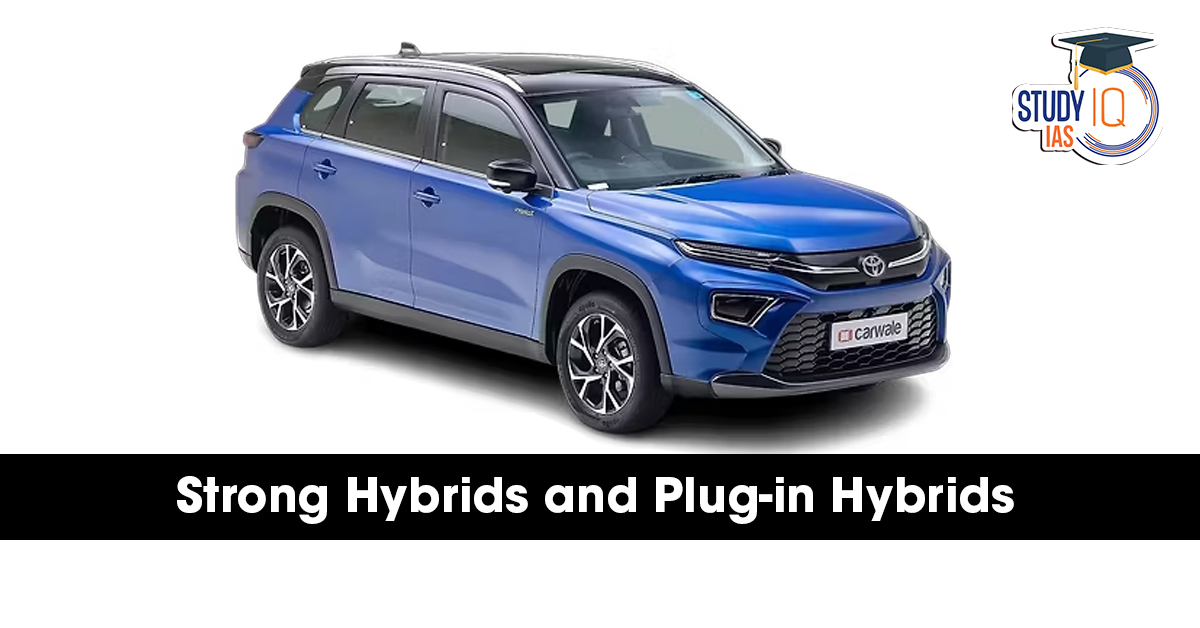
| ● Strong or Full Hybrid Electric Vehicles (HEVs): Strong hybrids combine a conventional internal combustion engine (ICE) with an electric motor and battery. These vehicles can operate in three modes:
○ Electric mode at low speeds or short distances ○ Engine mode when higher power is needed ○ Combined mode where both systems work together The battery in HEVs is charged internally through: ○ Regenerative braking, which converts braking energy into electricity ○ Energy generated by the internal combustion engine This allows the vehicle to run partially on electricity without requiring external charging. ● Plug-in Hybrid Electric Vehicles (PHEVs): PHEVs are similar to strong hybrids but have larger batteries that can be charged externally using a power source. ● The vehicle starts in electric mode and runs on electricity until the battery is depleted. ● Once the battery is drained, the petrol or diesel engine takes over, and the vehicle operates like a hybrid. PHEVs therefore offer longer electric-only driving ranges compared to strong hybrids. |
Advantages of Hybrid Vehicles in India
- Transitional Technology: Hybrids can serve as a bridge technology between traditional vehicles and fully electric vehicles, particularly where EV infrastructure is still developing.
- Lower Range Anxiety: Unlike BEVs, hybrids do not depend entirely on charging infrastructure, reducing range anxiety for consumers.
- Better Suitability for Long-Distance Travel: In regions with limited charging networks, hybrid vehicles offer greater flexibility for long-distance travel.
Challenges and Concerns
- Continued Fossil Fuel Dependence: Hybrid vehicles still rely partly on petrol or diesel, which limits their environmental benefits compared to BEVs.
- Limited Impact on Urban Air Pollution: Cities with severe pollution may not experience significant improvements if hybrids replace conventional vehicles.
- Policy and Subsidy Concerns: Extending subsidies to hybrids could increase government fiscal burden and divert resources from developing EV infrastructure.
Way Forward
To balance environmental goals and technological realities, India could adopt a multi-technology transition strategy:
- Continue prioritising Battery Electric Vehicles (BEVs) for long-term decarbonisation.
- Use hybrid technologies as transitional solutions, particularly in regions lacking charging infrastructure.
Expand investments in EV charging infrastructure and battery manufacturing.
|
Read More Notes |
|
| Environment Notes | Art and Culture Notes |
| Science and Tech | History Notes |
| Geography Notes | Indian Polity Notes |
| General Knowledge | International Relation |
|
Explore StudyIQ Courses |
|
 Algorithmic Sovereignty Should Be Indiaâ...
 $100 Oil: Why Supply Security Matters Mo...
 Bridging the Digital Divide: Meaning, Ch...











 WhatsApp





