
Table of Contents
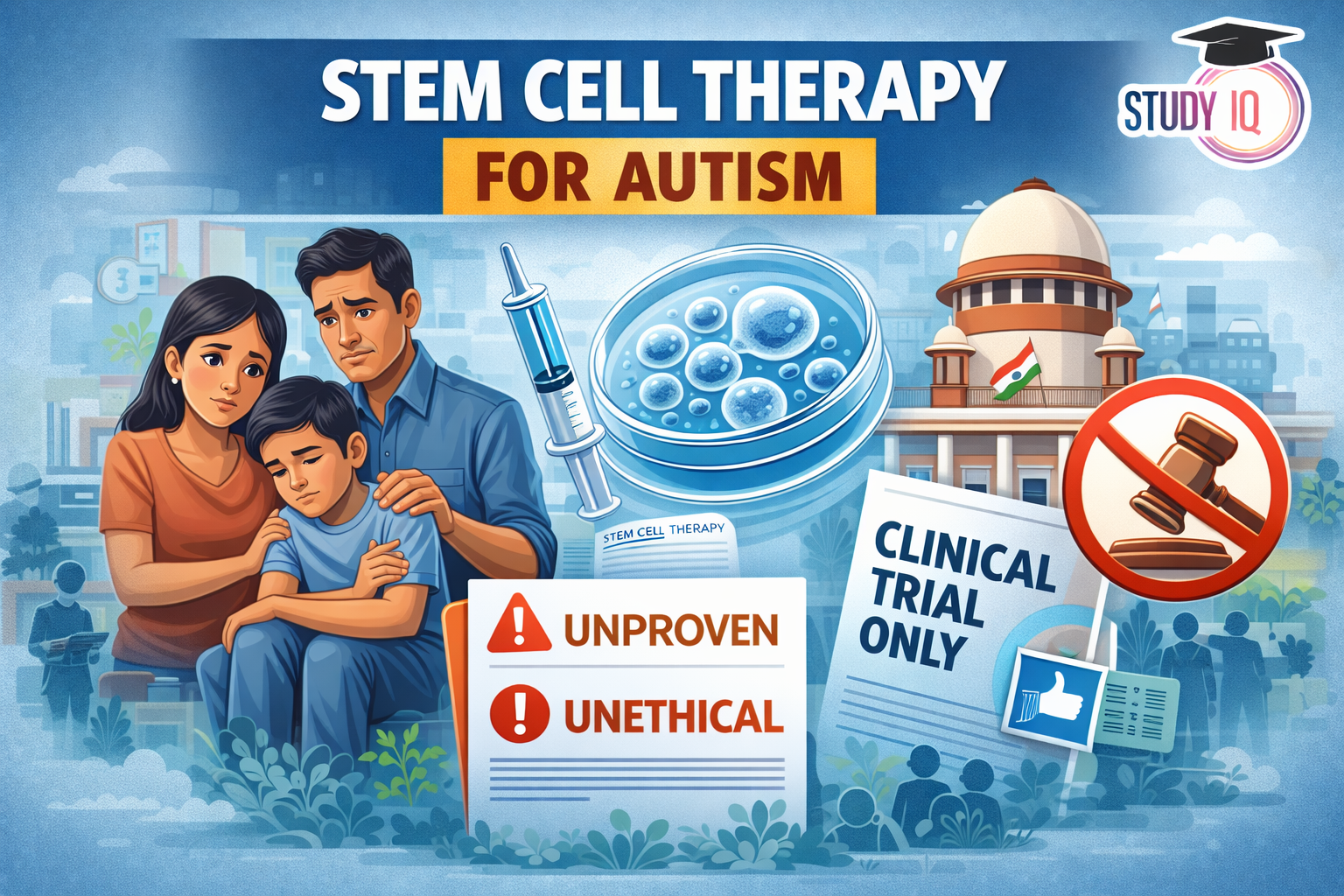
In a landmark decision, the Supreme Court of India has ruled that stem cell therapy cannot be offered as a clinical treatment for Autism Spectrum Disorder (ASD). The Court declared that using stem cell interventions for autism outside approved and regulated clinical trials is unethical and amounts to medical malpractice.
The judgment comes amid rising concerns over unproven medical therapies being marketed to vulnerable families seeking treatment options for autism, a condition for which no curative medical treatment currently exists.
What Is Autism Spectrum Disorder (ASD)?
Autism Spectrum Disorder is a neurodevelopmental condition characterised by challenges in:
-
Social interaction
-
Communication
-
Behaviour and sensory processing
ASD is not a disease but a spectrum condition, and current evidence-based interventions focus on behavioural therapy, educational support, and long-term care, not curative medical procedures.
Why Stem Cell Therapy for Autism Is Controversial
Stem cell therapy has shown promise in regenerative medicine, such as in blood disorders and certain cancers. However:
-
There is no credible scientific evidence proving its safety or effectiveness for autism.
-
Risks include immune reactions, infections, tumour formation, and unknown long-term consequences.
-
Despite this, some private clinics have offered stem cell therapy as a “treatment” for ASD, often at high cost.
This raised serious ethical concerns about misleading claims and exploitation of desperate families.
What the Supreme Court Ruled
1. Complete Ban on Clinical Use
The Court held that stem cell therapy cannot be used as a treatment for autism. Any such use outside approved clinical trials is impermissible.
2. Declared Medical Malpractice
The judgment clarified that:
-
Offering stem cell therapy for autism as a routine clinical service is professional misconduct.
-
Merely classifying stem cells as “drugs” under the Drugs and Cosmetics Act does not make their use lawful.
3. Limits of Informed Consent
The Court emphasised that:
-
Consent is invalid if it is not based on adequate and evidence-backed information.
-
Patients cannot demand experimental therapies as a matter of right.
-
Offering a choice between “no treatment” and an unproven therapy does not amount to genuine informed consent.
What Happens to Patients Already Undergoing Therapy?
In a balanced approach, the Court directed that:
-
Patients already receiving stem cell interventions should not be abruptly abandoned.
-
However, continuation is allowed only within ethically approved clinical trials.
-
Authorities such as the National Medical Commission, AIIMS, and the Ministry of Health and Family Welfare must ensure safe transition into regulated research frameworks.
Medical Ethics and Standard of Care
The Court reaffirmed settled principles of medical negligence:
-
Doctors must adhere to accepted professional standards based on current scientific knowledge.
-
Administering treatments that lack scientific backing violates the reasonable standard of care.
-
Deviations, especially involving experimental interventions presented as therapy, attract legal liability.
Scientific Consensus on Stem Cells and Autism
-
The Indian Council of Medical Research classifies stem cell therapy for autism as experimental, restricting it to approved trials.
-
The World Health Organization and the International Society for Stem Cell Research warn against premature clinical use due to safety risks and lack of evidence.
Why This Ruling Matters
1. Protects Vulnerable Families
The judgment shields families from false hope, financial exploitation, and medical harm.
2. Reinforces Evidence-Based Medicine
It draws a clear boundary between scientific research and unethical commercial practice.
3. Strengthens Regulatory Oversight
The ruling empowers regulators to act firmly against clinics offering unproven treatments.
4. Sets a National Precedent
It establishes that medical innovation cannot override ethics, evidence, and patient safety.
Way Forward
-
Promote evidence-based interventions such as behavioural therapy and inclusive education for ASD.
-
Encourage responsible stem cell research within strict ethical and regulatory frameworks.
-
Increase public awareness about risks of unproven therapies.
-
Strengthen enforcement against medical misinformation.
Conclusion
The Supreme Court’s ruling on stem cell therapy for autism is a decisive affirmation of ethical medicine. By prohibiting unproven treatments outside regulated research, the Court has prioritised patient safety, scientific integrity, and informed consent. The judgment sends a clear message: medical hope must be guided by evidence, not exploitation, and innovation must never come at the cost of human dignity and trust.
|
Read More Notes |
|
| Environment Notes | Art and Culture Notes |
| Science and Tech | History Notes |
| Geography Notes | Indian Polity Notes |
| General Knowledge | International Relation |
|
Explore StudyIQ Courses |
|
Sharing is caring!
 Bharat Audyogik Vikas Yojana (BHAVYA Sch...
 NavIC Satellite Clock Failures: Causes, ...
 Rare Earth Elements (REE) Sites in India...





 WhatsApp





