
Table of Contents
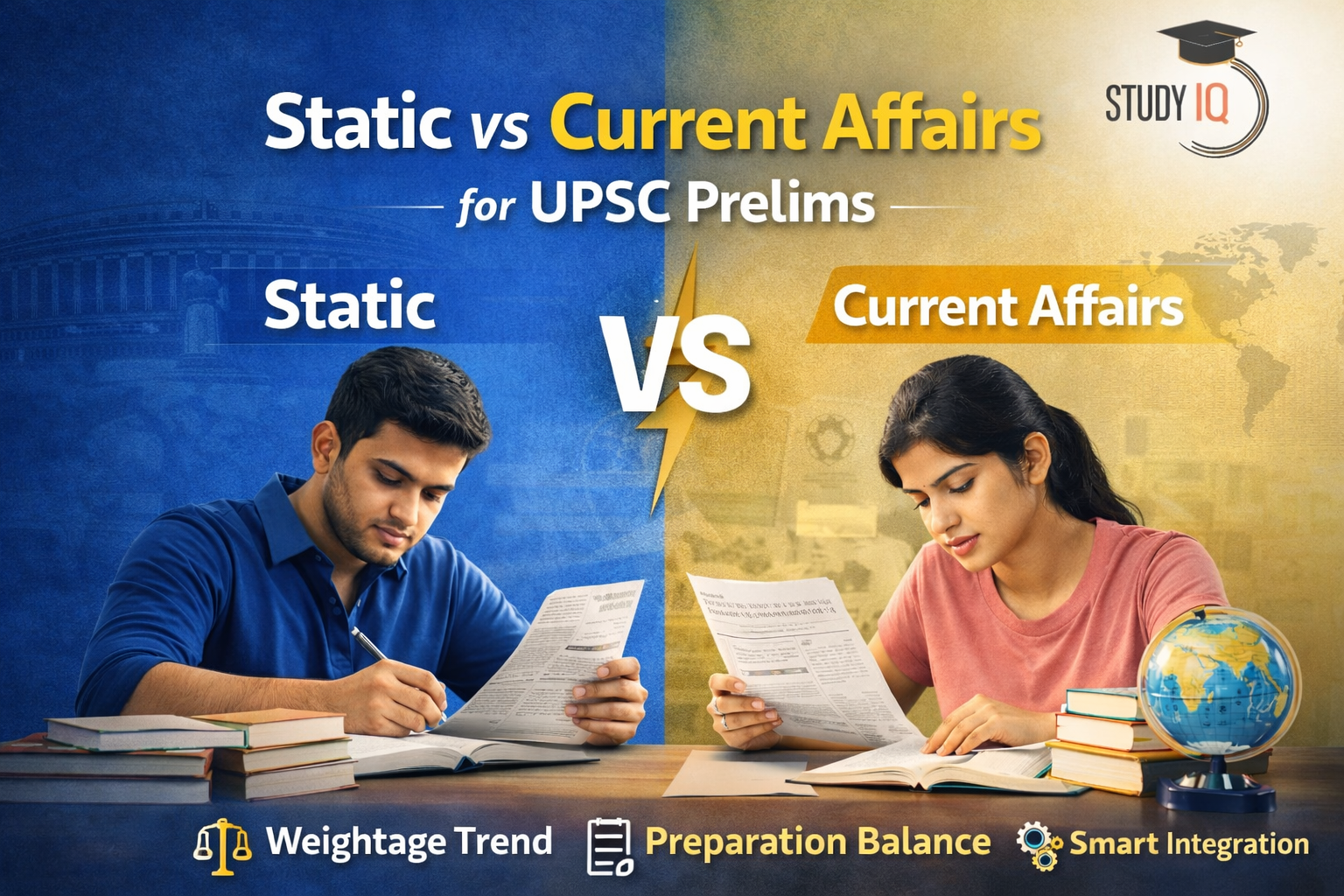
Preparing for the Civil Services Examination conducted by UPSC often creates one major confusion among aspirants — Should I focus more on static subjects or current affairs?
The reality is that UPSC Prelims is not a Static vs Current battle. It is a Static + Current Integration Exam. The right UPSC Prelims preparation strategy for 2026 focuses on building strong conceptual static knowledge and applying it through current affairs.
This article explains the real weightage trend, preparation strategy, and what aspirants should prioritize for UPSC Prelims 2026.
Understanding Static and Current Affairs in UPSC Context
What is Static Portion?
Static subjects include:
-
Polity
-
History
-
Geography
-
Economy (Basic Concepts)
-
Environment Fundamentals
-
Basic Science
Static forms the conceptual base of UPSC Prelims.
What is Current Affairs Portion?
Current affairs include:
-
Government schemes
-
International relations developments
-
Environment news
-
Science & Tech developments
-
Economic policy changes
Current affairs act as triggers for static-based questions.
Static vs Current Affairs: Actual UPSC Trend
Approximate Weightage Trend (Based on Recent Years)
| Section Type | Approx Weightage |
|---|---|
| Pure Static | 40–50% |
| Static + Current Link | 30–40% |
| Pure Current | 10–20% |
Key Conclusion
70–80% questions need static knowledge directly or indirectly.
Why Static Subjects Matter More
Static Builds Conceptual Base
Without static knowledge:
-
Current affairs become factual memorization
-
Elimination becomes difficult
-
Analytical questions become risky
Example:
If you don’t understand basic constitutional structure → You cannot solve polity-based current affairs questions.
Static Improves Elimination Skills
UPSC questions often:
-
Combine static + current
-
Test conceptual clarity
Static knowledge helps eliminate incorrect options even if exact facts are unknown.
Static Has Predictable Coverage
Static syllabus:
-
Does not change
-
Can be revised multiple times
-
Improves score stability
Why Current Affairs Are Still Crucial
Current Affairs Trigger Questions
UPSC often asks static questions through current events.
Example:
News → Climate Summit
Question → Static concept of climate agreements
Current Affairs Help in Applied Questions
UPSC increasingly tests:
-
Concept application
-
Analytical understanding
-
Policy-based thinking
Current Affairs Improve Guess Accuracy
Context knowledge helps:
-
Avoid trap options
-
Make intelligent guesses
Smart Static + Current Integration Strategy
Step 1: Build Strong Static First
Focus on:
-
NCERTs
-
Standard Books
-
Concept Clarity
Step 2: Link Every Current Affair with Static Topic
| Current Topic | Static Link |
|---|---|
| New National Park | Geography + Environment |
| New Law | Polity + Constitution |
| Inflation News | Economy Concepts |
Step 3: Revise Current Affairs Thematically
Instead of daily scattered notes:
-
Revise issue-wise
-
Link with syllabus topics
UPSC Current Affairs Strategy for Prelims 2026
Daily
-
Newspaper reading
-
Short notes
Weekly
-
Issue-based revision
Monthly
-
Compilation revision
Focus on understanding, not memorization.
Common Mistakes Aspirants Make
-
Studying current affairs without static base
-
Ignoring static thinking current is enough
-
Reading multiple current sources
-
Memorizing facts without understanding concepts
Ideal Preparation Balance for UPSC Prelims 2026
Early Preparation Phase
-
70% Static
-
30% Current
Mid Preparation Phase
-
60% Static
-
40% Current
Final Preparation Phase
-
50% Static
-
50% Current + Revision
Final Strategy for UPSC Prelims 2026
For best results:
-
Static = Foundation
-
Current Affairs = Application
-
PYQs = Direction
-
Mock Tests = Performance
This integrated approach provides maximum scoring potential and reduces preparation confusion.
|
Read More Notes |
|
| Environment Notes | Art and Culture Notes |
| Science and Tech | History Notes |
| Geography Notes | Indian Polity Notes |
| General Knowledge | International Relation |
|
Explore StudyIQ Courses |
|
 NATO Countries List 2026, Members, Funct...
 UPSC CMS Notification 2026 Out – Apply...
 UPSC CMS Previous Year Papers – Downlo...


 WhatsApp





