
Table of Contents
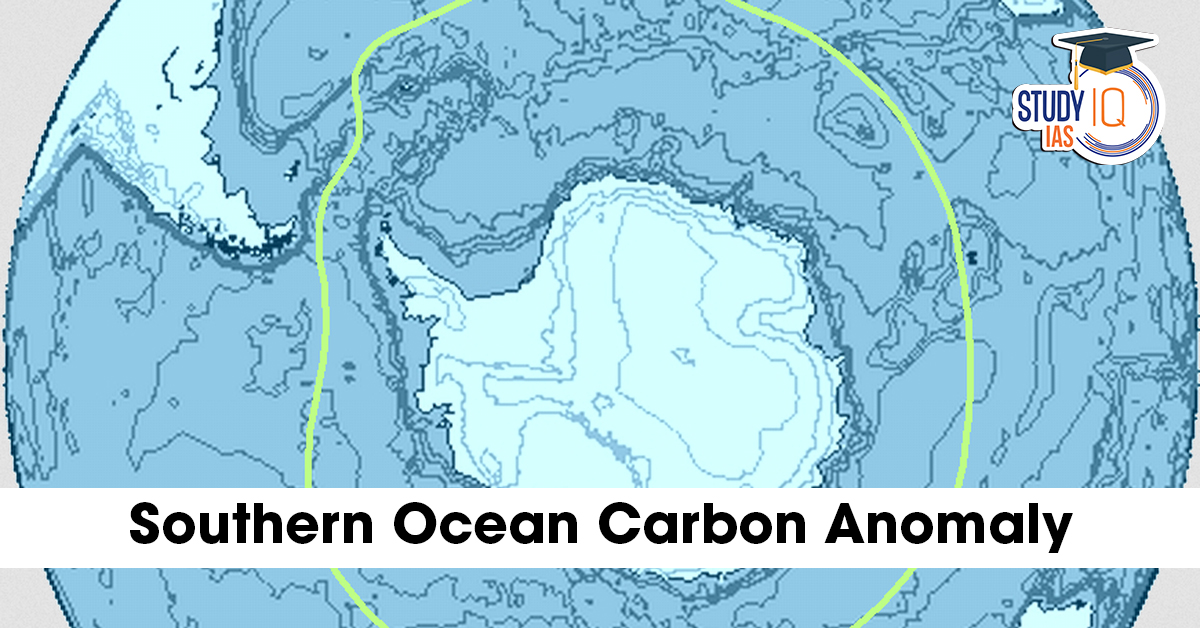
Recent climate research has revealed a surprising development in Earth’s carbon cycle. Contrary to long-standing climate model predictions, the Southern Ocean has absorbed more carbon dioxide since the early 2000s, instead of weakening as a carbon sink. This unexpected behaviour, highlighted in a study published in Nature Climate Change, is now referred to as the Southern Ocean Carbon Anomaly.
This finding challenges existing assumptions about ocean–atmosphere interactions and carries profound implications for climate modelling, global carbon budgets, and climate policy.
What Is the Southern Ocean Carbon Anomaly?
The Southern Ocean carbon anomaly refers to the observed strengthening of the Southern Ocean’s role as a carbon sink, despite climate models predicting the opposite under global warming conditions.
According to prevailing models, intensifying westerly winds around Antarctica should have enhanced upwelling of carbon-rich deep waters, leading to greater release of carbon dioxide into the atmosphere. Instead, observations show that the Southern Ocean has continued to absorb an increasing share of human-emitted CO₂, defying expectations.
Why the Southern Ocean Matters for Climate Regulation
The Southern Ocean plays a disproportionately large role in the global climate system:
-
It absorbs nearly 40% of oceanic uptake of anthropogenic CO₂
-
It connects the Atlantic, Pacific, and Indian Oceans through the Antarctic Circumpolar Current
-
It regulates heat, carbon, and nutrient circulation across the globe
Any change in its behaviour has planetary-scale consequences.
How Does the Southern Ocean Carbon Anomaly Occur?
1. Strengthened Westerly Winds and Upwelling
Climate warming has intensified Southern Hemisphere westerly winds, which draw carbon-rich circumpolar deep waters upward toward the ocean surface.
Under earlier assumptions, this process was expected to release stored CO₂ into the atmosphere.
2. Freshwater Input from Ice Melt and Rainfall
Simultaneously, Antarctic ice-sheet melt and increased precipitation have added large volumes of freshwater to the ocean surface.
-
Fresher water is less salty and lighter
-
This reduces surface water density
3. Formation of a Stratified Surface “Lid”
The influx of freshwater creates a buoyant surface layer, strengthening vertical stratification.
This stratified layer acts like a physical barrier, separating surface waters from deeper, carbon-rich layers below.
4. Blocked Air–Sea Gas Exchange
Although deep waters are upwelled, they do not fully reach the surface.
-
Carbon-rich waters remain trapped 100–200 metres below
-
CO₂ cannot escape into the atmosphere
-
Net carbon absorption continues
5. Role of Small-Scale Ocean Processes
Processes such as:
-
Ocean eddies
-
Ice-shelf cavity dynamics
-
Fine-scale mixing
further reinforce stratification. However, these mechanisms are poorly resolved in coarse-resolution climate models, contributing to earlier prediction failures.
Key Factors Behind the Anomaly
Freshening of Surface Waters
-
Caused by Antarctic glacier melt and increased rainfall
-
Reduces salinity and surface density
Enhanced Vertical Stratification
-
Light surface layers sit above warmer, saltier deep waters
-
Limits vertical mixing
Trapping of Carbon Below the Surface
-
Upwelled circumpolar deep waters remain sub-surface
-
Prevents CO₂ outgassing
Limitations of Climate Models
-
Underrepresentation of eddies and ice–ocean interactions
-
Simplified freshwater flux dynamics
Sparse Observational Data
-
Southern Ocean observations are seasonal and geographically limited
-
Reduced model validation accuracy
Implications of the Southern Ocean Carbon Anomaly
1. Temporary Climate Buffer
The anomaly has slowed the rise of atmospheric CO₂, acting as a short-term buffer against global warming.
However, this buffering effect is not permanent.
2. Risk of Sudden Carbon Release
Recent observations indicate that surface stratification may be thinning.
If this stratified “lid” collapses:
-
Trapped deep carbon could rapidly outgas
-
Triggering an abrupt climate feedback
3. Urgent Need for Model Refinement
The anomaly exposes weaknesses in climate projections and highlights the need to:
-
Integrate fine-scale ocean physics
-
Improve representation of freshwater inputs
-
Strengthen coupling between ocean chemistry and circulation
4. Policy and Climate Strategy Relevance
The findings reinforce a critical message:
-
Natural carbon sinks are unreliable
-
They cannot substitute for rapid emission reductions
Overreliance on oceans and forests to offset emissions carries serious risk.
5. Importance of Sustained Polar Observation
To anticipate tipping points, the world needs:
-
Year-round monitoring of the Southern Ocean
-
Expanded autonomous floats and satellite observations
-
International collaboration in polar research
Conclusion
The Southern Ocean carbon anomaly demonstrates that nature can temporarily defy model expectations—but not indefinitely. Freshwater-driven stratification has hidden deeper vulnerabilities in the climate system, masking the potential for rapid carbon release.
As this protective layer weakens, the Southern Ocean could quickly shift from a climate ally to a climate amplifier. The anomaly serves as a warning: improved climate models, sustained observations, and aggressive emission reductions are not optional—they are essential.
 AP High Court Notification 2026 Out: App...
 Electric Cooking Solutions in India: Wor...
 CAPF Bill 2026: Formalising IPS Deputati...











 WhatsApp





