
Table of Contents
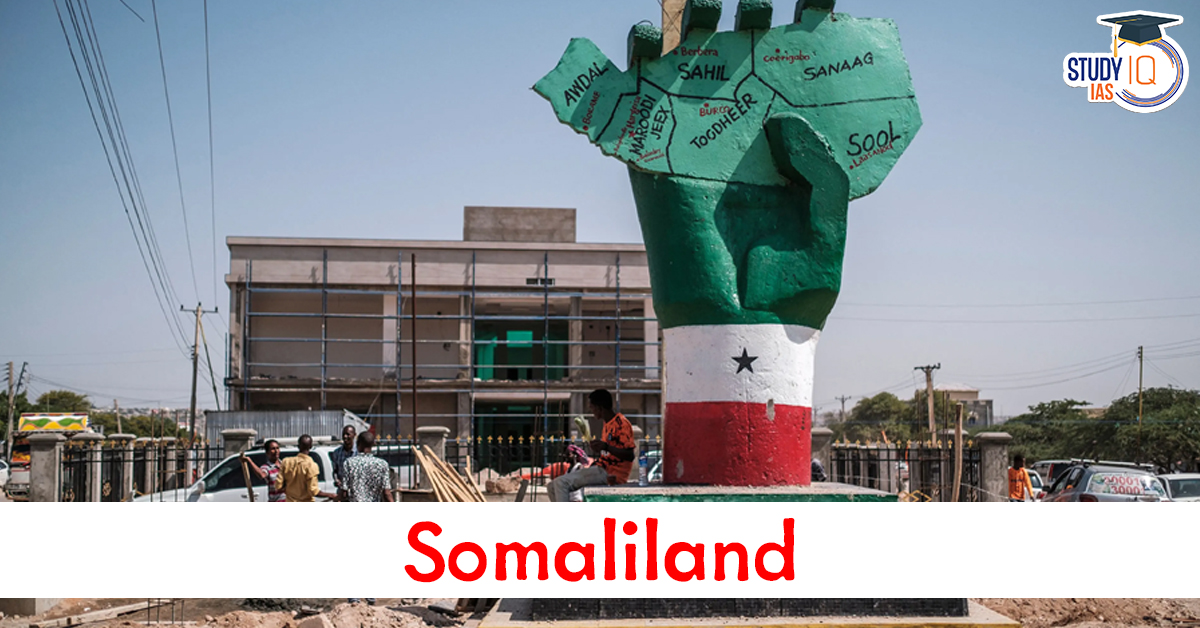
Somaliland is one of the most intriguing unresolved political entities in the world. Despite functioning as a stable, self-governing state for over three decades, Somaliland remains largely unrecognised by the international community. Recent global developments have brought renewed attention to the region, highlighting its strategic importance in the Horn of Africa and the Red Sea corridor. This article explains what Somaliland is, where it is located, its historical background, current status, and why it matters geopolitically.
Where Is Somaliland Located?
Somaliland is located in the Horn of Africa, along the southern coast of the Gulf of Aden. It lies at the entrance of the Bab el-Mandeb Strait, one of the world’s most critical maritime chokepoints linking the Red Sea to the Indian Ocean.
Neighbours of Somaliland
-
Djibouti to the northwest
-
Ethiopia to the west and south
-
Somalia to the east
Its capital city is Hargeisa.
Historical Background of Somaliland
Colonial Era
During the colonial period:
-
Northern Somalia was administered as British Somaliland
-
Southern Somalia was under Italian rule
British Somaliland gained independence on 26 June 1960 and was briefly recognised by several countries.
Union with Somalia (1960)
In July 1960, British Somaliland voluntarily united with Italian Somaliland to form the Somali Republic. However, political power and economic development became heavily centralised in Mogadishu, creating deep dissatisfaction in the north.
Breakdown of the Union
-
A 1961 constitutional referendum was overwhelmingly rejected in the north
-
Under President Siad Barre, the Somali state carried out brutal military operations against northern clans
-
In 1988, the bombing of Hargeisa devastated the region
Following the collapse of the Somali state in 1991, northern leaders declared the dissolution of the union and restored the borders of British Somaliland.
Current Political Status of Somaliland
De Facto Statehood
Since 1991, Somaliland has functioned as a de facto independent state with:
-
A constitution approved by referendum
-
Regular multi-party elections
-
Its own government, parliament, judiciary, and security forces
-
A separate currency and flag
However, it lacks formal international recognition and is officially considered part of Somalia.
Economy of Somaliland
Somaliland’s economy is:
-
Largely import-dependent
-
Supported by livestock exports, especially to Gulf countries
-
Sustained by diaspora remittances and private investment
Due to lack of recognition:
-
Somaliland cannot access IMF or World Bank loans
-
Foreign direct investment remains limited
-
Citizens travel on unrecognised passports
Why Is Somaliland Geopolitically Important?
Strategic Maritime Location
Situated near Bab el-Mandeb, Somaliland overlooks a route through which a significant share of global trade and energy shipments pass. Control or access to this corridor is vital for maritime security.
Regional Power Competition
Somaliland has become a focal point in:
-
Red Sea geopolitics
-
Horn of Africa power rivalries
-
Middle Eastern strategic calculations
Agreements with regional and extra-regional actors have increased interest in the region’s ports and security potential.
Secession or Dissolution? The Legal Debate
Somaliland argues that it is not seceding from Somalia but dissolving a failed voluntary union, reclaiming borders it held as a recognised state in 1960.
Somalia and the African Union maintain that:
-
Somaliland remains part of Somalia
-
Unilateral separation violates the principle of territorial integrity
This debate reflects a broader international dilemma between self-determination and state sovereignty.
African Union’s Concerns
The African Union fears that recognising Somaliland could:
-
Encourage separatist movements elsewhere in Africa
-
Lead to “Balkanisation” of fragile states
-
Undermine post-colonial borders inherited at independence
Somaliland vs Somalia: A Contrast
| Aspect | Somaliland | Somalia |
|---|---|---|
| Political stability | High | Low |
| Elections | Regular | Irregular |
| Security | Relatively stable | Insurgency-affected |
| International recognition | No | Yes |
Global Implications of Somaliland’s Recognition Debate
-
Challenges international norms on statehood
-
Impacts Red Sea security architecture
-
Influences Africa–Middle East geopolitics
-
Tests flexibility of international law
Conclusion
Somaliland represents a rare paradox in global politics—a functioning state without recognition. Its stability, democratic practices, and strategic location contrast sharply with Somalia’s prolonged instability. Yet, concerns over territorial integrity and regional precedent continue to block formal recognition. As geopolitical competition intensifies in the Red Sea and Horn of Africa, Somaliland’s status is likely to remain a critical issue in international diplomacy.
 FATF Report on India’s Action on Virtu...
 India Pharma Expo 2026: Key Highlights, ...
 India–Arab League Relations: Cooperati...













 WhatsApp





