
Table of Contents
Context
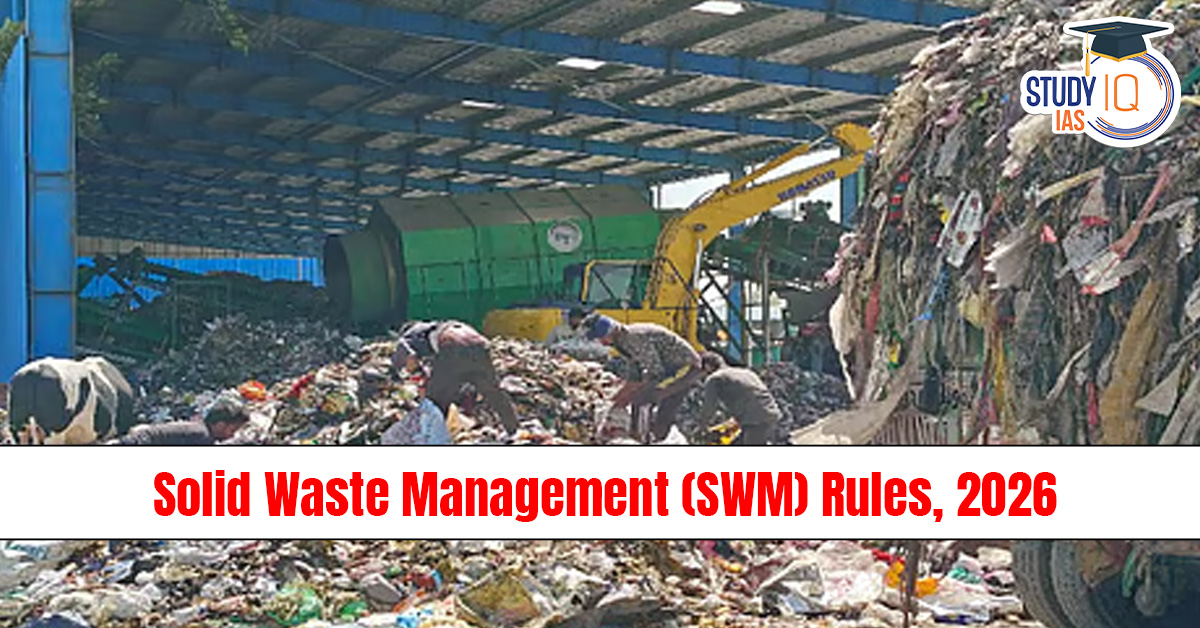
The Union Ministry of Environment, Forest and Climate Change has notified the Solid Waste Management (SWM) Rules, 2026, superseding the Solid Waste Management Rules, 2016.
Key Provisions of Solid Waste Management (SWM) Rules, 2026
- Four-stream segregation at source: Mandatory segregation of waste into wet waste, dry waste, sanitary waste and special care waste at the point of generation.
- Clear definition of Bulk Waste Generators (BWGs): BWGs are defined based on built-up area (≥20,000 sq. m), water consumption (≥40,000 litres/day) or waste generation (≥100 kg/day).
- Extended Bulk Waste Generator Responsibility: BWGs must process wet waste on-site where feasible or ensure scientific processing through authorised agencies and obtain certification.
- Polluter Pays Principle: Environmental compensation will be imposed for non-compliance such as non-segregation, false reporting or operating without authorisation.
- Centralised online monitoring system: A national portal will track waste generation, collection, transport, processing and disposal, along with online registration and reporting.
- Material Recovery Facilities (MRFs) recognised: MRFs are formally integrated into urban waste management systems to enhance recycling and resource recovery.
- Promotion of Refuse Derived Fuel (RDF): Industries such as cement and waste-to-energy plants are mandated to progressively increase the use of RDF from 5% to 15%.
- Restrictions on landfilling: Only inert, non-recyclable and non-recoverable waste is permitted in landfills, with higher charges for unsegregated waste.
- Legacy waste management: Mandatory biomining and bioremediation of old dumpsites with periodic progress reporting.
- Special provisions for hilly areas and islands: Tourist waste management measures, decentralised processing and user charges linked to local carrying capacity are mandated.
- Strengthened institutional framework: Central and State-level committees headed by senior officials are created to ensure effective implementation and monitoring.
|
Read More Notes |
|
| Environment Notes | Art and Culture Notes |
| Science and Tech | History Notes |
| Geography Notes | Indian Polity Notes |
| General Knowledge | International Relation |
|
Explore StudyIQ Courses |
|
 Bharat Audyogik Vikas Yojana (BHAVYA Sch...
 NavIC Satellite Clock Failures: Causes, ...
 Rare Earth Elements (REE) Sites in India...





 WhatsApp





