
Table of Contents
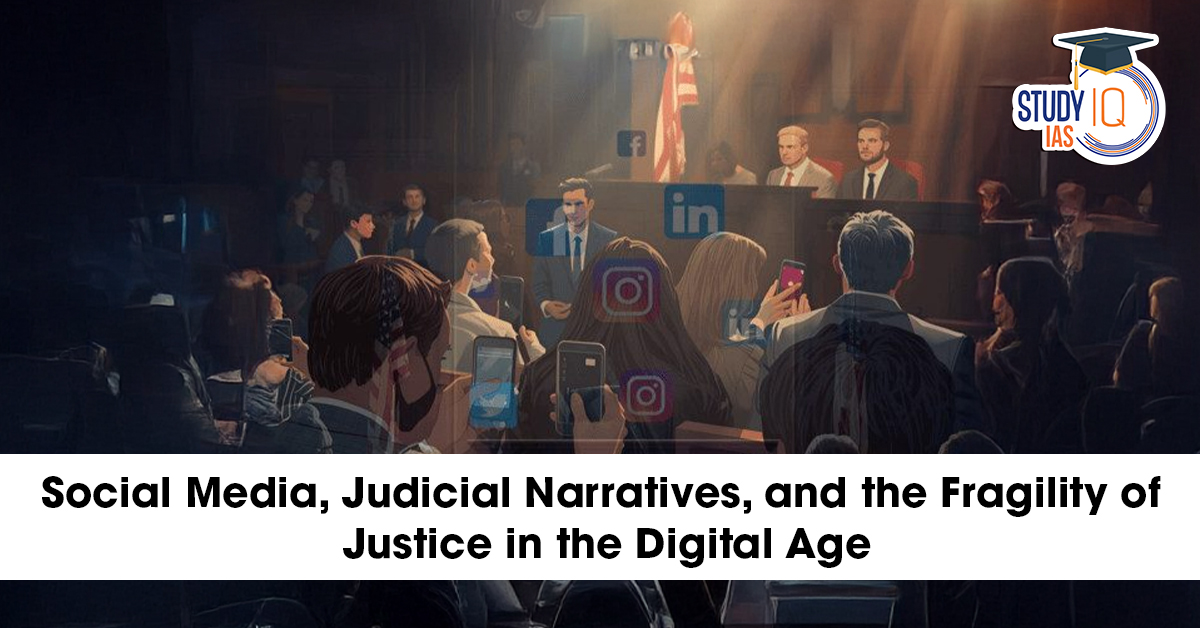
The swift proliferation of social media has profoundly transformed the production, dissemination, and consumption of information. This shift has improved openness and public involvement; however, it has also posed significant problems for democratic institutions, especially the judiciary. Recent remarks by Supreme Court Justice Manmohan regarding the concept of “social media justice” highlight an escalating judicial apprehension that courtroom exchanges, verbal observations, and isolated snippets are progressively being regarded as definitive decisions by the judiciary. This transition, he cautioned, jeopardises the integrity of legal outcomes, diminishes judicial legitimacy, and undermines public confidence in constitutional adjudication.
Justice Manmohan’s remarks, presented at the International Legal Conference hosted by the Supreme Court Advocates-on-Record Association (SCORA), underscore the complex interplay between judicial operations and digital media environments. His intervention is positioned within a wider conversation regarding the influence of social media narratives on legal discussions, frequently favouring expediency over precision and virality over subtlety. This essay analyses the emergence of social media-influenced judicial narratives, their societal implications, the constitutional status of courts in this context, and the responsibilities of judges and lawyers in maintaining judicial integrity. It further examines pertinent case law to evaluate the responses of Indian courts to these concerns.
The Rise of Social Media as a Narrative-Constructing Force
Social media platforms have become potent narrative generators. In contrast to traditional media, characterised by editorial control and time lag, social media excels in immediacy, conciseness, and emotional impact. Legal procedures, once conveyed through well-reasoned decisions and organised reports, are now increasingly disseminated via tweets, brief films, and curated quotations.
Justice Manmohan saw a “hunger for court news” and a competition to be the first to disseminate courtroom happenings. This competitive haste frequently leads to insufficient or deceptive representations of judicial procedures. Judgments from the Constitution Bench, which may include many concurring and dissenting opinions, are especially susceptible to misreporting when preliminary oral summaries or minority opinions are erroneously regarded as binding decisions.
The Judge recounted an occasion where a Chief Justice’s judgment was published as the final decision, albeit representing a minority view. Such misrepresentations illustrate how the structure of social media encourages simplification, even when legal accuracy necessitates complexity.
Oral Observations Compared to Final Judgments: An Essential Distinction
Justice Manmohan has expressed a primary concern with the prevalent public confusion between oral observations made during hearings and final, binding decisions. Verbal statements are frequently experimental, provisional, or intended to evaluate the arguments put forth by legal counsel. They lack binding authority.
The Indian constitutional jurisprudence has always upheld this difference. In State of Uttar Pradesh v. Johri Mal (2004), the Supreme Court determined that informal remarks made during hearings do not constitute authoritative legal pronouncements. In Divisional Manager, Aravali Golf Club v. Chander Haas (2008), the Court warned against overinterpreting oral remarks, asserting that judicial power derives solely from written judgments.
Justice Manmohan emphasised that justices may reach divergent conclusions after meticulously reviewing the record following the hearing. Characterising oral observations as definitive rulings misrepresents judicial reasoning and imposes excessive pressure on judges, thereby compromising their decisional independence.
The Influence of Social Media Justice on Society
The concept known as “trial by social media” or “social media justice” signifies a profound cultural transformation in which moral evaluations are made openly and quickly. In this context, courts may be viewed as reactive entities rather than rational adjudicators of law.
The societal ramifications are significant. Public opinion, influenced by viral narratives, may undermine judicial outcomes that do not conform to prevailing digital views. This subverts the rule of law, which relies on institutional confidence rather than public endorsement.
The Supreme Court in Sahara India Real Estate Corp. v. SEBI (2012) acknowledged the risks of media influence on active procedures, determining that unfettered reportage could compromise the integrity of fair trials. Although the case pertained to traditional media, its rationale is much more pertinent in the era of algorithmic amplification.
Justice Manmohan’s apprehensions align with this legal philosophy. When public discourse perceives courtrooms as venues for immediate judgments instead of deliberative spaces, justice is at risk of becoming performative rather than principled.
Judicial Restraint and the Public Role of Judges
A notable aspect of Justice Manmohan’s remarks is on judicial behaviour in the public sphere. He advised judges to refrain from engaging in public debates on contentious matters, cautioning that such involvement could undermine their perceived impartiality.
He emphasised that judicial legitimacy derives from impartiality and reasoned adjudication, rather than from popularity or media visibility. A judge who assumes the role of a public commentator jeopardises their perception as an impartial adjudicator, potentially being viewed as a vested participant.
This notion is deeply rooted in the Constitution. In C. Ravichandran Iyer v. Justice A.M. Bhattacharjee (1995), the Supreme Court emphasised that judges should refrain from actions that undermine public trust in judicial independence. Likewise, the Bangalore Principles of Judicial Conduct, supported by Indian courts, emphasise propriety and restraint as fundamental qualities of judicial authority.
Justice Manmohan’s caution underscores the apprehension that, in the era of social media, the distinction between institutional authority and individual prominence is becoming increasingly indistinct. When judicial figures eclipse institutional rationale, the legitimacy of the judgments may decline.
The Function of the Bar in Combating Misinformation
Justice Manmohan, although dismissing the application of contempt jurisdiction towards social media users, underscored the obligation of the legal profession, especially entities such as SCORA, to proactively combat misinformation. Fact-checking, contextualising judgments, and ensuring the accessibility of relevant sections to the public are vital for maintaining an educated conversation.
This method is consistent with democratic norms. In In Re: Prashant Bhushan (2020), the Supreme Court recognised the significance of informed criticism of the court while warning against irresponsible or deceptive narratives that undermine institutional integrity.
Justice Manmohan endorsed public legal knowledge as a suitable reaction instead of punitive actions. Informing citizens about judicial processes, the differences between observations and judgments, and the framework of constitutional decisions is essential for maintaining democratic faith.
Advancement of Social Media and Its Legal Consequences
The emergence of social media must be contextualized within its historical and technological framework. Originally lauded as instruments for democratizing expression, social media platforms have transformed into influential middlemen that may mould public awareness. Algorithms prioritise engagement, frequently favouring outrage, disagreement, and simplicity.
Courts globally have contended with this reality. The case of Shreya Singhal v. Union of India (2015) acknowledged the significance of online free speech in India while recognising the inherent dangers of unrestrained digital discourse. The Court invalidated Section 66A of the IT Act while concurrently underscoring the necessity for responsible discourse.
Justice Manmohan’s comments illustrate this nuanced equilibrium. Although freedom of expression requires safeguarding, the legal process must not be diminished to mere viral soundbites, since this would endanger constitutional governance.
Polyvocality, Consistency, and Judicial Credibility
The fundamental apprehensions regarding social media justice stem from a profound unease about the consistency of judicial communication. When disjointed snippets are disseminated without context, they generate the appearance of judicial contradiction, even when the legal reasoning is sound.
Justice Manmohan’s remarks reflect wider discussions within the judiciary over the preservation of doctrinal clarity. The Supreme Court’s authority relies on both constitutional mandate and the clarity and consistency of its judgments. Social media distortions jeopardise this consistency by detaching fragments from their legal context.
Conclusive Remarks
Justice Manmohan’s remarks represent a timely intervention in an age where the rapid dissemination of information jeopardises the profundity of justice. Social media, however essential to contemporary democratic existence, should not be permitted to alter judicial power or supplant rational adjudication with sensational narratives.
The judiciary’s function in a constitutional democracy is to safeguard rights by deliberation, independence, and institutional integrity. Oral observations serve as instruments of argument rather than conclusions; judgments obtain their legitimacy from legal statutes, not social media endorsements. Judges should practice restraint, the Bar should advocate for legal literacy, and society must resist the allure of immediate justice.
As Indian democracy confronts the difficulties of the digital revolution, the maintenance of judicial legitimacy will rely on the reaffirmation of these fundamental values. In the era of social media, justice should be deliberative, not hasty; principled, not ostentatious.
 Trial by Social Media: Public Shaming, D...
 Governors’ Address to State Legislatur...
 Mandating Prior Approval for Corruption ...








 WhatsApp





