
Table of Contents
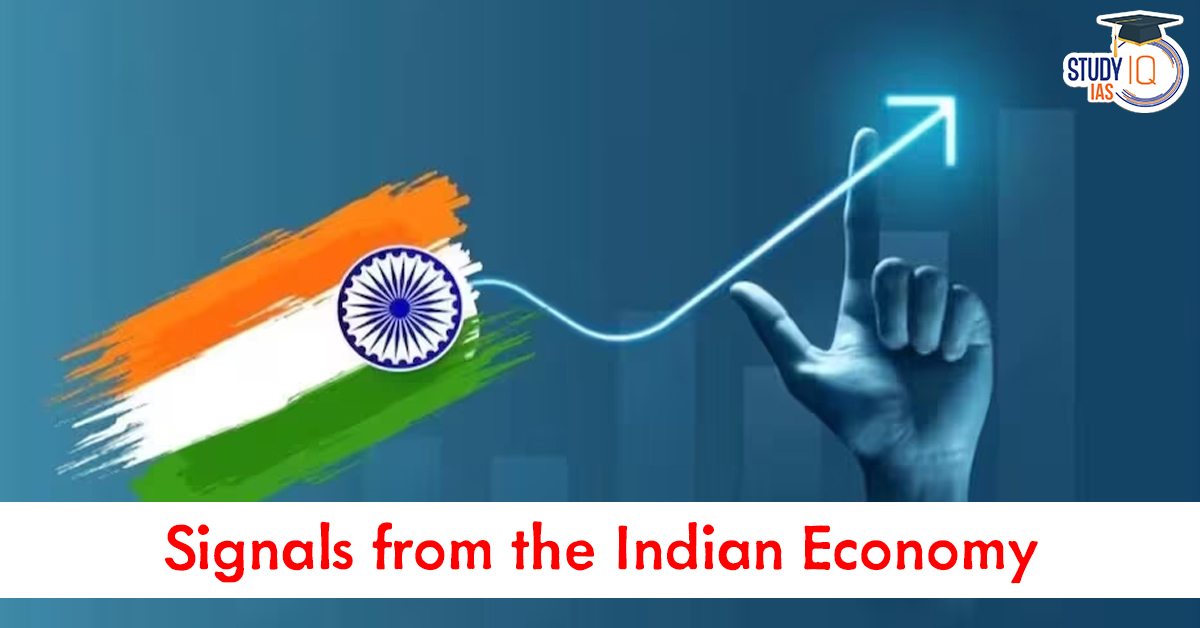
Signals from the Indian economy offer crucial insights into the country’s growth momentum, structural strengths, and emerging vulnerabilities. In recent years, India has shown resilience amid global uncertainty, yet economic indicators also reflect stress points linked to inflation, trade disruptions, and uneven demand recovery. Understanding these signals is essential to assess whether India’s growth is cyclical, structural, or policy-driven.
Growth Signals: Moderation, Not Meltdown
India continues to remain one of the fastest-growing major economies, but growth signals indicate moderation rather than acceleration. GDP growth remains robust by global standards, yet quarterly trends suggest slowing momentum in the latter half of the year. This reflects weaker global demand, cautious private investment, and trade-related headwinds.
Key Insight:
India’s growth story is intact, but increasingly dependent on domestic demand and public investment.
Inflation Signals: Gradual Easing with Persistent Risks
Headline inflation has moderated compared to earlier peaks, aided by better food management and monetary tightening. However, core inflation remains sticky, indicating persistent cost pressures in services, housing, and healthcare.
What It Signals:
-
Monetary policy will remain cautious
-
Rate cuts are likely to be delayed
-
Inflation management remains a policy priority
Consumption Signals: Uneven Recovery
Private consumption presents mixed signals. Urban demand shows signs of fatigue due to higher living costs and interest rates, while rural consumption has improved modestly with better agricultural output and government support schemes.
Structural Concern:
Consumption growth remains uneven, raising questions about income distribution and job quality.
Investment Signals: Public Capex Leading the Way
Investment indicators reveal a clear divergence:
-
Public capital expenditure continues to drive infrastructure growth
-
Private investment remains cautious, despite healthy corporate balance sheets
Large infrastructure projects in roads, railways, defence, and logistics signal long-term capacity creation, but crowding-in of private investment is yet to fully materialise.
Employment Signals: Formalisation Without Security
Labour market signals show rising formalisation through digital payrolls and GST-linked employment. However:
-
Informal employment remains dominant
-
Wage growth is uneven
-
Job creation in manufacturing is slower than expected
This highlights a gap between economic growth and employment quality.
External Sector Signals: Trade Resilience Under Pressure
India’s exports face stress due to:
-
Global slowdown
-
Rising protectionism
-
Geopolitical trade disruptions
At the same time, India’s foreign exchange reserves and services exports provide a cushion, ensuring external stability.
Signal:
India must move from volume-based exports to value-added and technology-driven trade.
Fiscal Signals: Consolidation with Expansion
Fiscal indicators show a delicate balance between:
-
Reducing fiscal deficit
-
Maintaining growth-supporting expenditure
The government’s emphasis on capital expenditure over revenue spending signals a shift toward productive fiscal consolidation.
Monetary Policy Signals: Data-Driven Caution
The Reserve Bank of India continues a tight but flexible stance. Liquidity management, inflation targeting, and financial stability remain central. Policy signals suggest:
-
No abrupt easing
-
Focus on macroeconomic stability
Structural Reform Signals: Long-Term Confidence
Key reforms in taxation, labour laws, digital public infrastructure, and data governance signal long-term intent. Planned revisions in GDP, CPI, and IIP base years are expected to improve data accuracy and policy effectiveness.
Key Takeaways from India’s Economic Signals
-
Growth is resilient but slowing
-
Inflation risks persist
-
Public investment is the main growth engine
-
Private consumption and jobs remain uneven
-
External sector risks are rising
Conclusion
Signals from the Indian economy point to resilience with restraint. India is not facing an economic crisis, but neither is it in a high-growth breakout phase. The challenge lies in converting policy-led growth into employment-intensive, inclusive, and sustainable expansion. The coming years will test whether India can move from managing macroeconomic stability to achieving structural transformation.
 FATF Report on India’s Action on Virtu...
 India Pharma Expo 2026: Key Highlights, ...
 India–Arab League Relations: Cooperati...













 WhatsApp





