
Table of Contents
The Santhali language is one of India’s oldest and most vibrant tribal languages, spoken predominantly by the Santhal tribe, one of the largest indigenous communities in eastern India. Recognised in the Eighth Schedule of the Indian Constitution, Santhali represents not only linguistic richness but also the cultural identity, history, and worldview of millions of tribal citizens. In recent years, efforts such as the publication of the Constitution of India in Santhali (Ol Chiki script) have further strengthened its status in India’s inclusive democratic framework.
Overview of Santhali Language
Santhali belongs to the Austroasiatic language family, specifically the Munda branch, which distinguishes it from most Indian languages that belong to the Indo-Aryan or Dravidian families.
| Aspect | Details |
|---|---|
| Language Family | Austroasiatic (Munda) |
| Native Speakers | Over 7 million (Census-based estimates) |
| Script | Ol Chiki |
| Regions Spoken | Jharkhand, Odisha, West Bengal, Bihar |
| Constitutional Status | Eighth Schedule Language |
| Amendment | 92nd Constitutional Amendment Act, 2003 |
Historical Evolution of Santhali Language
Santhali is considered one of the most ancient living tribal languages of India. Long before the advent of written scripts, Santhali thrived as a rich oral tradition, passed down through folklore, songs, myths, rituals, and storytelling.
The language developed independently of Sanskritic influence and reflects a nature-centric worldview, with vocabulary deeply rooted in forests, rivers, seasons, and community life. This autonomy makes Santhali a crucial linguistic resource for understanding India’s pre-Aryan cultural landscape.
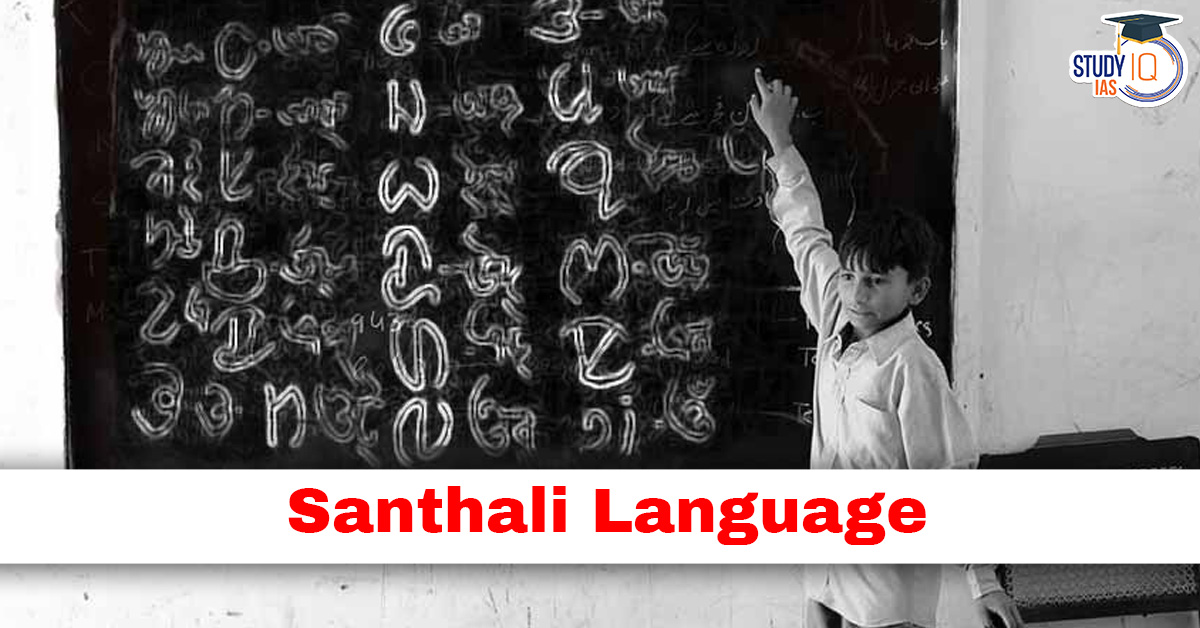
Ol Chiki Script: Identity Through Writing
Origin and Development
The Ol Chiki script was developed in the early 20th century by Pandit Raghunath Murmu, a Santhali scholar and social reformer. Prior to Ol Chiki, Santhali was written inconsistently using Bengali, Odia, Roman, or Devanagari scripts, which failed to capture its phonetic uniqueness.
Ol Chiki provided:
-
A scientific and phonetic script
-
Cultural self-expression
-
Linguistic independence
Significance of Ol Chiki
-
Specifically designed for Santhali sounds
-
Strengthened tribal literacy and education
-
Symbol of cultural assertion and resistance to assimilation
-
Recently completed 100 years (centenary)
Santhali in the Indian Constitution
Inclusion in the Eighth Schedule
Santhali was added to the Eighth Schedule of the Constitution by the 92nd Constitutional Amendment Act, 2003, along with Bodo, Maithili, and Dogri.
Implications of Eighth Schedule Status
-
Eligibility for official promotion by the Union and States
-
Use in competitive examinations
-
Development of textbooks and literature
-
Institutional support from bodies like Sahitya Akademi
Geographic Distribution of Santhali Speakers
Santhali is mainly spoken in:
-
Jharkhand (largest concentration)
-
Odisha
-
West Bengal
-
Bihar
Smaller Santhali-speaking populations are also found in Assam and parts of Bangladesh and Nepal.
Cultural Importance of the Santhali Language
Language is central to Santhal cultural life. Santhali plays a vital role in:
-
Festivals (Sohrai, Baha)
-
Traditional songs and dances
-
Oral epics and myths
-
Community governance and rituals
The language reflects:
-
Egalitarian social values
-
Strong community bonds
-
Deep ecological consciousness
Santhali Language and Education
Efforts have been made to introduce mother-tongue-based education in tribal areas, particularly at the primary level. Teaching Santhali in the Ol Chiki script:
-
Improves learning outcomes
-
Reduces dropout rates
-
Preserves indigenous knowledge systems
Institutions and state governments have begun producing:
-
School textbooks
-
Dictionaries and grammar books
-
Digital learning content
Recent Developments: Constitution in Santhali
In December 2025, the President of India released the Constitution of India in Santhali language, published in the Ol Chiki script. This milestone:
-
Enhanced constitutional awareness among tribal citizens
-
Strengthened democratic participation
-
Reinforced linguistic justice and inclusion
-
Honoured the centenary of the Ol Chiki script
Santhali and Inclusive Governance
The promotion of Santhali aligns with several constitutional ideals:
-
Article 29: Protection of linguistic and cultural minorities
-
Article 350A: Instruction in mother tongue
-
Article 51A(f): Duty to preserve India’s composite culture
Recognising tribal languages like Santhali helps bridge the gap between the State and indigenous communities, making governance more participatory and humane.
Challenges Facing the Santhali Language
Despite constitutional recognition, challenges remain:
-
Limited higher education resources
-
Inadequate digital presence
-
Urban migration reducing intergenerational transmission
-
Shortage of trained teachers in Ol Chiki
Addressing these issues requires sustained policy support and community participation.
Way Forward
To ensure the long-term vitality of Santhali, India must:
-
Expand digital content in Ol Chiki
-
Promote Santhali in higher education and research
-
Encourage translation of legal and administrative texts
-
Integrate tribal languages into e-governance platforms
Conclusion
The Santhali language is not merely a medium of communication—it is a living repository of India’s indigenous wisdom, history, and cultural diversity. From its ancient oral roots to constitutional recognition and modern revival through Ol Chiki, Santhali exemplifies India’s commitment to unity in diversity. Strengthening Santhali is essential not only for tribal empowerment but also for preserving the pluralistic soul of Indian democracy.
 FATF Report on India’s Action on Virtu...
 India Pharma Expo 2026: Key Highlights, ...
 India–Arab League Relations: Cooperati...













 WhatsApp





