
Table of Contents
Context
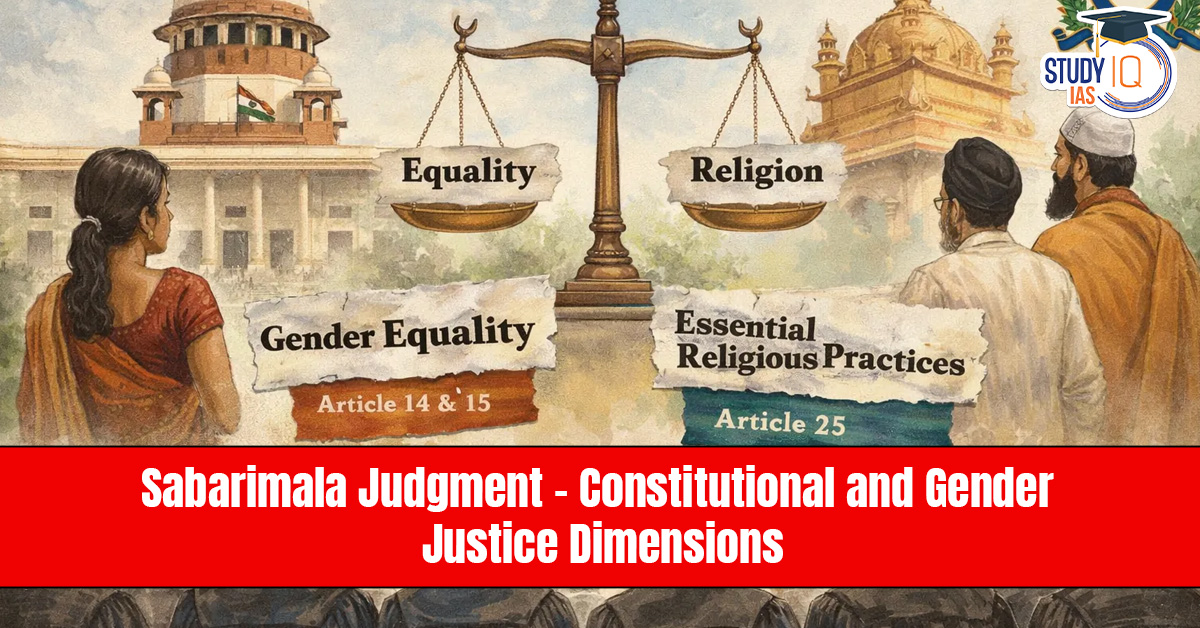
The Supreme Court of India is set to hear review petitions concerning its landmark 2018 judgment on women’s entry into the Sabarimala Sree Dharma Sastha Temple. The matter, which lies at the intersection of religious freedom, gender equality, and constitutional morality, has evolved through multiple judicial and political phases. The review proceedings, scheduled to begin in April 2026 before a nine-judge Constitution Bench, mark a significant constitutional moment with implications extending beyond a single religious practice.
Background to the Sabarimala Case
- Location and Deity: The Sabarimala Temple, among the most prominent pilgrimage sites in South India, is situated within the Periyar Tiger Reserve in the Western Ghats of Kerala.
- The shrine is dedicated to Lord Ayyappa, traditionally regarded as the son of Lord Shiva and Mohini, the female manifestation of Lord Vishnu.
- Distinctive Religious Practices: The pilgrimage is characterised by rigorous observances, most notably a 41-day period of austerity during which devotees abstain from worldly comforts before undertaking the journey. Ayyappa is venerated as a celibate deity, and historically women between the ages of 10 and 50 were restricted from entry, a practice justified as preserving the deity’s celibate nature.
- Early Judicial Challenge (1991): The restriction on women’s entry was first legally contested before the Kerala High Court in 1991.
- In Mahendran v. The Secretary, Travancore, the Court upheld the exclusion, reasoning that it constituted an established religious custom. The ruling held that the practice did not infringe constitutional guarantees of equality (Article 14) or freedom of religion (Article 25).
- Subsequent Constitutional Litigation: In 2006, the Indian Young Lawyers Association approached the Supreme Court of India challenging the restriction on women’s entry.
- The State of Kerala, which had earlier supported the prohibition, revised its position and endorsed women’s access to the shrine. The case was referred to a three-judge bench in 2008, heard in 2016, and subsequently placed before a five-judge Constitution Bench in 2017.
Perspectives on the Sabarimala Case
| Arguments against women entry | Arguments Supporting Women’s Entry |
| ● Religious Tradition and Custom: The Travancore Devaswom Board, responsible for temple administration, maintained that the restriction formed an integral part of the shrine’s religious character. It emphasised that the limitation applied only to women within a specific age group and was linked to the celibate nature of the deity.
● Protection of Denominational Rights: Supporters argued that the temple constitutes a religious denomination entitled to protection under Article 26, which guarantees autonomy in managing internal religious matters. ● Statutory Backing: Rule 3(b) of the Kerala Hindu Places of Public Worship (Authorisation of Entry) Rules, 1965 recognised exclusions based on custom, including restrictions on women in certain circumstances. ● Judicial Precedent: In Ritu Prasad Sharma v. State of Assam (2015), the Guwahati High Court held that practices protected under Articles 25 and 26 enjoy immunity from challenges under other fundamental rights provisions. ● Practical and Ritual Considerations: Proponents also contended that the demanding 41-day preparatory observance constitutes an essential religious requirement, which they argued may be physically difficult for menstruating women to complete. |
● Equality and Non-Discrimination: Advocates asserted that exclusion based on sex and age contravenes constitutional guarantees of equality and non-discrimination under Articles 14 and 15.
● Freedom of Religion for All: They argued that every individual possesses an equal right to practise and profess religion, and that denying women access unjustifiably curtails this freedom. ● Dynamic Nature of Religious Practice: Supporters of entry emphasised that religious traditions must evolve in harmony with constitutional morality and contemporary principles of gender justice. ● Statutory Prohibition of Discrimination: Section 4 of the Kerala Hindu Places of Public Worship (Authorisation of Entry) Act, 1965 prohibits discriminatory regulations that restrict access to places of worship on sectional grounds. ● Challenge to Social Stereotype: Permitting women’s entry was framed as a step toward dismantling stigma associated with menstruation and promoting inclusivity in religious spaces. ● Claim of Untouchability: The exclusion was characterised by some petitioners as a form of untouchability prohibited under Article 17. ● Questioning Denominational Status: It was further argued that the temple does not constitute a separate religious denomination, as its rituals are not fundamentally distinct from those of other Hindu temples. |
Kerala High Court Judgment (1991)
- The Kerala High Court upheld the restriction on women’s entry.
- The Court held that the practice was consistent with long-standing custom and did not violate fundamental rights.
- The Travancore Devaswom Board was directed to enforce the restriction on women of menstruating age.
Supreme Court Verdict on the Sabarimala Temple Entry Issue (2018)
- On 28 September 2018, a Constitution Bench of the Supreme Court of India delivered its judgment on the challenge to the exclusion of women from temple entry. By a 4:1 majority, the Court held that the practice barring women of menstruating age was unconstitutional.
Majority Opinion
- The majority concluded that prohibiting women between the ages of 10 and 50 infringed their fundamental rights. It held that devotees of the deity did not constitute a separate religious denomination entitled to exclusive protections, and the exclusion could not be justified as an essential religious practice.
- The judges further found the practice discriminatory under Article 15 of the Constitution. Justice D.Y. Chandrachud observed that the constitutional prohibition of untouchability extends beyond caste-based exclusion to encompass social exclusion grounded in notions of ritual purity.
- In addition, Rule 3(b) of the Kerala Hindu Places of Public Worship (Authorisation of Entry) Rules enabled restrictions on women’s entry—was declared unconstitutional for violating principles of equality and dignity.
Dissenting Opinion
- In her dissent, Justice Indu Malhotra emphasized judicial restraint in matters of faith.
- She argued that courts should not ordinarily adjudicate on the validity of religious practices unless they are manifestly oppressive, pernicious, or constitute a social evil comparable to practices such as Sati.
- She further maintained that standards of rationality are not readily applicable to religious belief systems, and that constitutional guarantees of equality must be balanced with the protection of religious freedom.
Developments after the judgment
- Public Response and Implementation Challenges: The verdict triggered significant protests by sections of devotees who perceived the ruling as interference with long-standing religious customs. The Kerala government faced considerable challenges in implementing the decision, including ensuring security for women attempting to enter the shrine.
Review Proceedings
- In 2019, the Court referred review petitions in Kantaru Rajeevaru v. Indian Young Lawyers’ Association to a larger bench. Pending adjudication of these petitions, the 2018 judgment continues to remain operative.
Review hearings in 2026
The upcoming Constitution Bench hearings assume significance due to:
- The continuing constitutional debate on balancing equality with religious autonomy.
- The broader doctrinal implications for judicial intervention in religious practices.
- The intersection of judicial review with democratic and political processes.
- The outcome is expected to shape the jurisprudence on essential religious practices and define the constitutional contours of gender justice in matters of faith.
Conclusion
The Sabarimala litigation represents a pivotal constitutional dialogue on the relationship between tradition and transformative constitutionalism. The forthcoming review proceedings offer the judiciary an opportunity to clarify doctrinal inconsistencies and articulate a principled framework governing the interaction between fundamental rights and religious freedom in India’s plural constitutional order.
 Gold Imports and the Indian Economy – ...
 Nilgiri Tahr Conservation: Ecology, Habi...
 50 Years of the Bonded Labour System (Ab...











 WhatsApp





