
Table of Contents
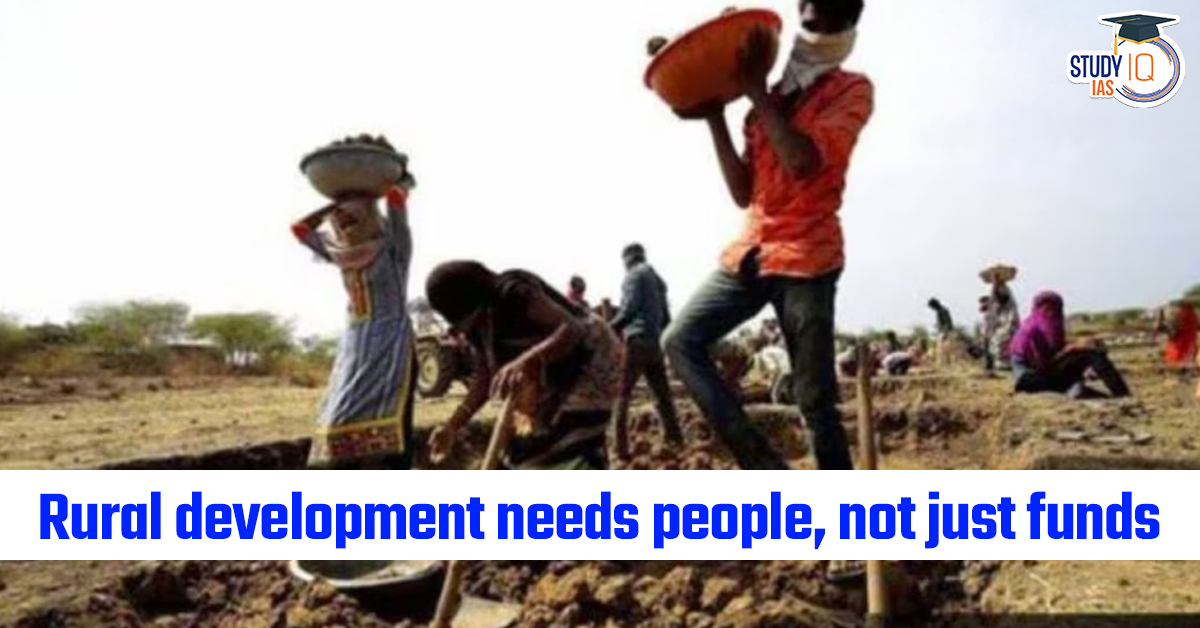
India’s rural development framework is rich in schemes and financial allocations, yet outcomes on the ground often remain uneven. Massive investments in agriculture, irrigation, and employment generation have not always translated into sustainable livelihoods or climate-resilient farming. The missing link is not money, but people—a continuous, skilled, and locally rooted human presence that can transform public expenditure into productive and resilient rural systems. In this context, the idea of creating a national cadre of trained local para-professionals, or Dharti-Putras, offers a promising institutional solution.
The Paradox of High Spending and Limited Impact
India spends heavily on agriculture and rural development through:
-
Ministry of Agriculture and Farmers Welfare allocations
-
MGNREGA
-
State-level agriculture and allied sector budgets
-
Multiple schemes for irrigation, livestock, soil health, and horticulture
However, reviews often focus on inputs and outputs:
-
Number of beneficiaries
-
Fertiliser distribution
-
Assets created
They rarely assess outcomes:
-
Improved cropping patterns
-
Higher incomes
-
Better water use efficiency
-
Climate resilience
This shows a systemic gap between spending and sustainable impact.
Why Rural Development Needs Human Infrastructure
Agriculture is a practice-based system where success depends on:
-
Timely advice
-
Local adaptation
-
Continuous monitoring
-
Behavioural change
Public assets such as irrigation tanks, compost pits, or livestock shelters deliver results only when someone:
-
Guides farmers in their use
-
Ensures maintenance
-
Helps integrate them into livelihoods
Thus, human infrastructure is as critical as physical infrastructure.
Concept of Dharti-Putras
Dharti-Putras are envisioned as:
-
Trained local para-professionals
-
Selected from their own villages
-
Certified in climate-resilient farming, livestock care, water management, and small enterprise support
They would act as:
-
Extension agents
-
Livelihood facilitators
-
Climate adaptation guides
-
Grassroots monitors of public assets and schemes
They are not permanent government employees but locally embedded professionals engaged through flexible contracts and service payments.
Functions of Dharti-Putras
-
Climate-Resilient Agriculture
-
Promote crop diversification
-
Guide water-efficient farming
-
Support soil health management
-
Encourage climate-smart practices
-
-
Livestock and Allied Activities
-
Basic animal health support
-
Improved fodder planning
-
Dairy and poultry productivity enhancement
-
-
Livelihood and Enterprise Support
-
Handholding SHGs, FPOs, and micro-enterprises
-
Market linkage facilitation
-
Value-chain integration
-
-
Public Asset Utilisation and Social Audit
-
Ensure functionality of irrigation structures and farm assets
-
Basic reporting on scheme performance and maintenance
-
Cost-Effectiveness of the Model
Training and certifying Dharti-Putras is fiscally modest:
-
Even training 10,000 para-professionals at ₹1 lakh per person would require only ₹100 crore
-
This is negligible compared to national agriculture budgets
-
The return on investment lies in:
-
Better utilisation of assets
-
Higher productivity
-
Reduced wastage of public funds
-
Thus, small investments in people can multiply the effectiveness of large investments in infrastructure.
Learning from Existing Models
India already has partial precedents:
-
Krishi Sakhis
-
NRLM community cadres
-
Local resource persons
Globally:
-
Community animal health workers in Africa
-
Farmer-field facilitators in Asia
-
Forest stewards in Nepal
What is missing is a permanent national architecture that treats local human capacity as public infrastructure rather than project-based manpower.
Designing the Dharti-Putra Cadre
1. Local and Inclusive Recruitment
-
Selection from within villages
-
Priority to women and youth
-
Community trust as a qualification
2. Competency-Based Certification
-
Training in:
-
Climate-smart agriculture
-
Livestock management
-
Digital tools
-
Market systems
-
-
Continuous technical support from:
-
KVKs
-
Agricultural universities
-
Extension institutions
-
3. Blended Financing Model
-
Modest public honorarium for public services
-
Fee-based income from:
-
Farmers
-
FPOs
-
SHGs
-
Value-chain actors
-
4. Institutional Anchoring
-
National coordination with state ownership
-
Institutions like Tribhuvan Sahkari University can serve as training and certification hubs
Strengthening Governance and Accountability
-
Mandatory state participation ensures ownership
-
Digital monitoring for:
-
Skill updates
-
Service delivery
-
Outcome measurement
-
-
Career progression pathways ensure motivation and continuity
This transforms rural development from asset counting to outcome measurement.
Significance for Climate-Resilient Farming
Climate change demands:
-
Local adaptation
-
Rapid response
-
Decentralised knowledge systems
Dharti-Putras provide:
-
Real-time local problem solving
-
Community trust
-
Low-cost, scalable climate resilience architecture
They become the grassroots drivers of sustainable agriculture.
Conclusion
Rural development in India does not suffer from a shortage of schemes or funds, but from a shortage of people who stay, guide, and adapt solutions locally. Dharti-Putras represent a shift from infrastructure-heavy thinking to human-centred development. By investing in trained local para-professionals, India can ensure that public money translates into resilient livelihoods, higher productivity, and genuine rural transformation. People, not just funds, are the true foundation of sustainable development.
Sharing is caring!
 Navigating Uncharted Waters: What Next f...
 Astronaut Reentry Explained: How Spacecr...
 Missile Interceptors Explained: Role in ...











 WhatsApp





