
Table of Contents
Context
- Pakistan and Afghanistan engage in intense military clashes, signalling a break in political, military, and societal ties across the Durand Line; driven by differences over Tehrik-e-Taliban Pakistan and collapsing strategic trust
Rupture Across the Durand Line
Political Rupture (Islamabad vs Kabul)
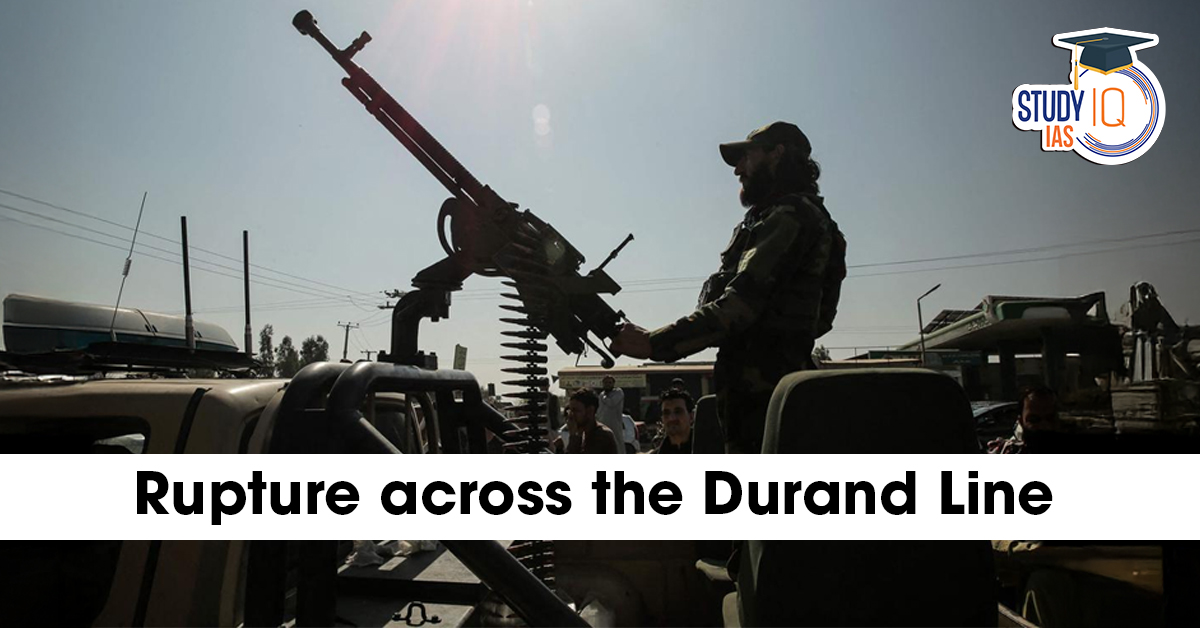
- Escalation to Direct Strikes: Pakistan’s air and missile strikes deep inside Afghan territory, including Kabul and Kandahar, represent a major escalation beyond routine border skirmishes.
- Collapse of Diplomatic Trust: Despite mediation efforts by countries like Türkiye and Qatar, ceasefires have repeatedly failed. Public declarations of “open war” indicate lack of credibility and mutual trust.
- From Strategic Alignment to Confrontation: After 2021, Pakistan expected ideological alignment with the Taliban. However, conflicting security priorities have transformed cooperation into confrontation.
Rupture Between Pakistan’s Establishment and Taliban Leadership
- Unmet Security Expectations: Islamabad expected the Taliban to dismantle the Tehrik-e-Taliban Pakistan (TTP) infrastructure. Instead, militant attacks inside Pakistan increased after the Taliban takeover, deepening suspicion.
- Shift from Engagement to Coercion: Pakistan now relies more on airpower and border operations to compel compliance.
- Taliban’s Assertion of Autonomy: The Afghan Taliban seek to project themselves as a sovereign government rather than a Pakistani proxy. Acting decisively against the TTP may weaken their domestic legitimacy.
Societal Rupture (People-to-People Divide)
- Refugee Deportation Crisis: Pakistan’s large-scale deportation of Afghan refugees has generated resentment in Afghanistan and humanitarian concerns.
- Erosion of Cross-Border Pashtun Solidarity: Historically, Pashtun communities straddled the Durand Line with fluid movement. Increased militarisation and nationalism are weakening these social linkages.
- Narrative Polarisation: Media and political discourse in both countries increasingly frame the other as destabilising, embedding hostility at the societal level.
Origins of the Divide
Tehrik-e-Taliban Pakistan (TTP)
- Ideological Objective: The TTP seeks to overthrow the Pakistani state and establish a rigid interpretation of Sharia law. It rejects Pakistan’s constitutional framework and state institutions.
- Security Threat to Pakistan: The group has intensified attacks in Khyber Pakhtunkhwa and former tribal areas, targeting military installations, police, and civilians, undermining state authority.
- Core Bilateral Dispute: Pakistan accuses Afghanistan of providing sanctuary to TTP fighters. The Taliban, however, view TTP members as ideological allies who supported them during the U.S. war, complicating decisive action.
Islamic State Khorasan (IS-K)
- Formation and Ideology: IS-K was formed in 2015 as the regional branch of ISIS. It follows a more transnational jihadist agenda and rejects Taliban nationalism.
- Threat to Taliban RegimeIS-K conducts high-profile attacks inside Afghanistan, aiming to delegitimise the Taliban government and portray it as incapable of providing security.
- Taliban’s Strategic Dilemma: If the Taliban aggressively suppress TTP elements, disgruntled fighters may defect to IS-K, strengthening a more dangerous adversary.
Strategic Mistrust and Miscalculation
- Pakistan’s Security Lens: Islamabad views cross-border militancy as a direct consequence of Taliban inaction or complicity.
- Taliban’s Counter-Accusation: Kabul argues that Pakistan is externalising its internal security failures and blaming Afghanistan for problems rooted within its own militant networks.
- End of Strategic Depth Doctrine: Pakistan’s long-standing policy of cultivating influence in Afghanistan for strategic depth has now produced instability instead of security.
An Unequal Battlefield
- Military Asymmetry: Pakistan possesses airpower, missile capabilities, and structured armed forces. The Taliban lack an air force and rely primarily on asymmetric tactics, limiting their ability to sustain open war.
- Economic Dependence: Afghanistan, being landlocked, depends heavily on Pakistani trade routes and access to Karachi port. Pakistan can exert economic pressure through border closures.
- Diplomatic Leverage: Pakistan retains broader international recognition and regional alliances. The Taliban government lacks formal global legitimacy, reducing Kabul’s diplomatic flexibility.
|
Read More Notes |
|
| Environment Notes | Art and Culture Notes |
| Science and Tech | History Notes |
| Geography Notes | Indian Polity Notes |
| General Knowledge | International Relation |
|
Explore StudyIQ Courses |
|
 Tiniest QR Code: Scientists Develop Ultr...
 Why Berbera Port Matters: Israel’s Rec...
 Coconut Cultivation in India: Climate Re...











 WhatsApp





