
Table of Contents
Context
Opposition parties are preparing a motion to remove Gyanesh Kumar, alleging biased conduct by the Election Commission of India.
Appointment process
The 2023 Legislative Change
- Parliament enacted the Chief Election Commissioner and Other Election Commissioners (Appointment, Conditions of Office and Terms of Office) Act, 2023.
- The law provides that the President appoints Election Commissioners based on the recommendation of a selection committee comprising:
- Prime Minister
- A Union Minister
- Leader of Opposition
Judicial background
- In Anoop Baranwal v. Union of India, the Supreme Court had earlier suggested inclusion of the Chief Justice of India in the selection panel.
- The omission of the judicial member in the 2023 law has generated debate on institutional independence.
- The law is under challenge in Jaya Thakur v. Union of India, with further hearings expected.
Constitutional Foundation of the Election Commission
Article 324: Core Mandate
- Article 324 establishes a permanent Election Commission of India.
- It vests the Commission with powers of:
- Superintendence
- Direction
- Control of elections to the President, Vice-President, Parliament, and State legislatures.
- This constitutional status provides the primary structural guarantee of independence.
Tenure Protection
- Under the 2023 Act, the CEC holds office for six years or until age 65, whichever is earlier.
- Service conditions cannot be altered to the disadvantage of the CEC during tenure.
Removal Safeguards
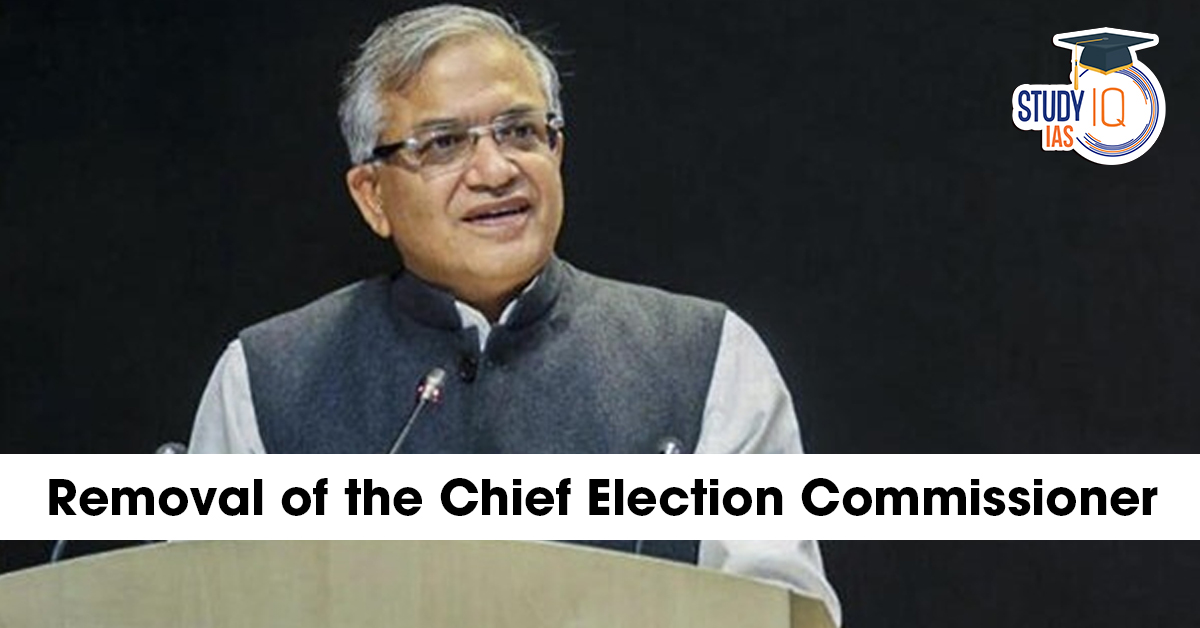
Removal of the Chief Election Commissioner
- Article 324(5) provides that the CEC can be removed only in the same manner as a Supreme Court judge under Article 124(4).
- Grounds are limited to:
- Proven misbehaviour
- Incapacity
- This high threshold is designed to prevent arbitrary executive interference.
Removal of Other Election Commissioners
- The President may remove other Election Commissioners on the recommendation of the CEC.
- In Vineet Narain v. Union of India, the Supreme Court clarified that the CEC’s advice should not be given suo motu.
- The arrangement attempts to balance executive authority with institutional autonomy.
Evolution of the Multi-Member Commission
- Article 324 permits a Commission comprising the CEC and other Election Commissioners.
- Key developments:
- 1989: Commission briefly became multi-member.
- 1990: Additional posts were abolished.
- 1993: Multi-member structure was restored permanently.
- The Supreme Court upheld this structure in N. Seshan v. Union of India case.
- The CEC functions as Chairperson, ensuring coordinated and consensus-based decision-making.
Parliamentary Procedure for Removal
Initiation of Motion
- Removal proceedings follow the Judges (Inquiry) Act, 1968 framework.
- A motion requires:
- At least 100 Lok Sabha members, or
- At least 50 Rajya Sabha members.
Investigation Mechanism
- Upon admission, a three-member inquiry committee is formed, comprising:
- The Chief Justice of India or a Supreme Court judge
- A Chief Justice of a High Court
- A distinguished jurist
- Specific charges must be framed and communicated.
Principles of Natural Justice
- The CEC must receive:
- Adequate time to respond
- Opportunity to present a defence
- In cases of alleged incapacity, a medical examination may be ordered.
- These safeguards reflect adherence to the rule of fair hearing, a core constitutional value.
Institutional and Political Considerations
- Motions for removal require special parliamentary majorities, making success difficult without a broad consensus.
- The ruling coalition’s parliamentary strength often becomes a practical factor.
- The broader constitutional expectation is that all stakeholders respect the autonomy of independent bodies.
- Excessive politicisation of constitutional institutions may erode public confidence.
Analytical Perspective
- India’s constitutional design provides substantial structural protections for the Election Commission.
- However, debates over appointments, voter roll management, and institutional perception highlight the importance of:
- Transparency
- Procedural fairness
- Cross-party trust
- The durability of electoral credibility depends not only on formal safeguards but also on institutional culture and public confidence.
Conclusion
- The independence of the Election Commission remains central to India’s democratic legitimacy.
- Constitutional safeguards, especially the rigorous removal process, provide strong formal protection.
- Going forward, maintaining both legal autonomy and public trust will be essential to preserving the integrity of India’s electoral system.
|
Read More Notes |
|
| Environment Notes | Art and Culture Notes |
| Science and Tech | History Notes |
| Geography Notes | Indian Polity Notes |
| General Knowledge | International Relation |
|
Explore StudyIQ Courses |
|
 Regulating Social Media Use Among Childr...
 Amrit Bharat Station Scheme: Modernising...
 Prioritising Natural Gas Supplies Amid W...










 WhatsApp





