
Table of Contents
Context
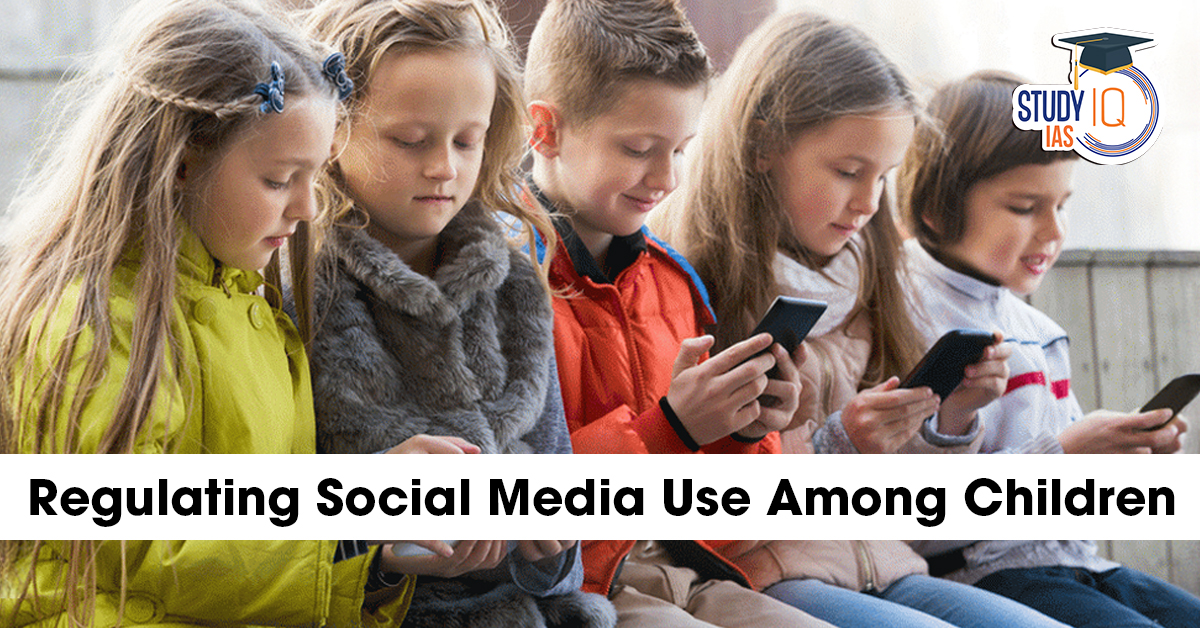
- Governments across the world are exploring ways to limit children’s exposure to social media because of growing evidence linking excessive screen use with mental health and learning problems.
- Governments in Karnataka and Andhra Pradesh have announced plans to restrict social media access for children below certain age limits.
Significance of banning social media for children
- Safeguarding developing brains: Adolescents are particularly responsive to dopamine-driven rewards such as likes and comments on social media. This can create a compulsive need for digital validation that disrupts sleep, studies, and real-life interactions.
- Eg: The prefrontal cortex, responsible for judgement and impulse control, continues to mature until the mid-20s. Supporters of restrictions argue that children therefore lack the neurological capacity to resist addictive features like endless scrolling or autoplay.
- Protecting mental health and well-being: Studies increasingly associate heavy social media use with anxiety, depression, and low self-esteem, especially among teenagers. Exposure to carefully curated and idealised online lifestyles often leads to unhealthy comparisons.
- Eg: The Economic Survey 2025–26 highlighted growing concerns about digital addiction, noting that excessive usage correlates with higher levels of anxiety, depressive symptoms, and hopelessness among young people.
- Preventing cyberbullying and online harassment: Children may encounter cyberbullying, harmful content, online predators, and manipulative design features that they are not mature enough to handle.
- Eg: Australia has imposed strict limits on social media access for those under 16.
- Limiting the spread of misinformation: Social media platforms can rapidly amplify false information related to health, elections, and public safety.
- Eg: Algorithm-driven systems often prioritise sensational or emotionally charged content over factual accuracy, making misinformation difficult to correct.
- Addressing political polarisation: Algorithmic recommendations frequently create echo chambers, exposing users mainly to views similar to their own.
- This dynamic can intensify ideological divisions, weaken constructive debate, and sometimes contribute to real-world tensions.
- Protecting data privacy: Social media companies collect vast amounts of user data, often without fully informed consent.
- Children are less capable of understanding the long-term implications of their digital footprints, making restrictions a way to prevent premature exposure to data harvesting practices.
Limitations of banning social media for children
- Freedom of expression and access to information: Social media platforms serve as important channels for news, knowledge sharing, and public discussion and banning access restricts children’s rights to information and self-expression, suggesting that responsible usage should be taught rather than prohibited.
- Social connection and sense of belonging: For some young people—particularly those in remote areas or those who feel socially marginalised—online communities provide valuable emotional support.
- A blanket ban could deepen feelings of isolation and negatively affect mental health for such groups.
- Difficulty of enforcement: Age-based restrictions are challenging to implement effectively. Children can bypass them by using VPNs, borrowed accounts, or false age declarations.
- Such workarounds might drive them toward poorly moderated or fringe platforms where exposure to harmful content could be even greater.
- Impact on learning opportunities: Many educational discussions, tutorials, and collaborative learning communities operate on social media platforms.
- Limiting access could reduce opportunities for knowledge exchange and digital skill development in an increasingly technology-driven world.
- Reduced civic participation: Social media has enabled young people to engage with issues such as climate change, social justice, and community development.
- Restrictions may reduce opportunities for youth participation in public debates and civic initiatives.
- Concerns about state overreach: Some critics argue that decisions regarding children’s media use should primarily rest with parents rather than governments.
- A legal ban may therefore be viewed as excessive state interference in family decision-making.
|
Global Trends on children’s social media use |
| AUSTRALIA
● In 2024, Australia proposed some of the toughest regulations on children’s access to social media. ● The proposal includes a legal prohibition on social media use for individuals below 16 years of age, without any parental exemption. ● Platforms such as Meta Platforms (Facebook, Instagram) and TikTok may be required to implement mandatory age-verification systems and prevent underage users from creating accounts. ● Companies that fail to comply could face penalties of up to $50 million. FRANCE ● France has introduced a restriction on social media access for children under 15 years. ● A new law mandates that minors below this age can create social media accounts only with parental approval. UNITED STATES OF AMERICA ● In Utah, minors must obtain parental consent to use social media, and platforms are required to verify users’ ages. ● Arkansas has enacted similar legislation, requiring parental permission before minors can join social media platforms. CHINA ● China has implemented stringent digital regulations for minors. ● Platforms such as Douyin, the Chinese version of TikTok, offer a “youth mode” that restricts screen time and filters content deemed inappropriate for younger users. UNITED KINGDOM ● The Online Safety Act 2023 obliges digital platforms to protect children from harmful content. ● It also requires companies to strengthen age-verification mechanisms to prevent underage access. INDONESIA ● Indonesia plans to enforce a ban on social media use for individuals below 16 years starting March 28, 2026. ● The restriction targets “high-risk” platforms such as TikTok, YouTube, Instagram, and several online gaming platforms. INDIA ● In Karnataka, authorities have proposed a ban on social media access for children under 16. ● Andhra Pradesh has also examined possible restrictions for children under 13. |
Way forward
- Age-sensitive regulation instead of blanket bans: Rather than outright prohibitions, governments could require platforms to create child-friendly digital environments.
- This may include limits on algorithmic content promotion, bans on targeted advertising to minors, and stronger privacy protections.
- Frameworks such as the Age Appropriate Design Code offer useful policy models.
- Strengthening platform accountability: Social media companies should implement default privacy protections for minors, such as private accounts, disabled location sharing, and restrictions on messages from unknown users.
- These safeguards should be automatic rather than optional.
- Promoting digital literacy: Schools should incorporate digital literacy education into curricula.
- Students need to learn how algorithms function, how to identify misinformation, how to manage screen time, and how to protect their personal data online.
- Introducing tiered access by age: A graded approach may be more practical than a simple ban.
- Eg: Strict limits for children under 13, supervised and restricted access for ages 13–15, and broader access with safeguards for those aged 16 and above.
- Supporting parents: Governments and institutions can provide parents with resources to better understand digital platforms and guide children’s online behaviour.
- Encouraging open conversations about online safety and establishing family guidelines for screen use can be more effective than strict prohibitions.
- International cooperation: Since social media operates across national boundaries, isolated national policies have limited impact.
- Coordinated global standards through international forums such as the United Nations or G20—could help ensure consistent protections for minors worldwide.
|
Read More Notes |
|
| Environment Notes | Art and Culture Notes |
| Science and Tech | History Notes |
| Geography Notes | Indian Polity Notes |
| General Knowledge | International Relation |
|
Explore StudyIQ Courses |
|
 Supreme Court Examines Challenge to Musl...
 Removal of the Chief Election Commission...
 Amrit Bharat Station Scheme: Modernising...











 WhatsApp





