
Table of Contents
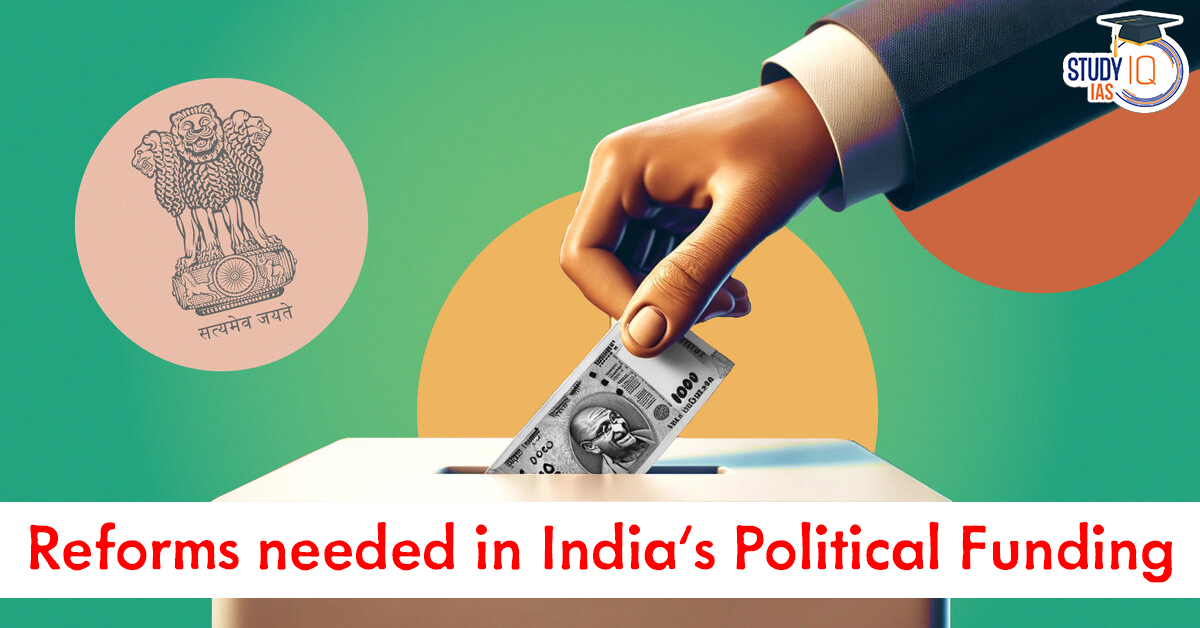
Political funding plays a decisive role in shaping electoral outcomes and democratic governance in India. However, repeated disclosures by the Election Commission of India (ECI), reports by the Association for Democratic Reforms (ADR), and landmark Supreme Court judgments have exposed deep structural flaws in India’s political funding system. The dominance of money power, lack of transparency, and excessive corporate influence have raised serious concerns about the fairness of elections. This article examines why reforms are urgently needed in India’s political funding system and the way forward.
Political Funding in India: An Overview
Political funding in India is regulated by the Representation of the People Act, 1951, Income Tax Act, 1961, and Companies Act, 2013. Political parties receive funds from individual donations, corporate contributions, electoral trusts, and membership fees. While donations above ₹2,000 are mandated to be made through traceable modes, significant loopholes allow anonymous funding to persist.
The Electoral Trust mechanism, introduced to improve transparency, has instead highlighted unequal access to funds, with ruling and incumbent parties receiving a disproportionate share of political donations.
Key Problems in India’s Political Funding System
1. Lack of Transparency and Anonymous Donations
Despite regulatory provisions, political parties continue to receive large amounts of money from unknown sources. According to ADR data, national parties have collected thousands of crores in anonymous donations over the years. This undermines the voter’s right to information, a core democratic principle upheld under Article 19(1)(a) of the Constitution.
2. Unequal Playing Field in Elections
There is no legal cap on political party expenditure, unlike individual candidates who are subject to strict limits. This creates an uneven electoral arena where financially powerful parties dominate campaign narratives, marginalising smaller parties and independent candidates.
3. Corporate Influence and Policy Capture
Corporate donations constitute a major share of political funding. This increases the risk of quid pro quo arrangements, where public policy is influenced by private financial interests. The Supreme Court, in its 2024 judgment on electoral bonds, described opaque funding as a form of institutionalised corruption.
4. Weak Enforcement and Oversight
The Election Commission lacks adequate powers to audit party finances or penalise violations effectively. Delayed disclosures, under-reporting of donations, and poor financial accountability weaken the regulatory framework.
Why Reforms in Political Funding Are Necessary
-
To ensure free and fair elections
-
To reduce the influence of money power in democracy
-
To strengthen political equality among parties
-
To restore public trust in electoral institutions
-
To align electoral processes with constitutional values
Major Reforms Needed in India’s Political Funding
1. Public Funding of Elections
Public or state funding of elections, as recommended by the Indrajit Gupta Committee (1998), can reduce dependence on private donors. Partial state funding, such as providing free media time or campaign materials, can ensure minimum resources for all recognised parties.
2. Creation of a National Election Fund
A National Election Fund can act as a common pool where individuals and companies donate transparently. Funds can then be allocated to political parties based on objective criteria like vote share, compliance, and internal democracy.
3. Cap on Political Party Expenditure
Introducing a legal ceiling on party-level election expenditure is essential to ensure electoral fairness. This would curb excessive spending and reduce incentives for illegal funding.
4. Mandatory Real-Time Disclosure
All political donations should be disclosed in real time on a public portal maintained by the Election Commission. This would enhance transparency and allow citizens to scrutinise the sources of political finance.
5. Strengthening the Role of the Election Commission
The ECI should be empowered with:
-
Audit authority over party finances
-
Powers to deregister non-compliant parties
-
Independent financial investigation mechanisms
6. Regulating Corporate Donations
Corporate political contributions should be capped and linked to profits. Mandatory shareholder approval and full disclosure of political donations should be enforced to prevent misuse.
Global Best Practices and Lessons for India
Several democracies have adopted strict disclosure norms, public funding models, and independent electoral oversight bodies. Countries like Germany and Canada demonstrate how transparent political finance systems can coexist with competitive democratic politics. India can adapt these best practices to its constitutional and federal context.
Conclusion
Reforming India’s political funding system is no longer optional—it is a democratic imperative. Transparency, accountability, and equity must replace opacity and money dominance. Without comprehensive reforms, elections risk becoming contests of financial power rather than democratic choice. Strengthening political funding regulations will not only enhance electoral integrity but also deepen the quality of Indian democracy.
 FATF Report on India’s Action on Virtu...
 India Pharma Expo 2026: Key Highlights, ...
 India–Arab League Relations: Cooperati...













 WhatsApp





