
Table of Contents
Context
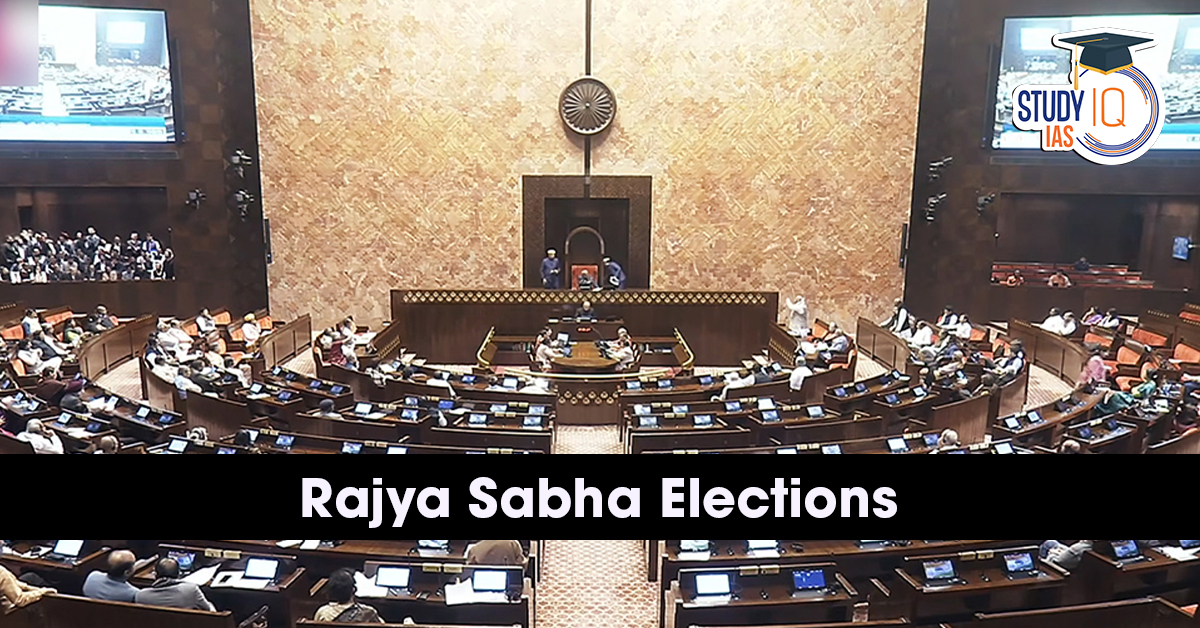
On 16 March 2026, Legislative Assemblies of 10 states elected 37 Members of Parliament to the Rajya Sabha.
Key Facts about the Rajya Sabha
Nature of the House
- Upper House of Parliament: The Rajya Sabha, also called the Council of States, is the upper chamber of the Indian Parliament and represents the interests of States and Union Territories.
- Composition: It includes representatives elected from States and certain Union Territories, along with members nominated by the President for their expertise.
Constitutional Provisions
- Article 80: This article sets the maximum strength of the Rajya Sabha at 250 members.
- Nominated Members: Out of these, 12 members are nominated by the President for their contribution to fields such as literature, science, art and social service.
- Current Strength: At present, the House has 245 members, including 233 elected members from States and Union Territories (Delhi, Puducherry and Jammu & Kashmir) and 12 nominated members.
Allocation of Seats
- Basis of Distribution: Seats are allotted to States and Union Territories according to their population.
- Constitutional Source: The distribution is mentioned in the Fourth Schedule of the Constitution.
Eligibility for Membership
- Constitutional Basis: The qualifications for becoming a member of Parliament are laid down in Article 84.
- Key Requirements: A candidate must be
- A citizen of India,
- At least 30 years old,
- Take an oath or affirmation before an authorised authority as specified in the Third Schedule, and
- Meet any additional qualifications prescribed by Parliament through law.
Tenure
- Permanent House: The Rajya Sabha is a continuing chamber and cannot be dissolved, unlike the Lok Sabha.
- Retirement System: One-third of its members retire every two years, and each member serves a six-year term.
- Bye-elections: When a vacancy occurs due to resignation, death or disqualification, a bye-election is conducted. The new member serves only the remaining period of the original term as provided under the Representation of the People Act, 1951.
Presiding Officer
- Chairperson: The Vice-President of India acts as the ex-officio Chairperson of the Rajya Sabha and presides over its proceedings.
Special Powers of the Rajya Sabha
Power to Legislate on State List
- Article 249: The Rajya Sabha can authorize Parliament to make laws on subjects listed in the State List if it considers the matter to be of national importance.
- Voting Requirement: Such a resolution must be approved by two-thirds of the members present and voting.
Creation of All-India Services
- Article 312: The Rajya Sabha has the exclusive authority to initiate the creation of new All-India Services that serve both the Union and the States.
- Approval: This also requires a two-thirds majority of members present and voting.
Role during Emergencies
- Continuity of Governance: When the Lok Sabha is dissolved, the Rajya Sabha can approve emergency proclamations.
- Relevant Articles: Under Articles 352, 356 and 360, it can keep such proclamations in force until the Lok Sabha is reconstituted.
Process of Election to the Rajya Sabha
Election Method
- Indirect Election: Members are elected indirectly by the elected Members of Legislative Assemblies (MLAs) of States and certain Union Territories.
- Voting System: The election follows proportional representation through the Single Transferable Vote (STV) system.
Preference Voting
- Ranking of Candidates: MLAs rank candidates in order of preference (1, 2, 3, etc.) on the ballot instead of voting for only one candidate.
- Quota Requirement: A candidate must secure a minimum number of votes (quota) to be declared elected.
Transfer of Votes
- Surplus Votes: If a candidate receives more votes than required, the extra votes are transferred to other candidates based on voters’ next preferences.
- Elimination: If seats remain unfilled, the candidate with the lowest votes is eliminated, and their votes are redistributed according to subsequent preferences.
Electoral College
- Who Votes: Only elected MLAs of the State Legislative Assemblies and eligible Union Territory Assemblies participate in the voting.
Domicile Requirement
- Before 2003: Candidates had to be residents of the State from which they contested.
- After 2003: The Representation of the People (Amendment) Act, 2003 removed this requirement, allowing candidates to contest from any State if they are registered as an elector in India.
Open Ballot System
- Transparent Voting: MLAs belonging to political parties must show their marked ballot to the party’s authorised agent before placing it in the ballot box.
- Purpose: This system aims to reduce cross-voting and the influence of money power.
- Independent MLAs: Independent legislators are not required to show their ballots to anyone.
Anti-Defection Provision
- Supreme Court Interpretation: Voting against the party’s instructions in a Rajya Sabha election does not lead to disqualification under the Tenth Schedule (Anti-Defection Law).
- Party Action: However, political parties may take disciplinary action, such as suspension or expulsion.
Removal of NOTA Option
- Supreme Court Decision (2018): In Shailesh Manubhai Parmar vs Union of India, the Court removed the ‘None of the Above’ (NOTA) option from Rajya Sabha elections.
- Reason: The Court held that NOTA is inconsistent with the principle of proportional representation and the Single Transferable Vote system used in these elections.
|
Read More Notes |
|
| Environment Notes | Art and Culture Notes |
| Science and Tech | History Notes |
| Geography Notes | Indian Polity Notes |
| General Knowledge | International Relation |
|
Explore StudyIQ Courses |
|
 Finance Commission Grants to Cities
 Governor’s Transfer and Lessons for Ce...
 Labour Market Impacts of Artificial Inte...




 WhatsApp





