
Table of Contents
Context
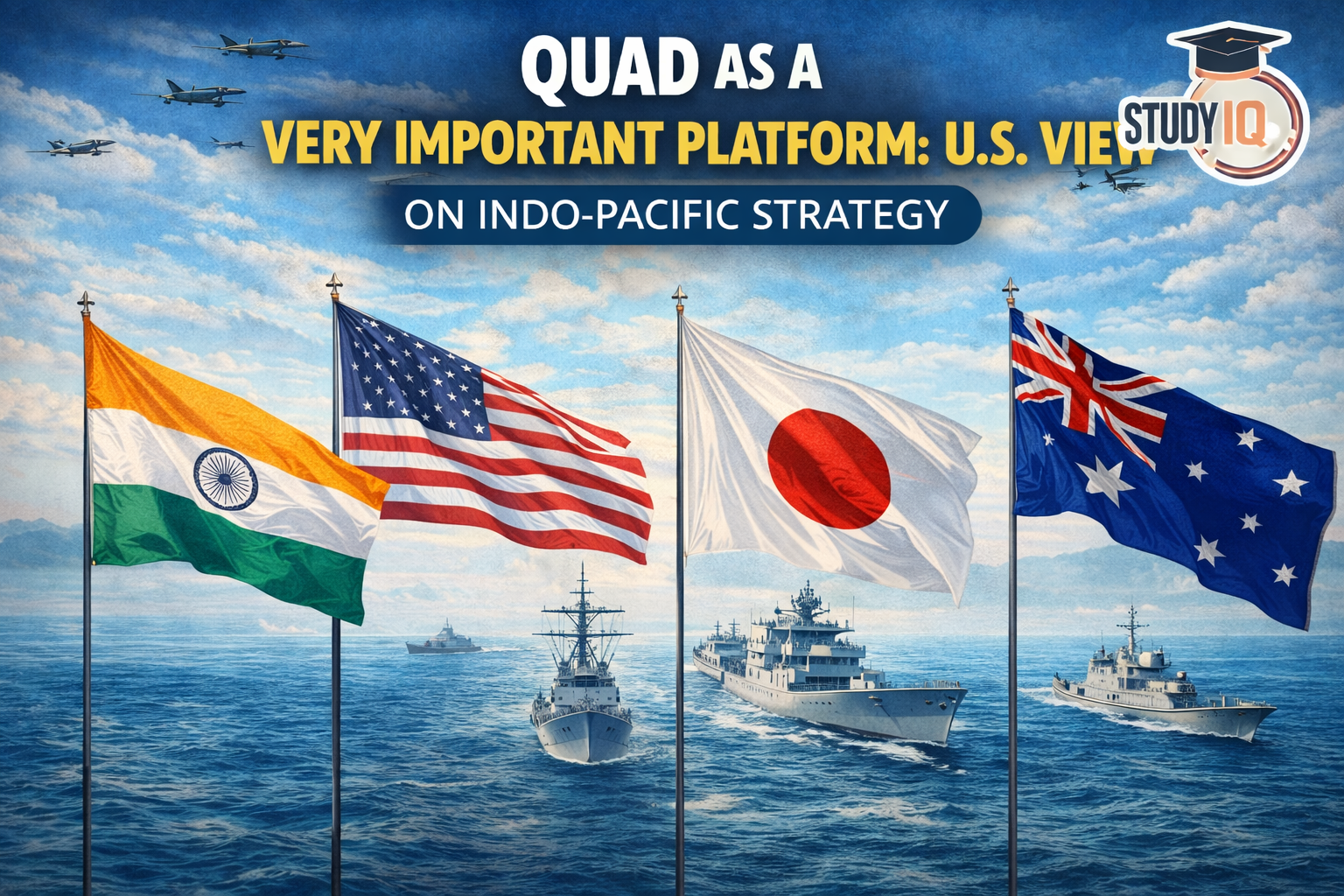
At a recent U.S. congressional hearing, Assistant Secretary of State for South and Central Asia S. Paul Kapur described the Quadrilateral Security Dialogue (Quad) as a “very important platform.”
| About Quadrilateral Security Dialogue (QUAD) |
| ● Members: India, United States, Japan, and Australia.
● Nature: Strategic forum; not a formal military alliance. ● Purpose: Promote a free, open, inclusive Indo-Pacific and uphold rules-based order. ● Key Focus Areas: Maritime security, regional stability, cyber security, counterterrorism, supply chains, climate, and health cooperation. ● Origin: Initiated in 2007 (Shinzo Abe’s idea), later lapsed. ● Revival: Revived in 2017 due to growing concerns over China’s assertiveness in the Indo-Pacific. ● Maritime Exercises: All QUAD members participate in the annual Malabar naval exercise. ● Quad Critical Minerals Initiative (QCMI) ○ Context: The Quad foreign ministers announced the launch of the Quad Critical Minerals Initiative at their meeting in Washington, D.C. on 1 July 2025. ○ Core objectives ● Reduce supply-chain vulnerabilities in critical minerals and related processing technologies. ● Build reliable, diversified and transparent supply chains that can withstand shocks and coercive disruptions. ● Encourage greater private-sector investment and industry coordination across Quad countries |
Emphasis on the Quad’s Strategic Importance
- Platform for Indo-Pacific Stability: Quad is described as central to maintaining a “free and open” Indo-Pacific..
- Strategic Counterbalance to China: Although the U.S. does not officially frame the Quad as anti-China, Kapur stressed that a strong and independent India limits China’s strategic space.
- Defence Cooperation and Interoperability: US Administration highlighted the October 2025 ten-year defence cooperation framework between India and the U.S. Expanding military exercises, logistics coordination, and interoperability.
- Defence Procurement and Technology Transfers: Defence trade was portrayed as strengthening mutual trust. Also it would enhance India’s self-defence capacity
- Energy and Supply Chain Security: The Quad’s broader agenda includes critical minerals and energy diversification. US administration India’s reduction of Russian oil imports and increased purchase of U.S. energy.
- Democratic Partnerships in the Region: US linked democratic transitions in countries like Bangladesh and Nepal to the broader U.S. strategy of supporting democratic governance in South Asia, which aligns with Quad values.
| Issues Highlighted by U.S. Congress in India–U.S. Relations |
| During the hearing, several concerns were raised by Members of Congress:
● Tariff Disputes and Trade Friction: Representatives called 50% tariffs imposed earlier impacting on bilateral trust. Some lawmakers described the tariff move as a “needless rupture.” ● H-1B Visa Restrictions: Concerns were expressed about the imposition of high visa fees affecting Indian professionals. Lawmakers noted that such measures strain economic and technological cooperation. ● Quad’s Limited Mention in U.S. National Security Strategy: Representatives questioned why the Quad was mentioned only briefly in the 2025 U.S. National Security Strategy, implying possible downgrading. ● Trump’s Kashmir Mediation Offer: Lawmakers argued that President Trump’s offer to mediate on Kashmir, and his claim of brokering a ceasefire in the India–Pakistan conflict of May 2025, risked complicating sensitive diplomatic dynamics. ● Afghanistan Policy and Refugee Concerns: Some members criticised U.S. policies regarding Afghan refugees and women’s rights, linking broader South Asia strategy to credibility concerns. |
Strategic Implications
- Quad as a Stabilising Architecture: The Quad remains central to U.S. Indo-Pacific strategy, even amid trade tensions.
- India as a Net Security Provider: The U.S. views a strong India as a means to secure a large portion of the Indo-Pacific from strategic dominance by China.
- Trade Tensions vs Strategic Alignment: Despite tariff disputes, defence and geopolitical cooperation appear largely intact.
- Domestic Political Divisions in the U.S.: The hearing revealed partisan differences in approach, but bipartisan support for India’s strategic role remains strong.
|
Read More Notes |
|
| Environment Notes | Art and Culture Notes |
| Science and Tech | History Notes |
| Geography Notes | Indian Polity Notes |
| General Knowledge | International Relation |
|
Explore StudyIQ Courses |
|
 Disaster Management in India, Classifica...
 Good Friday 2026: Date, History, Meaning...
 Removal of the Chief Election Commission...







 WhatsApp





