
Table of Contents
Context
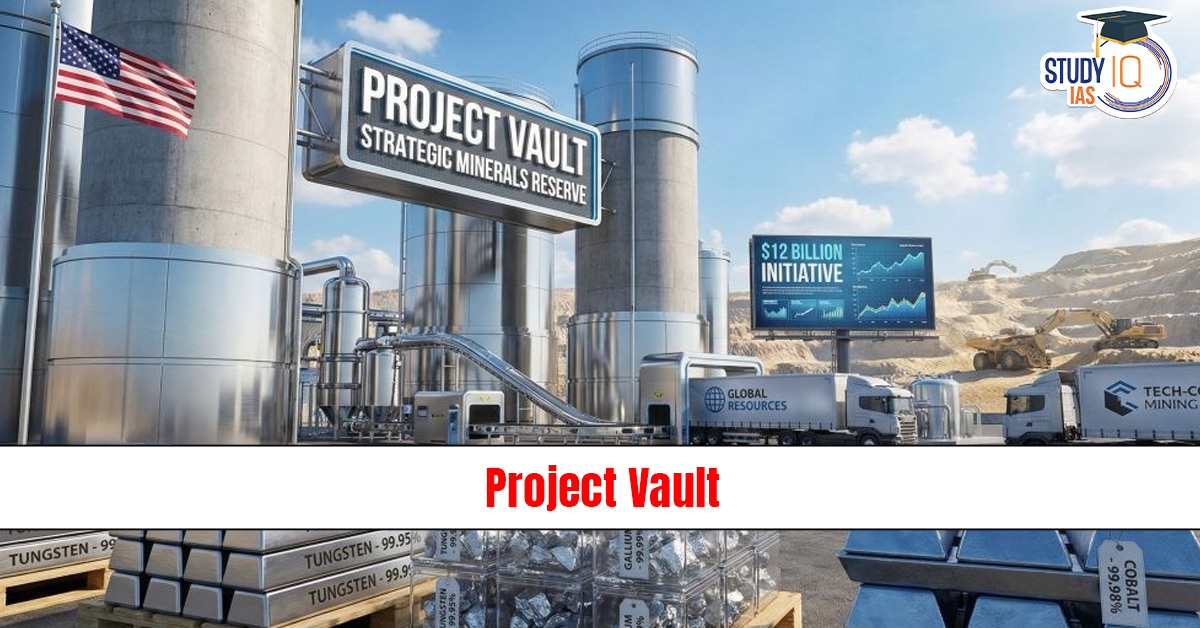
The Donald Trump administration officially launched “Project Vault,” a strategic initiative designed to secure the United States’ supply of critical minerals and rare earth elements
About Project Vault
- Project Vault is a $12 billion federal program established to create a U.S. Strategic Critical Minerals Reserve.
- Its primary purpose is to stockpile minerals, such as lithium, cobalt, graphite, and rare earth elements, to protect American manufacturers from supply chain disruptions, price volatility, and geopolitical leverage.
- Unlike traditional government stockpiles, Project Vault is structured as a public-private partnership (PPP).
- It acts as a “buffer” for civilian industries rather than just the military, ensuring that companies producing electric vehicles (EVs), smartphones, semiconductors, and fighter jets have uninterrupted access to raw materials.
Funding and finance structure
- The project launched with a total of $11.67 billion in seed capital:
- $10 billion Loan: Provided by the U.S. Export-Import (EXIM) Bank. This is the largest loan in the agency’s 92-year history.
- $1.67 billion Private Capital: Contributed by private investors and participating corporations.
- 15-Year Horizon: The government-backed loan is set for 15 years, providing long-term certainty for mining and processing investments.
Mechanism of the vault
- Upfront Commitments: Participating companies (Original Equipment Manufacturers or OEMs) like General Motors, Boeing, and Google commit to buying specific minerals at an agreed-upon fixed price.
- Storage and Management: Project Vault procures and stores these minerals. Trading firms such as Hartree Partners and Traxys North America handle the logistics.
- Replenishment Rule: If a manufacturer draws minerals from the reserve during a shortage, they are obligated to replenish the stockpile later, ensuring the “Vault” remains full.
- Independent Governance: The reserve is managed by an independent board, separating it from direct political interference in daily operations.
Key Minerals Involved
While the target includes up to 60 critical minerals, the initial focus is on the most “at-risk” elements:
- Rare Earths: Neodymium and Dysprosium (for magnets in EVs and wind turbines).
- Battery Metals: Lithium, Cobalt, and Nickel.
- Tech Essentials: Gallium, Germanium, and Silicon (for semiconductors and AI infrastructure).
- Industrial Inputs: Copper and Zinc.
Global Significance
- The project is a direct response to China’s dominance in the sector. China currently controls approximately 70% of global rare earth mining and 90% of processing.
- In 2025, during trade disputes, China restricted exports of rare earths used in jet engines and laptops. Project Vault aims to ensure that such restrictions can no longer “stall” American manufacturing.
- The Washington Accords: Alongside Project Vault, the Trump administration has pursued “The Washington Accords,” signing bilateral mineral agreements with nations like Australia, Japan, Rwanda, and Congo to diversify sourcing away from Chinese-controlled mines.
Strategic significance for India
- Minerals Security Partnership (MSP): India is a key partner in the revamped MSP, now known as FORGE (Forum on Resource Geostrategic Engagement).
- Supply Chain Integration: As U.S. companies seek to “onshore” or “friend-shore” their supply chains, Indian mining and processing firms may find new opportunities to supply the Vault, provided they meet the project’s technical and environmental standards.
- Price Stabilization: If Project Vault successfully stabilizes global mineral prices, it could lower the input costs for India’s own domestic manufacturing ambitions under schemes like “Make in India.”
|
Read More Notes |
|
| Environment Notes | Art and Culture Notes |
| Science and Tech | History Notes |
| Geography Notes | Indian Polity Notes |
| General Knowledge | International Relation |
|
Explore StudyIQ Courses |
|
 West Bengal Elections 2026: Full Schedul...
 ISRO Launches Mission MITRA in Ladakh: A...
 Disaster Management in India, Classifica...










 WhatsApp





