
Table of Contents
Context
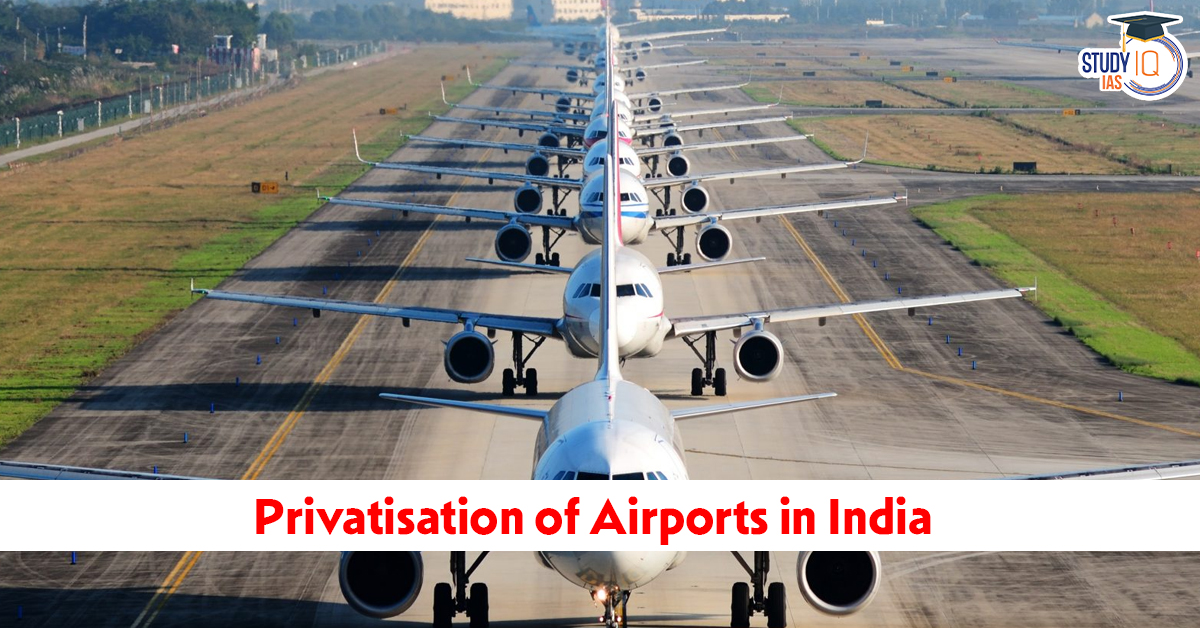
The Ministry of Civil Aviation has sent a proposal to the Public Private Partnership Appraisal Committee (PPPAC) for in-principle approval of the third round of airport privatisation.
More in News
- 11 airports will be privatised in five bundled groups, airports included: Amritsar–Kangra, Varanasi–Kushinagar–Gaya, Bhubaneswar–Hubli, Raipur–Aurangabad, Tiruchi–Tirupati.
- The move is part of the National Monetisation Pipeline (NMP) and the Asset Monetisation Plan 2025–30.
What is the Process of Privatising Airports?
- Selection of airports: Chosen from Airports Authority of India (AAI) airports handling 1–1 million passengers annually.
- Based on traffic growth potential, investment needs, and proximity for bundling.
- Bundling strategy: Metro airports paired with non-metro airports to enable cross-subsidisation.
- PPPAC appraisal: Examines:
- Revenue-share vs per-passenger fee models
- Cap on number of airports per bidder
- Tariff structure and User Development Fee (UDF)
- Land monetisation for non-aeronautical revenue
- Cabinet approval: Required before issuing Request for Proposal (RFP).
- Bidding and concession: Airports leased to private operators for long-term operation, development, and maintenance.
- Regulated by Airport Economic Regulatory Authority (AERA).
Pros of Airport Privatisation
- Infrastructure modernisation: Faster expansion of terminals, runways, cargo, and passenger amenities.
- Efficiency gains: Professional management, better technology adoption, and improved service delivery.
- Fiscal benefits: Monetisation of brownfield assets unlocks capital for new infrastructure.
- Cross-subsidisation: Bundling allows financially strong airports to support smaller regional airports.
- Capacity augmentation: Supports India’s target of 850 million passengers per annum (mppa) capacity in the next five years.
Cons and Concerns
- Risk of monopoly / duopoly: Concentration of airports with a single corporate group reduces competition.
- g., The Adani Group currently operates 8th major airports, including 6 privatised airports and the strategic Mumbai and Navi Mumbai airports
- Rising costs for passengers: Sharp increases in User Development Fee, landing charges, and disembarkation fees after privatisation.
- g., At Thiruvananthapuram International Airport, the User Development Fee (UDF) for domestic passengers increased from ₹506 to ₹770 in the first year after privatisation, with further hikes approved subsequently.
- Higher airline operating costs: Increased airport charges ultimately passed on to passengers.
- g., Post-privatisation tariff revisions at airports such as Ahmedabad Airport and Jaipur Airport saw significant increases in landing and parking charges.
- Weak bargaining power: Airlines and service providers have limited negotiating leverage against dominant operators.
- g., Mumbai–Navi Mumbai airport system.
- Service quality concerns: Complaints related to congestion, accessibility, high taxi fares, and forced ancillary charges.
- g., Telecom operators complained of “extortionary charges” and denial of right of way at Navi Mumbai International Airport for installing in-building cellular infrastructure.
- Regulatory challenges: Under-reporting of non-aeronautical revenues reduces cross-subsidisation benefits.
Way Forward
- Ensure competition safeguards: Impose a cap on the number of airports per operator to prevent monopolisation.
- Strengthen tariff regulation: AERA should tightly link tariff hikes to service quality benchmarks.
- Transparent revenue assumptions: Accurate projection of non-aeronautical revenues to reduce passenger burden.
- Service-delivery-linked penalties: Enforce proposed 5% tariff reduction for failure to meet service benchmarks.
- Balanced privatisation strategy: Combine privatisation with strong public oversight and periodic reviews.
- Holistic aviation ecosystem: Parallel focus on financially robust airlines, regional connectivity, and last-mile access.
 Viksit Bharat Shiksha Adhishthan Bill 20...
 Cyclone Maila Intensifies Over Solomon S...
 List of Military Exercises of India 2026...












 WhatsApp





