
Table of Contents
Context
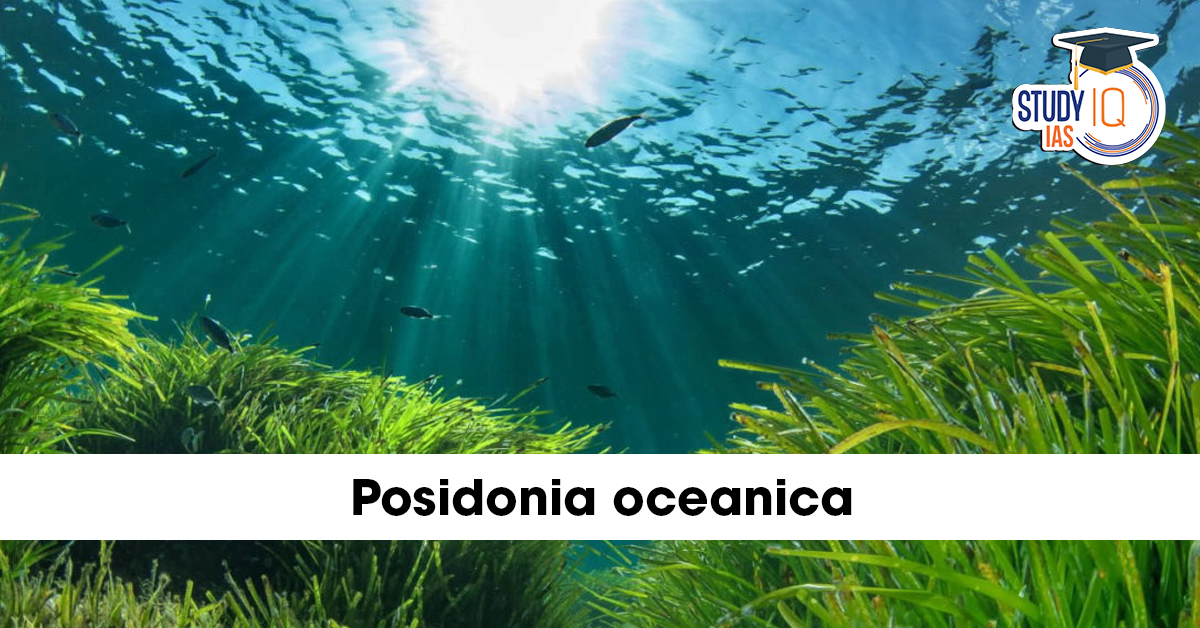
Greece has launched a specialized eco-mooring project at Porto Rafti to protect Posidonia oceanica, a seagrass species
About Posidonia oceanica
- Common Name: Neptune Grass or Mediterranean Tapeweed.
- Endemism: It is endemic to the Mediterranean Sea (found nowhere else).
- Classification: It is not seaweed (algae) but a flowering plant (angiosperm) with roots, stems (rhizomes), and ribbon-like leaves.
- Conservation Status: Classified as a “priority habitat” by the European Union (Habitats Directive).
- Ecological importance
- Carbon Sequestration: These meadows are among the world’s most effective carbon sinks, storing carbon beneath their rhizomes for millennia.
- Oxygen Production: Often called the “lungs of the Mediterranean” for their high oxygen output.
- Coastal Protection: They stabilize the seabed and buffer the coastline against erosion by absorbing wave energy.
- Biodiversity Support: Acts as a nursery and habitat for numerous marine species.
- Water Quality: Filters and purifies seawater, maintaining clarity.
|
Eco-Mooring Technology |
| ● Mechanism: Instead of a heavy block or a dragging anchor, a special drill bores up to three meters into the seabed to install a fixed anchorage with symmetrical fins.
● Design: The anchor locks into place, and a chain is attached to a permanent marker buoy. ● Benefit: Vessels tie up to the buoy rather than dropping their own anchors, ensuring zero contact with the sensitive seagrass meadows. |
|
Read More Notes |
|
| Environment Notes | Art and Culture Notes |
| Science and Tech | History Notes |
| Geography Notes | Indian Polity Notes |
| General Knowledge | International Relation |
|
Explore StudyIQ Courses |
|
 Regulating Social Media Use Among Childr...
 Removal of the Chief Election Commission...
 Amrit Bharat Station Scheme: Modernising...











 WhatsApp





