
Table of Contents
Point Nemo, often called the most isolated place on Earth, is a fascinating location in the South Pacific Ocean that has gained global attention due to its importance in oceanography, space exploration, and environmental studies. It represents the oceanic pole of inaccessibility, meaning it is the point on Earth farthest from any landmass. Its extreme remoteness makes it both scientifically valuable and strategically important.
What is Point Nemo?
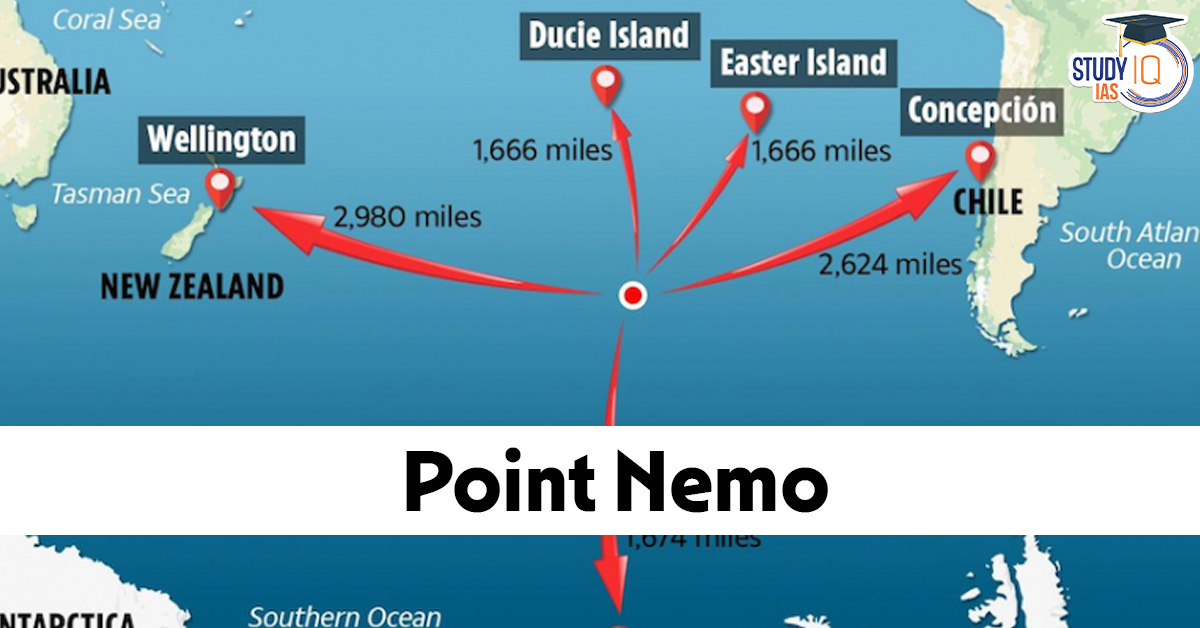
Point Nemo is located in the South Pacific Ocean within the South Pacific Gyre at coordinates 48°52.6′ S latitude and 123°23.6′ W longitude. It is the most distant point from any coastline, surrounded by thousands of kilometers of open ocean in every direction.
The name “Nemo” comes from Jules Verne’s famous fictional character Captain Nemo and also means “no one” in Latin, symbolizing the complete isolation of the region.
Discovery of Point Nemo
Unlike most geographical locations that were discovered through exploration, Point Nemo was identified in 1992 using computer calculations by Hrvoje Lukatela, a Croatian-Canadian survey engineer. He calculated the point that is farthest from any landmass by analyzing global coastline data.
This makes Point Nemo a product of modern geospatial science rather than traditional navigation or exploration.
Closest Landmasses to Point Nemo
The three nearest landforms to Point Nemo are all tiny, uninhabited islands:
-
Ducie Island (Pitcairn Islands)
-
Motu Nui (a small islet off Easter Island)
-
Maher Island (near Antarctica)
Each of these is approximately 2,688 km (1,670 miles) away from Point Nemo.
The nearest inhabited land lies thousands of kilometers away, such as the Chatham Islands of New Zealand.
Interestingly, astronauts aboard the International Space Station (ISS), orbiting about 400 km above Earth, are often closer to Point Nemo than any human on land.
Point Nemo as the Spacecraft Graveyard
Due to its extreme isolation and minimal shipping traffic, Point Nemo is used as a spacecraft disposal zone, also known as the orbital graveyard.
Decommissioned spacecraft are intentionally crashed into this area to avoid danger to human populations and infrastructure.
Notable examples include:
-
Mir Space Station (2001) – safely deorbited into the waters near Point Nemo
-
International Space Station (ISS) – planned to meet the same fate at the end of its operational life
More than 250 spacecraft remnants already lie scattered on the ocean floor near Point Nemo.
This makes it a unique intersection point of ocean science and space technology.
The Mystery of “The Bloop”
In 1997, underwater sensors of the US National Oceanic and Atmospheric Administration (NOAA) detected a powerful low-frequency sound near Point Nemo called “The Bloop.”
Initially, it was a mystery and sparked speculation about unknown marine creatures. However, later research revealed that it was caused by an icequake—the cracking and melting of massive Antarctic icebergs.
This incident highlighted the usefulness of Point Nemo for studying:
-
Ocean acoustics
-
Climate change
-
Ice dynamics in polar regions
South Pacific Gyre: The Oceanic Setting of Point Nemo
Point Nemo lies within the South Pacific Gyre, one of the largest ocean gyres in the world.
Formation of the South Pacific Gyre
It is formed by a combination of major ocean currents:
-
Antarctic Circumpolar Current
-
Humboldt Current
-
West Wind Drift
These currents create a slow-moving circular system that traps water within the gyre.
Why is the South Pacific Gyre a Biological Desert?
The South Pacific Gyre is considered one of the most biologically barren regions of the world’s oceans.
Reasons include:
-
Extreme Distance from Land
Winds carry almost no dust, nutrients, or organic matter into surface waters. -
No Upwelling
Circular ocean currents prevent the rise of nutrient-rich deep waters. -
Low Plankton Growth
With limited nutrients, phytoplankton growth is minimal. -
Weak Marine Food Chain
Since plankton forms the base of the marine ecosystem, the lack of it makes higher life forms scarce.
Thus, the region around Point Nemo is often described as a marine desert.
Scientific Importance of Point Nemo
Point Nemo plays a vital role in several scientific fields:
1. Oceanography
-
Study of gyres and nutrient circulation
-
Understanding biological deserts
-
Monitoring climate-driven changes
2. Space Exploration
-
Safe disposal of spacecraft
-
Research on atmospheric re-entry behavior
3. Environmental Studies
-
Monitoring ocean pollution and microplastics
-
Climate change and iceberg dynamics
Conclusion
Point Nemo is not just the most remote location on Earth; it is a remarkable example of how geography, oceanography, climate science, and space technology intersect. Its isolation makes it ideal for scientific research and safe spacecraft disposal, while its position in the South Pacific Gyre highlights the dynamics of ocean currents and marine ecosystems.
From being a spacecraft graveyard to hosting mysterious ocean sounds like The Bloop, Point Nemo remains one of the most intriguing and scientifically valuable places on our planet.
 Shia Politics in India: History, Influen...
 Future of Chipmaking: Trends, Technologi...
 Nucleic Acid Testing (NAT): Meaning, Wor...











 WhatsApp





