
Table of Contents
Context
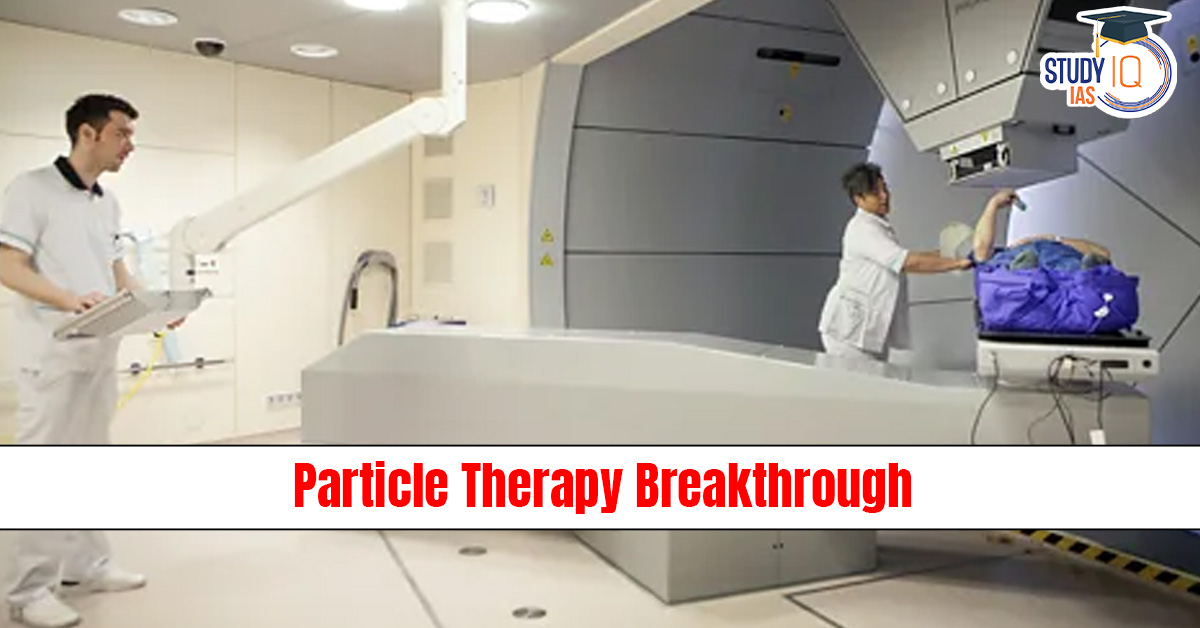
Cancer treatment is moving beyond conventional radiation methods towards particle therapies that can precisely target tumours while sparing healthy tissues.Researchers in Japan have found that using heavier ions like oxygen can reduce the error margin in multi-ion cancer therapy.
|
Types of Cancer Therapy |
| ● Surgery
○ Physical removal of tumours. ○ Effective for localized cancers but unsuitable for deep or metastatic tumours. ● Chemotherapy ○ Uses drugs to kill rapidly dividing cells. ○ Affects both cancerous and healthy cells, causing side effects. ● Conventional Radiotherapy (Photon Therapy) ○ Uses X-rays or gamma rays. ○ Radiation spreads beyond tumour, damaging surrounding tissue. ● Proton Therapy ○ Uses protons with a Bragg peak, delivering maximum energy at tumour depth. ○ Better precision than photons but low Linear Energy Transfer (LET), limiting effectiveness against resistant tumours. ● Heavy-Ion Therapy (Carbon-Ion Therapy) ○ Uses heavier particles like carbon ions. ○ Offers high Linear Energy Transfer (LET), causing complex DNA damage in cancer cells. Multi-Ion Cancer Therapy It is an advanced form of particle therapy that combines multiple heavy ions (carbon, oxygen, neon) in a single treatment plan to match the biological and physical properties of a tumour. Key Idea: Different ions behave differently in tissue. Combining them allows: ● Higher tumour control ● Lower damage to surrounding healthy tissues ● Better adaptability to tumour size, depth and resistance What is LET? ● LET measures how much energy radiation deposits per unit length in tissue. ● High-LET radiation causes clustered DNA damage, which cancer cells struggle to repair. LET Trilemma in Particle Therapy In particle therapy, doctors want three things at the same time: ● Efficiency: Kill cancer cells effectively ● Uniform Dose: Give radiation evenly inside the tumour ● Robustness: Ensure the plan still works even if small errors occur The problem is: improving one often weakens the others.This is called the LET trilemma. For example ● High LET is not evenly spread. When planners push LET higher: Dose becomes less uniform and Some tumour regions may get less dose. ● High LET is not robust as High-LET regions are highly position-dependent. Thus even a few millimetres of error can Reduce tumour dose and Increase damage to organs at risk. |
How Multi-Ion Therapy Addresses the LET Trilemma
- Tailored Ion Selection
- Different ions have different strengths. Carbon ions offer precise dose delivery, while oxygen and neon ions provide higher LET.
- Using them together increases biological effectiveness without raising radiation dose excessively.
- Improved Tumour Control: Higher dose-averaged LET (LETd) causes severe DNA damage in cancer cells. This improves treatment outcomes, especially for radio-resistant, deep-seated, and head-and-neck tumours.
Better Robustness with Heavier Ions: Studies show oxygen-ion dominant plans are less affected by range and setup errors. Heavier ions reach target LET levels more reliably, improving treatment consistency.
|
Explore StudyIQ Courses |
|
 Petrol Prices in India: Comprehensive Li...
 Excise Duty on Petrol: Impact on Petrol ...
 Racism Against the Northeastern Communit...













 WhatsApp





