
Table of Contents
Context
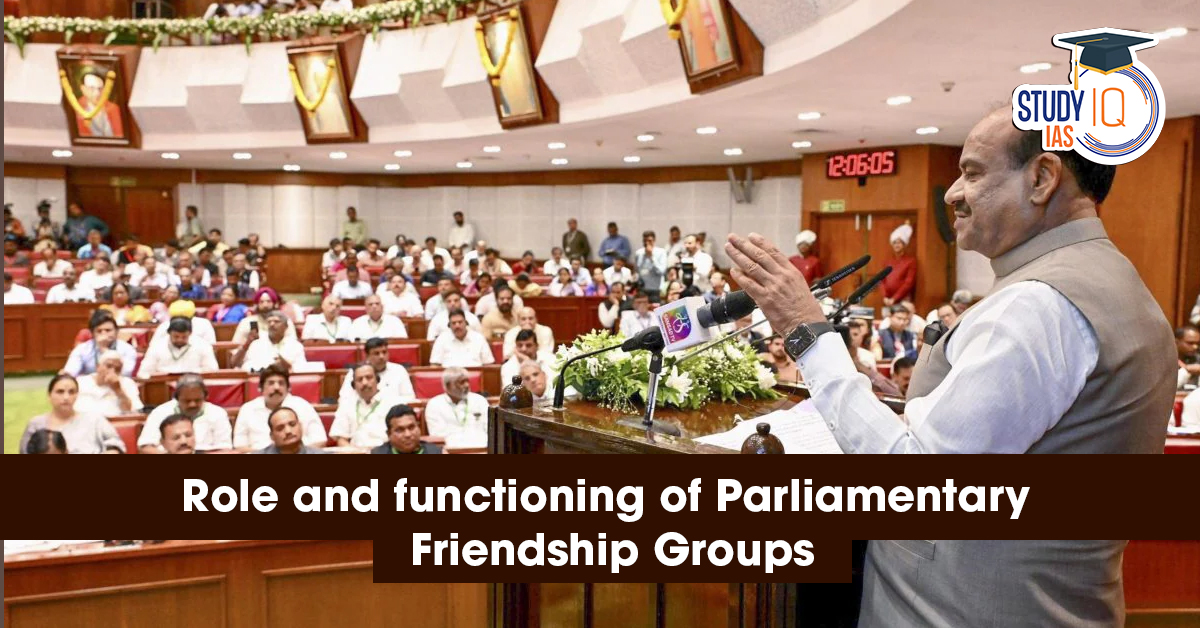
- In a major initiative to strengthen India’s inter-parliamentary outreach, Lok Sabha Speaker Om Birla has constituted Parliamentary Friendship Groups (PFGs) with more than 60 countries.
Contemporary relevance
- Parliamentary diplomacy refers to the international engagement of legislators to build understanding, trust, and cooperation between countries.
- It supplements traditional government-to-government diplomacy by leveraging the representative legitimacy of elected parliamentarians.
- In India, it has emerged as an important “second-track” diplomatic channel, especially useful in complex geopolitical environments.
- Recent years have seen increased parliamentary outreach, particularly with neighbouring countries and major global powers, reflecting India’s growing international profile and commitment to multilateral engagement.
Mechanisms of Parliamentary diplomacy in India
Parliamentary Delegations
- Indian parliamentary delegations regularly visit foreign countries, and India hosts reciprocal visits.
- These engagements facilitate structured dialogue on political, economic, and security issues.
- Delegation visits often help maintain communication even when formal diplomatic channels are under strain.
Inter-Parliamentary Forums
- India actively participates in global and regional parliamentary bodies such as the Inter-Parliamentary Union and the SAARC Parliamentary Forum.
- These platforms provide opportunities to:
- Exchange legislative practices
- Discuss regional and global challenges
- Build consensus on multilateral issues
Parliamentary Friendship Groups
- India has constituted Parliamentary Friendship Groups with numerous countries to promote structured bilateral engagement.
- As of recent years, such groups exist with more than 50 partner countries, and the network continues to expand.
- These groups enable sustained interaction beyond episodic visits.
Hosting Foreign Parliamentarians
- India frequently hosts visiting legislators and parliamentary officials.
- Such visits expose foreign delegates to India’s parliamentary procedures, federal structure, and democratic practices.
- They also provide informal spaces for policy dialogue.
Participation in International Conferences
- Indian MPs regularly attend international seminars and conferences on global themes such as:
- Climate change
- Sustainable development
- Democratic governance
- Emerging technologies
- These platforms amplify India’s parliamentary voice in global debates.
Recent parliamentary friendship groups initiative
|
About |
| ● In a major initiative to strengthen India’s inter-parliamentary outreach, Lok Sabha Speaker Om Birla has constituted Parliamentary Friendship Groups (PFGs) with more than 60 countries.
● The move reflects Parliament’s growing emphasis on parliamentary diplomacy as a complement to traditional executive-led foreign policy. ● The initiative aims to institutionalise sustained dialogue between Indian lawmakers and their global counterparts. Objectives of the Initiative ● Enable direct dialogue between legislators of India and partner countries. ● Promote exchange of legislative best practices and institutional experiences. ● Build mutual trust and long-term parliamentary networks. ● Support bilateral relations through discussions on: ○ Trade and investment ○ Technology cooperation ○ Social and developmental policies ○ Cultural exchanges ○ Shared global challenges faced by democracies. ● Strengthen the role of Parliament as an active stakeholder in foreign engagement. |
Role in India’s Foreign Policy
Strengthening Bilateral Relations
- Direct engagement between lawmakers builds personal rapport and institutional familiarity.
- For instance, sustained exchanges between Indian and United States legislators have contributed to the deepening of the India–United States strategic partnership.
- Parliamentary contacts often create a supportive political environment for executive agreements.
Promoting India’s Perspective
- Parliamentarians act as informal ambassadors, presenting India’s views on global issues.
- Their democratic mandate often enhances credibility in foreign legislatures and public forums.
Addressing Sensitive Issues
- Parliamentary channels can discuss politically delicate matters that may be difficult through formal diplomatic routes.
- The relatively informal setting allows confidence-building conversations.
Supporting Diaspora Engagement
- During foreign visits, MPs interact with Indian diaspora communities.
- These engagements help:
- Address diaspora concerns
- Strengthen emotional and economic ties
- Promote India’s image abroad
Enhancing Public Diplomacy
- Parliamentarians engage with universities, think tanks, civil society, and media abroad.
- Such outreach broadens India’s public diplomacy footprint beyond official government messaging.
|
Illustrative Examples |
| India–Bangladesh Parliamentary Engagement
● Parliamentary exchanges have supported cooperation on: ○ Border management ○ Water sharing ○ Connectivity initiatives ● These interactions have complemented formal diplomacy between India and Bangladesh. India–Africa Parliamentary Outreach ● India–Africa parliamentary interactions have helped expand: ○ Development cooperation ○ Capacity building ○ Trade and investment dialogue ● Parliamentary friendship initiatives have reinforced India’s broader Africa partnership strategy. India–European Union Dialogue ● Regular engagement between the European Parliament and the Indian Parliament has enabled discussions on: ○ Trade negotiations ○ Regulatory cooperation ○ Political and strategic issues ● These exchanges help sustain momentum in India–EU relations. |
Limitations
Absence of Binding Authority
- Parliamentary exchanges are non-binding in nature.
- Unlike executive agreements, they cannot directly produce enforceable outcomes.
- Their impact depends largely on follow-up by governments.
Political Polarisation
- Domestic political divisions within countries may sometimes spill over into parliamentary interactions.
- Differences in political ideology between partner legislatures can slow consensus-building.
Resource and Logistical Constraints
- Parliamentary diplomacy requires financial, institutional, and administrative support.
- Limited resources can restrict the frequency, depth, and geographical spread of engagements.
Coordination Gaps
- Effective parliamentary diplomacy requires close coordination between:
- Parliament
- Ministry of External Affairs
- Other executive agencies
- Weak institutional coordination can reduce policy coherence.
|
Read More Notes |
|
| Environment Notes | Art and Culture Notes |
| Science and Tech | History Notes |
| Geography Notes | Indian Polity Notes |
| General Knowledge | International Relation |
|
Explore StudyIQ Courses |
|
 Organ Donation in India: Legal, Ethical ...
 Finance Minister Launches National Monet...
 Green Ammonia and Its Role in Clean Ener...









 WhatsApp





