
Table of Contents
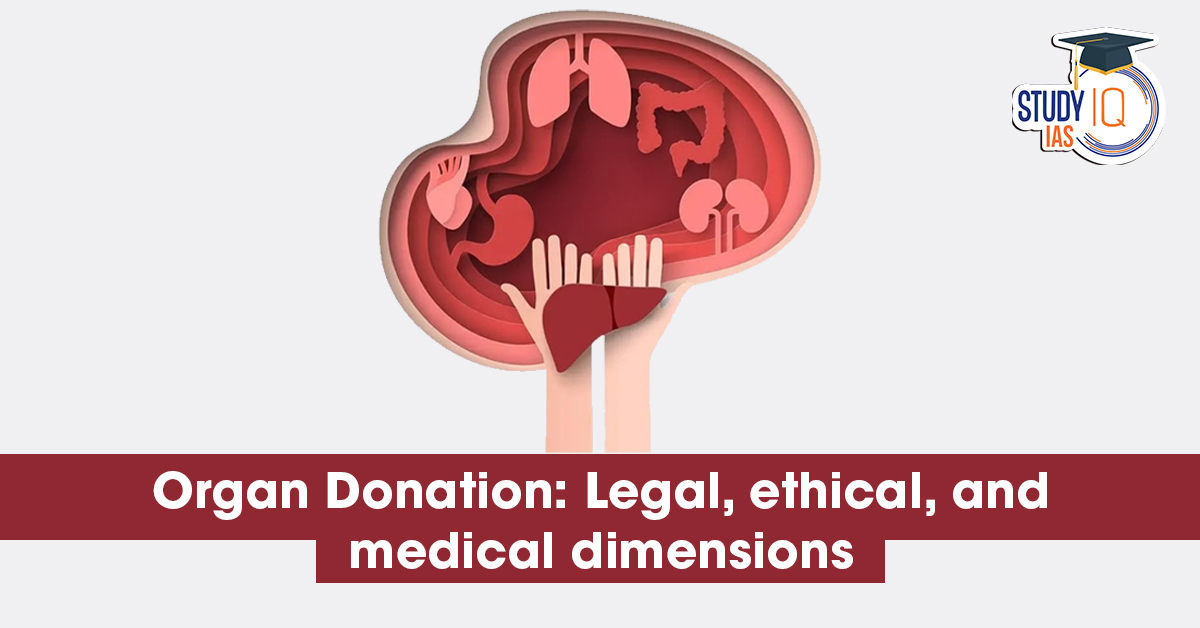
Organ Donation in India: Context
The Constitution embeds multiple institutional safeguards to preserve the Commission’s autonomy. However recent concerns have recently been raised regarding alleged manipulation of electoral rolls during Special Intensive Revision (SIR) exercises.
|
Recent Controversies and Allegations |
| ● Questions have emerged about the fairness and transparency of voter list revisions in certain States.
● Critics have alleged large-scale deletions of names, including claims that around 65 lakh voters were removed in one exercise. ● These issues have reached judicial scrutiny and political debate, including calls by Opposition parties to move a motion against the Chief Election Commissioner (CEC) |
Organ Donation in India: Appointment process
The 2023 Legislative Change
- Parliament enacted the Chief Election Commissioner and Other Election Commissioners (Appointment, Conditions of Office and Terms of Office) Act, 2023.
- The law provides that the President appoints Election Commissioners based on the recommendation of a selection committee comprising:
- Prime Minister
- A Union Minister
- Leader of Opposition
Judicial background
- In Anoop Baranwal v. Union of India, the Supreme Court had earlier suggested inclusion of the Chief Justice of India in the selection panel.
- The omission of the judicial member in the 2023 law has generated debate on institutional independence.
- The law is under challenge in Jaya Thakur v. Union of India, with further hearings expected.
Constitutional Foundation of the Election Commission
Article 324: Core Mandate
- Article 324 establishes a permanent Election Commission of India.
- It vests the Commission with powers of:
- Superintendence
- Direction
- Control of elections to the President, Vice-President, Parliament, and State legislatures.
- This constitutional status provides the primary structural guarantee of independence.
Tenure Protection
- Under the 2023 Act, the CEC holds office for six years or until age 65, whichever is earlier.
- Service conditions cannot be altered to the disadvantage of the CEC during tenure.
Removal Safeguards
Removal of the Chief Election Commissioner
- Article 324(5) provides that the CEC can be removed only in the same manner as a Supreme Court judge under Article 124(4).
- Grounds are limited to:
- Proven misbehaviour
- Incapacity
- This high threshold is designed to prevent arbitrary executive interference.
Removal of Other Election Commissioners
- Other Election Commissioners may be removed by the President on the recommendation of the CEC.
- In Vineet Narain v. Union of India, the Supreme Court clarified that the CEC’s advice should not be given suo motu.
- The arrangement attempts to balance executive authority with institutional autonomy.
Evolution of the Multi-Member Commission
- Article 324 permits a Commission comprising the CEC and other Election Commissioners.
- Key developments:
- 1989: Commission briefly became multi-member.
- 1990: Additional posts were abolished.
- 1993: Multi-member structure was restored permanently.
- The Supreme Court upheld this structure in N. Seshan v. Union of India case.
- The CEC functions as Chairperson, ensuring coordinated and consensus-based decision-making.
Parliamentary Procedure for Removal
Initiation of Motion
- Removal proceedings follow the Judges (Inquiry) Act, 1968 framework.
- A motion requires:
- At least 100 Lok Sabha members, or
- At least 50 Rajya Sabha members.
Investigation Mechanism
- Upon admission, a three-member inquiry committee is formed comprising:
- The Chief Justice of India or a Supreme Court judge
- A Chief Justice of a High Court
- A distinguished jurist
- Specific charges must be framed and communicated.
Principles of Natural Justice
- The CEC must receive:
- Adequate time to respond
- Opportunity to present a defence
- In cases of alleged incapacity, a medical examination may be ordered.
- These safeguards reflect adherence to the rule of fair hearing, a core constitutional value.
Institutional and Political Considerations
- Motions for removal require special parliamentary majorities, making success difficult without broad consensus.
- The ruling coalition’s parliamentary strength often becomes a practical factor.
- The broader constitutional expectation is that all stakeholders respect the autonomy of independent bodies.
- Excessive politicisation of constitutional institutions may erode public confidence.
Analytical Perspective
- India’s constitutional design provides substantial structural protections for the Election Commission.
- However, debates over appointments, voter roll management, and institutional perception highlight the importance of:
- Transparency
- Procedural fairness
- Cross-party trust
- The durability of electoral credibility depends not only on formal safeguards but also on institutional culture and public confidence.
Conclusion
- The independence of the Election Commission remains central to India’s democratic legitimacy.
- Constitutional safeguards, especially the rigorous removal process, provide strong formal protection.
- Going forward, maintaining both legal autonomy and public trust will be essential to preserving the integrity of India’s electoral system.
|
Read More Notes |
|
| Environment Notes | Art and Culture Notes |
| Science and Tech | History Notes |
| Geography Notes | Indian Polity Notes |
| General Knowledge | International Relation |
|
Explore StudyIQ Courses |
|
 Finance Minister Launches National Monet...
 Green Ammonia and Its Role in Clean Ener...
 Role and Functioning of Parliamentary Fr...










 WhatsApp





