
Table of Contents
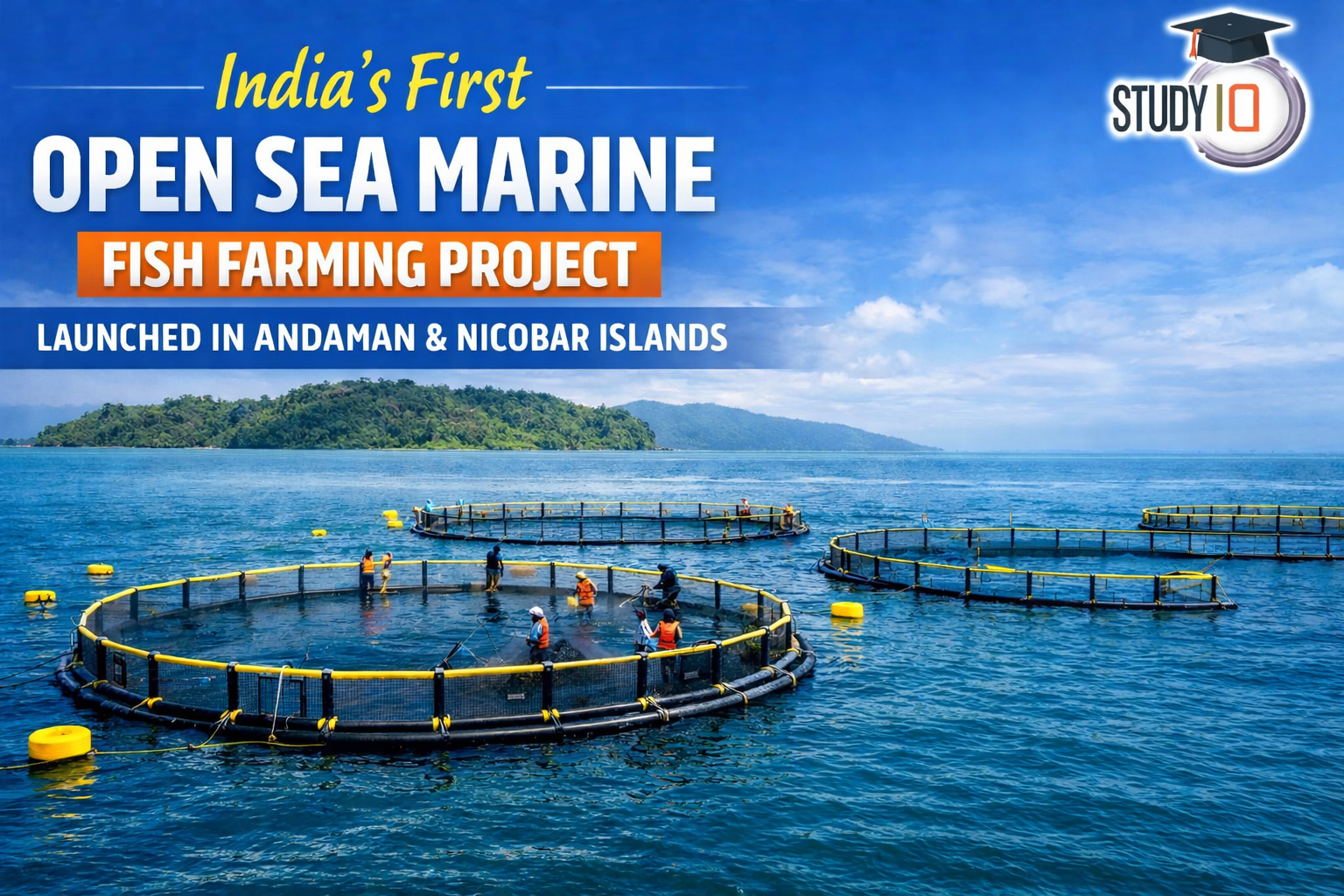
India has taken a historic step in strengthening its Blue Economy and sustainable fisheries sector with the launch of the country’s first-ever Open Sea Marine Fish Farming Project at North Bay, Sri Vijaya Puram, Andaman & Nicobar Islands. The project was inaugurated by Union Minister Dr. Jitendra Singh and marks a major shift from traditional coastal and pond-based aquaculture towards advanced offshore farming practices.
This initiative not only promotes scientific aquaculture in natural ocean conditions but also aims to generate sustainable livelihoods for coastal communities.
About India’s First Open Sea Marine Fish Farming Project
The project focuses on the open-sea cultivation of marine finfish and seaweed using innovative technologies in real oceanic conditions. It integrates:
-
Scientific research
-
Sustainable fisheries development
-
Livelihood generation for fishermen
-
Marine ecosystem conservation
Implementing Agencies
The project is being collaboratively implemented by:
-
Ministry of Earth Sciences (MoES)
-
National Institute of Ocean Technology (NIOT) (technical arm)
-
UT Administration of Andaman & Nicobar Islands
This collaboration ensures the blending of cutting-edge marine technology with local administrative support.
Key Components of the Project
1. Marine Flora Component (Seaweed Cultivation)
Under this component:
-
Deepwater seaweed cultivation in open sea is promoted.
-
Seaweed seeds are provided to local fishing communities.
-
It encourages:
-
Sustainable harvesting
-
Alternative income sources
-
Growth of the marine bio-economy
-
Seaweed has applications in:
-
Pharmaceuticals
-
Cosmetics
-
Food industry
-
Biofertilizers
-
Biofuels
2. Marine Fauna Component (Finfish Cage Farming)
This component focuses on:
-
Providing finfish seeds to fishermen.
-
Using open-sea cages developed by NIOT, specially designed to:
-
Withstand strong currents and waves
-
Function in natural oceanic environments
-
Enable large-scale fish cultivation
-
These cages allow fish to grow in a near-natural ecosystem while ensuring controlled farming.
What is Open Sea Cage Farming?
Open Sea Cage Farming, also known as Open Ocean Aquaculture or Offshore Aquaculture, is an emerging method where fish are reared in floating net cages placed in open sea waters. These cages allow:
-
Free flow of seawater
-
Natural oxygen supply
-
Healthy growth environment for fish
It represents a shift from land-intensive aquaculture to ocean-based sustainable food production.
Suitable Fish Species for Open Sea Cage Farming
Some ideal marine species for this type of farming include:
-
Sea Bass
-
Cobia
-
Pompano
These species:
-
Grow fast
-
Have high market demand
-
Thrive well in offshore cage environments
Benefits of Open Sea Cage Farming
1. Healthier and Faster Fish Growth
Fish grow in:
-
Natural currents
-
High oxygen levels
-
Clean seawater
This improves their overall health and quality.
2. Cost-Effective Infrastructure
-
Fabrication of cages is:
-
Faster
-
Simpler
-
Cheaper than onshore fish farms
-
3. Lower Initial Investment
-
Initial investment per unit of fish production is 30–40% lower than conventional pond aquaculture.
4. Efficient Use of Natural Water Bodies
-
Reduces pressure on limited land and freshwater resources.
-
Makes productive use of:
-
Open seas
-
Lagoons
-
Sheltered bays
-
5. Easy Expansion and Mobility
-
Cages can be:
-
Shifted easily
-
Expanded quickly
-
Installed at new locations without land acquisition
-
6. Faster and Easier Harvesting
-
Fish can be harvested:
-
Quickly
-
With less manpower
-
With minimal damage
-
7. Livelihood Generation for Fishing Communities
-
Provides:
-
Stable income
-
Skill development
-
Employment diversification
-
-
Reduces dependence on traditional capture fishing.
Significance for India’s Blue Economy
The project strongly supports:
-
Blue Economy Policy
-
Sustainable Development Goal 14 (Life Below Water)
-
Doubling fishermen’s income
-
Self-reliance in seafood production
It opens new avenues in:
-
Marine biotechnology
-
Export-oriented aquaculture
-
Climate-resilient food systems
Conclusion
India’s first Open Sea Marine Fish Farming Project is a game-changer in marine aquaculture. By combining scientific innovation, sustainable practices, and community participation, it strengthens India’s marine economy while protecting natural ecosystems. The Andaman & Nicobar Islands now stand as a model for future offshore aquaculture projects across India’s vast coastline.
 Shia Politics in India: History, Influen...
 Future of Chipmaking: Trends, Technologi...
 Nucleic Acid Testing (NAT): Meaning, Wor...











 WhatsApp





