
Table of Contents
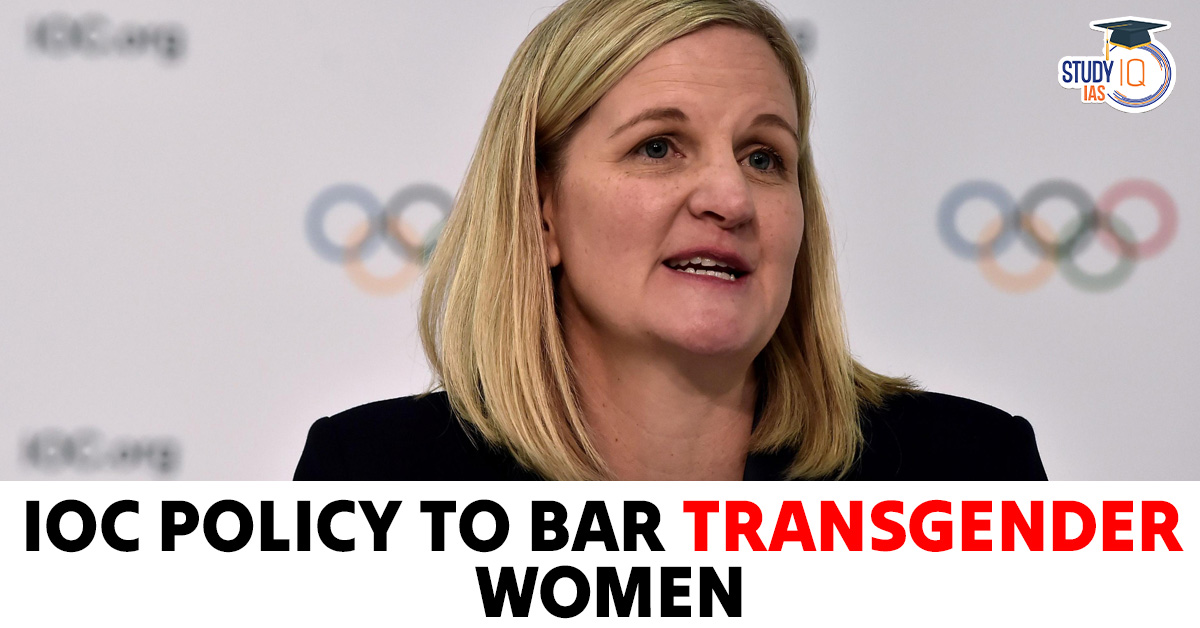
Context: The International Olympic Committee (IOC) has introduced a new policy restricting participation in women’s events to biological females. The Olympic Policy on Transgender Women will be implemented from the 2028 Olympic Games and aims to ensure fairness in competition.
Key Concepts
Difference between sex and gender
This distinction lies at the heart of the debate on sports eligibility.
- Sex refers to biological characteristics such as chromosomes and reproductive organs.
- Gender refers to a person’s identity, which may or may not match their biological sex.
Intersex and transgender athletes
Some individuals are intersex, meaning their biological traits do not fit typical male/female categories.
- Transgender athletes identify with a gender different from their birth sex.
- Their inclusion in women’s sports has raised questions of fairness and equality.
Key Features of the new IOC Policy
- Restriction based on biological sex: Only athletes classified as biological females can compete in women’s events.
- This excludes many transgender women and some intersex athletes.
- Focus on fair competition: The policy is based on the idea that biological differences may create unequal advantages in strength, speed, and endurance.
- It seeks to protect the integrity of women’s sports.
- Shift from earlier approach: Earlier, eligibility was often based on testosterone levels.
- The new approach places greater emphasis on biological sex instead of hormone levels.
Critical Analysis
- Fairness vs inclusion: One side argues that restrictions are needed for fair competition.
- The other side highlights the need for inclusion and equal opportunity for all athletes.
- Scientific uncertainty: Studies suggest testosterone may affect performance, but the exact impact is not fully clear.
- This creates uncertainty in setting uniform rules.
- Natural advantages debate: Critics question why some biological advantages (like height or lung capacity) are accepted, while others are restricted.
- It raises concerns about selective standards.
- Athlete-level controversies: Cases like Caster Semenya highlight disputes over eligibility rules for athletes with natural biological variations.
- Actions by other sports bodies: Several international federations have introduced restrictions or eligibility rules for transgender athletes.
- This indicates a broader global shift toward stricter participation norms.
Wider Implications
- Impact on international sports: The IOC policy is likely to influence global sports rules, as many organisations follow its guidance.
- Effect on grassroots participation: The policy may discourage participation of transgender individuals in local and amateur sports. This could reduce inclusivity in sports culture.
- Legal and ethical challenges: The policy may face challenges on grounds of equality, rights, and non-discrimination.
- Courts and human rights bodies may play a role in future decisions.
- Political and social debate: The issue has become part of a larger discussion on gender identity and rights worldwide.
- It reflects tensions between science, society, and law.
Possible Alternatives
| Open Category in Sports |
Sport-Specific Rules
|

 India’s Census 2027: World's Largest a...
 US-Israel-Iran Conflict: Iran’s Assert...
 Home Ministry’s AI Vision: Strategy, G...







 WhatsApp





