
Table of Contents
Context
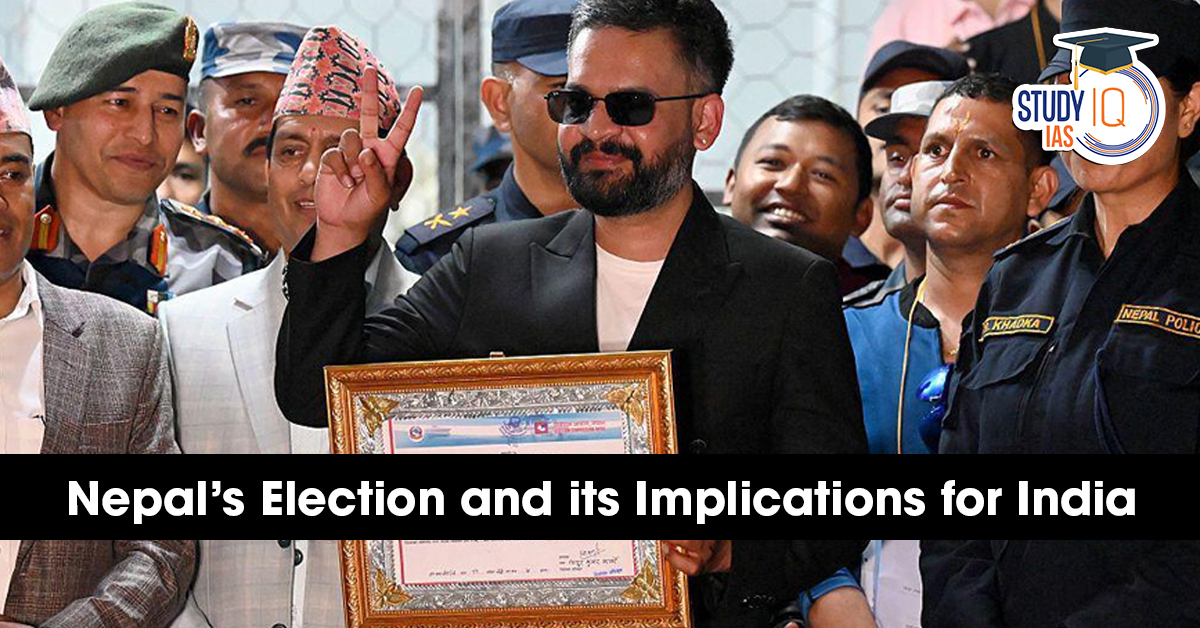
Nepal’s 2026 general election, held on 5 March 2026, marked a dramatic transformation in the country’s political landscape.
About the Election
- The elections were called after the 2025 Gen-Z protests forced the resignation of Prime Minister P. Sharma Oli and dissolved the parliament.
- Balendra “Balen” Shah of RSP party, a 35-year-old rapper-turned-politician and former Kathmandu mayor, surged ahead with a landslide lead, signalling a strong rejection of Nepal’s traditional political elite.
Key Features of the Political Shift in Nepal
- Rise of a New Political Force: The Rastriya Swatantra Party, founded only a few years ago, has emerged as the dominant force in the election, leading in a large number of constituencies. This reflects widespread public dissatisfaction with established parties such as the Nepali Congress and Communist parties, which have dominated Nepal’s politics for decades.
- Generational Political Change: The victory of Balen Shah represents a generational shift in Nepal’s politics. His popularity is largely driven by Gen-Z voters and urban youth, who mobilised through social media and grassroots campaigns demanding transparency, jobs, and political reform.
- Collapse of the Traditional Political Establishment: Many senior political leaders and former prime ministers have struggled in the election. The results indicate a collapse of Nepal’s old political order, which has long been criticised for corruption, nepotism, and political instability.
- Digital and Youth-Driven Campaign Strategy: Shah’s campaign relied heavily on digital mobilisation, diaspora funding, and grassroots engagement, marking a shift from traditional party-based campaigning to technology-driven politics.
Implications for India
- Uncertainty in India–Nepal Relations: India is closely watching the developments as the political transition could reshape India–Nepal diplomatic relations, which have experienced tensions in recent years over issues such as the Kalapani-Lipulekh territorial dispute and Nepal’s growing engagement with China.
- Strategic Balance between India and China: Nepal has historically balanced relations between India and China. A new leadership with a strong nationalist or reformist agenda may seek to recalibrate Nepal’s foreign policy, potentially affecting India’s strategic interests in the Himalayan region.
- Opportunity for Reset in Bilateral Relations: At the same time, the emergence of a new political leadership offers an opportunity for India to reset relations through economic cooperation, connectivity projects, and development partnerships.
- Security and Border Management: Nepal shares an open border with India, making political stability in Nepal important for security cooperation, migration management, and cross-border trade.
- Regional Geopolitics in South Asia: A major political transition in Nepal could also influence South Asian regional dynamics, especially as external powers such as China increase their engagement in the Himalayan region.
|
Read More Notes |
|
| Environment Notes | Art and Culture Notes |
| Science and Tech | History Notes |
| Geography Notes | Indian Polity Notes |
| General Knowledge | International Relation |
|
Explore StudyIQ Courses |
|
 Sinking of Iranian Warship IRIS Dena: Ca...
 U.S. 30-Day Waiver for India to Buy Russ...
 Upper Indravati Hydroelectric Project (U...










 WhatsApp





