
Table of Contents
Context
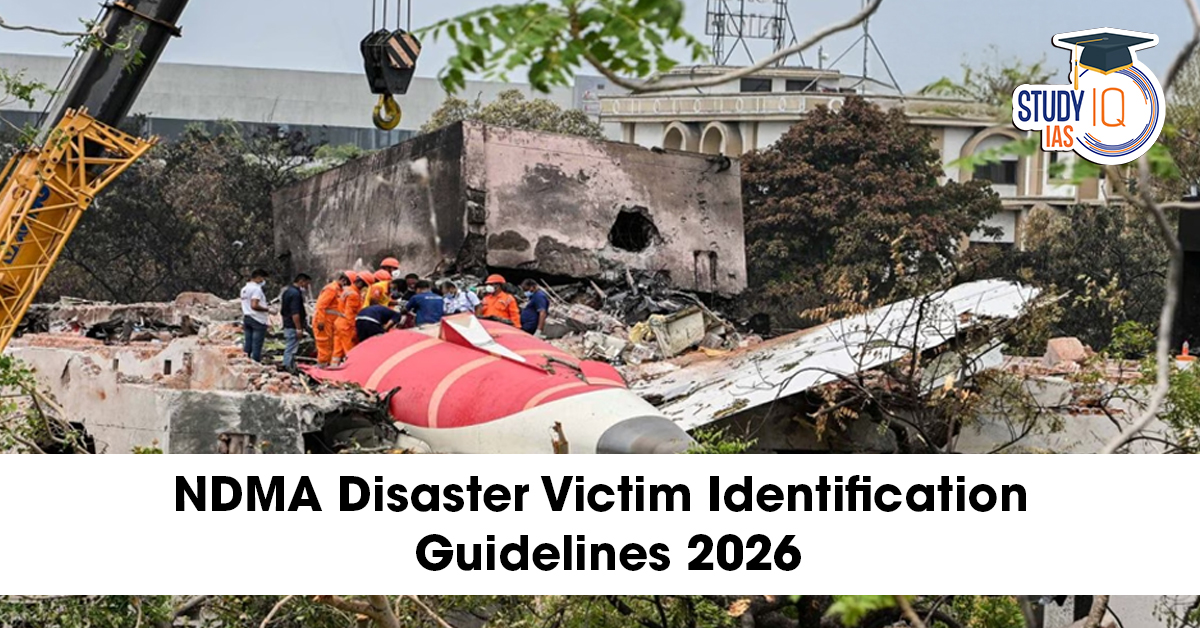
The National Disaster Management Authority (NDMA) recently unveiled the “National Disaster Management Guidelines on Comprehensive Disaster Victim Identification and Management.”-India’s first-ever Standard Operating Procedure (SOP) for managing Mass Fatality Incidents (MFIs).
About Disaster Victim Identification (DVI)
- DVI is a multi-disciplinary forensic and administrative process used to identify victims of Mass Fatality Incidents (MFIs) where traditional identification is impossible.
- Need for DVI
- Scientific Accuracy: DVI replaces error-prone visual identification with objective forensic methods (DNA, dental, fingerprints) to ensure reliability when remains are fragmented, charred, or decomposed.
- Legal Necessity: It provides the scientific proof required for official death certification, which is essential for settling insurance, inheritance, and government compensation claims.
- Humanitarian & Administrative Dignity: The process upholds the “Right to Dignity” after death, enabling families to find closure through proper last rites and facilitating the organized repatriation of victims across borders.
Core Objectives of NDMA Guidelines
- Scientific Accuracy: Utilizing forensic rigor to ensure zero-error identification.
- Human Dignity: Ensuring remains are handled with respect and according to cultural sensitivities.
- Inter-agency Synergy: Defining clear roles for police, medical professionals, and forensic experts to prevent jurisdictional chaos.
Four Stages of the DVI Process
The SOP adopts a globally recognized, linear workflow to ensure high-fidelity identification:
- Systematic Recovery: Methodical retrieval of remains from the disaster site.
- Post-Mortem (PM) Data: Recording physical, dental, and DNA profiles from the remains.
- Ante-Mortem (AM) Data: Collecting medical records, dental history, and personal identifiers from families of the missing.
- Reconciliation: Comparing PM and AM data to confirm identity before releasing remains.
Key Innovations and Features
- National Dental Data Registry: In a first for India, the NDMA emphasizes Forensic Odontology. Since teeth are highly resistant to fire and decay, a centralized dental registry will align India with Interpol DVI standards.
- Forensic Archaeology: The guidelines introduce specialized techniques for recovering remains from complex scenarios like landslides or long-term burials.
- Humanitarian Forensics: The SOP shifts the focus from “body counts” to “dignity.” It mandates sensitivity toward religious rites and provides for mandatory counseling for bereaved families.
Challenges Highlighted
- Operational Obstacles: Technical difficulties arise from the condition of remains, such as fragmentation, commingling (mixing of remains), and rapid decomposition due to India’s hot and humid climate. Specific disasters like fires (charring) and floods (displacement of bodies) further complicate recovery.
- Logistical Deficits: There is a critical shortage of modern mortuary space and “cold chain” infrastructure for the transport and storage of remains. Additionally, many incidents lack reliable passenger manifests or records, making identification difficult from the start.
- Institutional Gaps: India faces a shortage of specialized forensic experts. This is compounded by weak coordination between different agencies and leadership/command failures during large-scale, high-pressure disasters.
Suggested Measures
- Structural Reforms: Establish formal DVI organizational structures across the country and create specialized DVI teams in every State.
- Capacity Building: Launch large-scale training programs for experts in all forensic disciplines and fast-track the implementation of these guidelines on a “war footing.”
- Global Alignment: Adapt Interpol’s international best practices while tailoring them to suit unique Indian environmental and cultural conditions.
- Integrated Governance: Strengthen overall Disaster Risk Reduction (DRR) and post-disaster governance by blending advanced science and technology with core humanitarian values.
- Compliance: Ensure India meets international forensic standards to reinforce the credibility of its identification processes.
|
Read More Notes |
|
| Environment Notes | Art and Culture Notes |
| Science and Tech | History Notes |
| Geography Notes | Indian Polity Notes |
| General Knowledge | International Relation |
|
Explore StudyIQ Courses |
|
 World Meteorological Day 2026: Theme, Hi...
 Water Governance in India, Current Crisi...
 World Bear Day 2026: Date, Theme, Histor...







 WhatsApp





