
Table of Contents
Context
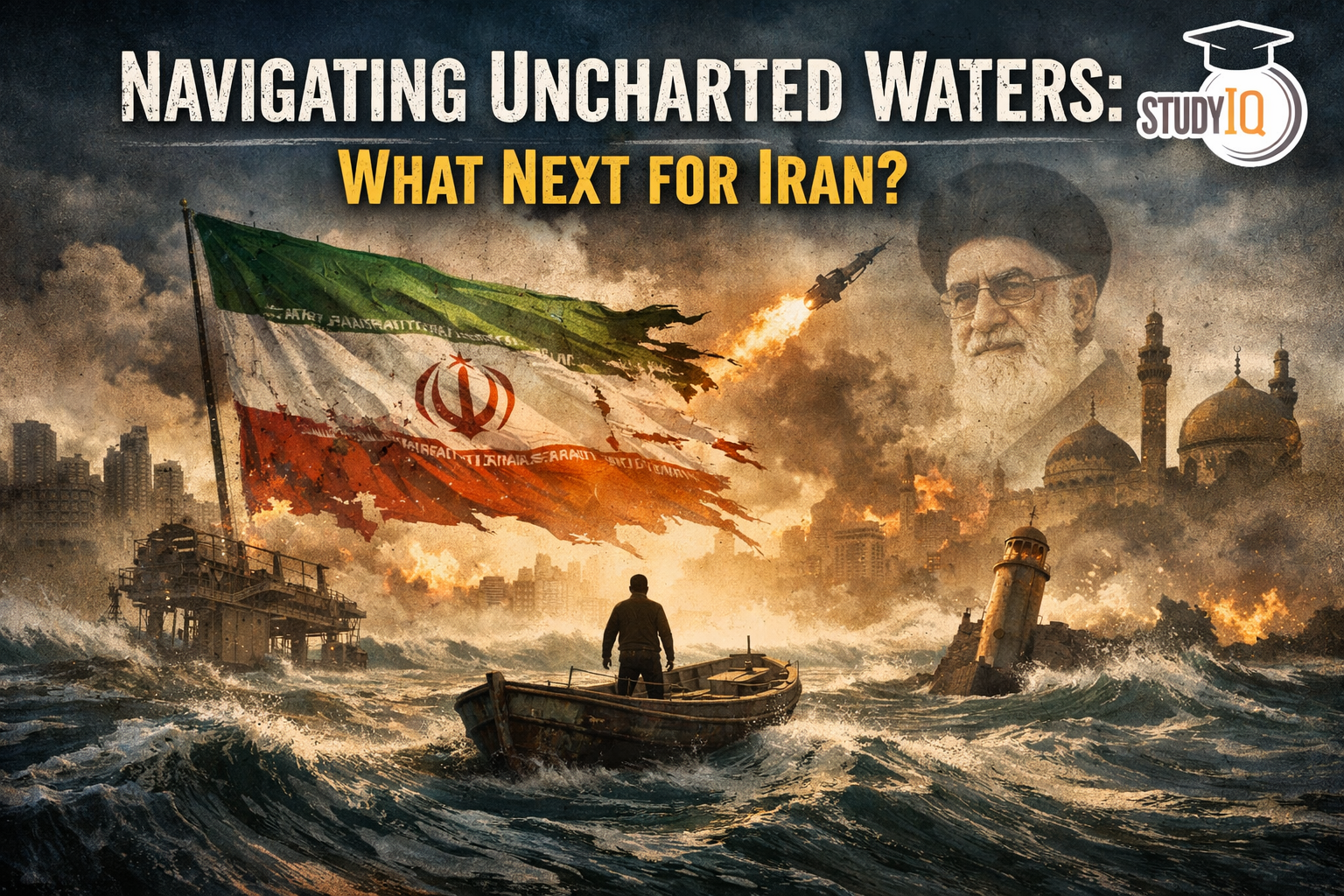
- The assassination of Supreme Leader Ayatollah Ali Khamenei in joint U.S.–Israeli strikes marks the most dramatic rupture in Iran’s post-revolutionary history. Khamenei’s death has accelerated an ongoing crisis that entwines leadership succession, internal security, regional conflict, and global strategic dynamics — creating one of the most unpredictable moments in West Asian geopolitics.
Centrality of Khamenei in Iran’s Political System
- Foundational Authority Since 1989: Khamenei succeeded Ayatollah Ruhollah Khomeini and consolidated power. As Supreme Leader, he was the final arbiter on foreign and domestic policy — a central node in Iran’s theocratic state.
- Architect of Regional Strategy: Under his tenure, Iran became a principal opponent of the U.S. and Israel, building the so-called “Axis of Resistance” with proxy groups (Hezbollah, militias in Iraq and Syria, and the Houthis in Yemen) that expanded Tehran’s influence across the region.
- IRGC Empowerment and Structural Dominance: Khamenei elevated the Islamic Revolutionary Guard Corps (IRGC) into a dominant force. The IRGC not only suppressed dissent but also directed major aspects of Iran’s missile and drone programmes.
- Repression as Regime Stability Tool: Decades of harsh internal repression — including violent crackdowns on protests, restrictions on freedoms, and the longest internet blackout in Iranian history — were hallmarks of his rule.
- Symbolic and Psychological Centrality: Khamenei embodied the Islamic Revolution’s ideological continuity. His sudden removal not only disrupts institutional authority but also the psychological cohesion that kept the system unified.
Internal Scenarios for Iran’s Future
- Regime Continuity Through Institutional Mechanisms: The Iranian constitution assigns the task of choosing a new Supreme Leader to the Assembly of Experts, an 88-member clerical body. In the immediate aftermath, an interim leadership council, including the president, judiciary head, and senior clerics — is handling governance to avoid power vacuum.
- Power Rebalancing and Elite Bargains: Potential successors include judiciary head Gholam-Hossein Mohseni-Eje’i, cleric Hassan Khomeini, and political figures like Ali Larijani. These figures reflect different elite factions — hardliners, pragmatic conservatives, and regime loyalists — competing for influence.
- IRGC Consolidation: Rather than a traditional coup, the IRGC may secure greater power by shaping the succession process and ensuring strategic continuity.
- Regime Collapse — Low Probability but High Stakes: A full collapse would require major splits in elite cohesion and effective opposition mobilisation — conditions not currently evident. The lack of a unified opposition and the IRGC’s grip on security mitigate this risk in the near term.
- Civil Unrest and Validity Crisis: Deep social discontent, especially following repeated violent crackdowns and economic woes, means the regime faces a long-term legitimacy crisis that could erupt if economic hardship and conflict persist.
Regional Escalation and Expanding Conflict
- Broader Conflict with U.S. and Israel: Iran has retaliated with missiles and drones against Israeli territory and U.S. military bases in Gulf states including Qatar, UAE, Bahrain, and Kuwait, expanding the conflict beyond the core strike zone.
- Proxy Network Activation: Iran’s allied militias in Lebanon (e.g., Hezbollah), Iraq, and the Red Sea region are poised to engage adversaries, creating multiple fronts of conflict.
- Gulf States’ Strategic Dilemma: Gulf monarchies — historically neutral or balancing relations with Iran — now face the impossible choice of entering the war or maintaining distance while within missile range, a dilemma that may reshape Gulf Cooperation Council (GCC) dynamics.
- Broader Middle East Instability: Escalation risks triggering wider hostilities involving Iraq, Syria, and Yemen, potentially creating a theatre resembling a regional conflict rather than isolated skirmishes.
- Diplomatic Breakdown: Iran’s declaration that the U.S. crossed a “red line” and its warning to Gulf hosts of American forces highlight the collapse of diplomatic engagement and rise of retaliatory postures.
The Strait of Hormuz: Iran’s Strategic Lever
- Key Energy Chokepoint: The Strait of Hormuz is a narrow shipping lane through which nearly 20% of global crude oil and significant volumes of LNG pass, making it a global energy artery.
- Economic Coercion Tool: Even partial disruption of traffic forces global oil prices higher, exerting macroeconomic pressure on economies dependent on energy imports.
- Inflation and Cost-of-Living Risks: Surging energy prices have immediate inflationary effects on fuel, transport, and production costs worldwide — a replay of earlier 1970s–2020s energy shocks.
- Naval Confrontation Potential: S. and allied naval forces may be compelled to secure shipping routes, raising the risk of direct naval clashes with the IRGC navy in the chokepoint
- Global Market Volatility: Financial markets are already exhibiting volatility due to fears of prolonged supply disruptions, with Brent crude and WTI benchmarks reacting sharply to developments.
Implications for the Global Order
- Multipolar Stress Test: The crisis intersects with other global conflicts (e.g., Ukraine), testing the resilience of international governance and crisis management mechanisms.
- S. Strategic Dilemmas: Washington must balance military escalation with domestic and global constraints — overextension could weaken U.S. influence across other theatres.
- Israel’s Strategic Aims: Israel’s direct involvement signals its intent to degrade Iran’s military infrastructure and reduce nuclear and missile threats, rather than simply deter them.
- Great Power Responses: China condemned the killing of Khamenei as a violation of sovereignty, while European actors call for de-escalation — underscoring a divided global reaction that complicates unified diplomacy.
- Proxy Entanglements: Shifts in alliances and proxy engagements could redraw regional alignments, making the Middle East less predictable and more fragmented.
Strategic Implications for India
- Energy Security Vulnerability: India imports about 60% of its energy from the Middle East; disruptions in Hormuz could spike import bills and inflation.
- Diaspora Protection: India’s ~9 million nationals in Gulf and West Asia face growing risks from cross-border hostilities, hastening evacuation and consular challenges.
- Remittance Flows at Risk: With ~38% of India’s remittances coming from Gulf workers, prolonged instability could reduce foreign income and impact rural economies.
- Diplomatic Tightrope: India must balance its relations with the U.S. and Israel, Gulf partners, and Iran — a delicate exercise in strategic autonomy.
- Maritime Security Posture: The Indian Navy may need enhanced presence near the Arabian Sea and Gulf to secure trade routes and protect Indian interests.
|
Read More Notes |
|
| Environment Notes | Art and Culture Notes |
| Science and Tech | History Notes |
| Geography Notes | Indian Polity Notes |
| General Knowledge | International Relation |
|
Explore StudyIQ Courses |
|
 Astronaut Reentry Explained: How Spacecr...
 Missile Interceptors Explained: Role in ...
 World Wildlife Day 2026: Theme, Signific...











 WhatsApp





