
Table of Contents
Context
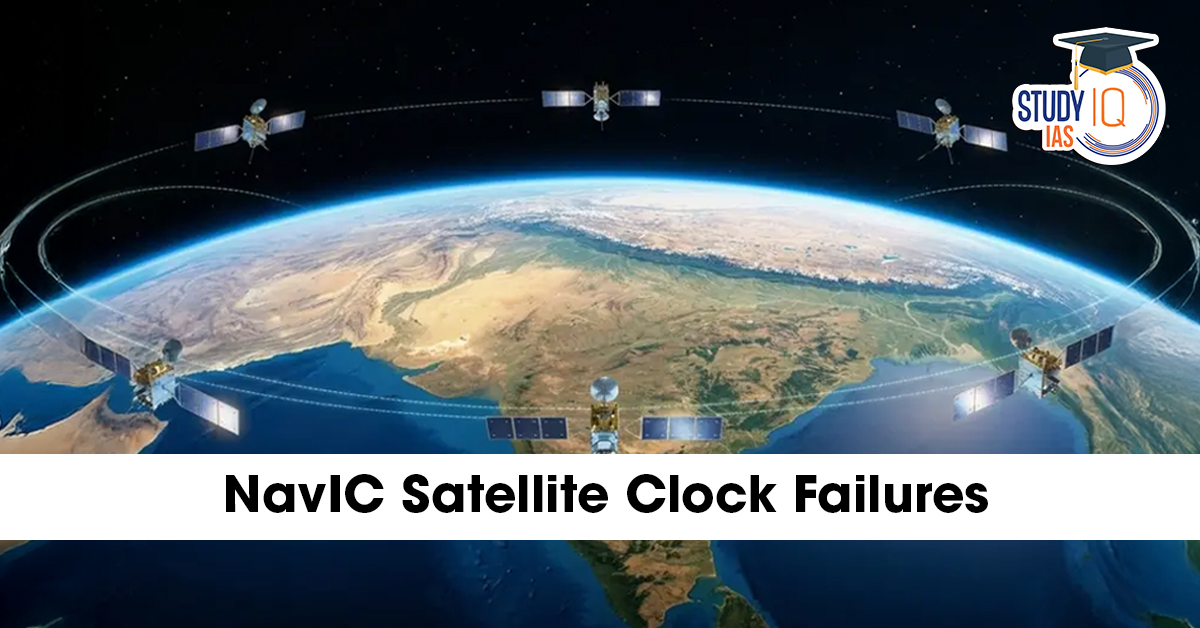
India’s regional navigation system, NavIC, faces a critical operational challenge as the atomic clock on the IRNSS-1F satellite failed and the replacement satellite NVS-02 failed to reach its intended orbit.
About NavIC
- What it is: The Indian Regional Navigation Satellite System (IRNSS), commercially known as NavIC (Navigation with Indian Constellation).
- Constellation: Originally planned with 7 satellites (3 in Geostationary and 4 in Geosynchronous orbits).
- Coverage: Designed to provide accurate position information service to users in India as well as regions extending up to 1500 km from its boundary.
- Frequency Bands:Standard Series: L5 and S-band.
- New Generation (NVS): Adds the L1 band (interoperable with GPS).
- Accuracy: Better than 10 meters over India (designed to be more accurate than GPS over the specific region).
|
Global Navigation Systems |
| NavIC is a regional system, unlike the four global systems:
1. GPS (USA) 2. GLONASS (Russia) 3. Galileo (European Union) 4. BeiDou (China) ● Regional Counterparts: India’s NavIC and Japan’s QZSS (Quasi-Zenith Satellite System). |
About Atomic Clocks
- An atomic clock is a highly precise timekeeping device that uses the resonant frequencies of atoms (usually Cesium or Rubidium) as a “metronome” to measure time.
- Unlike a mechanical clock that uses a pendulum, or a digital watch that uses a vibrating quartz crystal, an atomic clock relies on the fundamental and unchanging properties of nature.
- Satellites provide positioning data by measuring the time it takes for a signal to travel. Even a billionth of a second error can lead to a kilometer-level mistake in location.
| Type | Characteristics | Use Case |
| Cesium Fountain | Most accurate; large and complex. | Primary standard for “Universal Coordinated Time” (UTC). |
| Rubidium Clock | Smaller, cheaper, slightly less accurate. | Used on NavIC and GPS satellites. |
| Hydrogen Maser | Extremely stable over short periods. | Used in Radio Astronomy (Deep Space Network). |
| Optical Clocks | Use light instead of microwaves; 100x more accurate than Cesium. | Future of timekeeping (currently in research). |
|
Read More Notes |
|
| Environment Notes | Art and Culture Notes |
| Science and Tech | History Notes |
| Geography Notes | Indian Polity Notes |
| General Knowledge | International Relation |
|
Explore StudyIQ Courses |
|
 Bharat Audyogik Vikas Yojana (BHAVYA Sch...
 Rare Earth Elements (REE) Sites in India...
 Gynandromorphy in Vela carli: Rare Spide...






 WhatsApp





