
Table of Contents
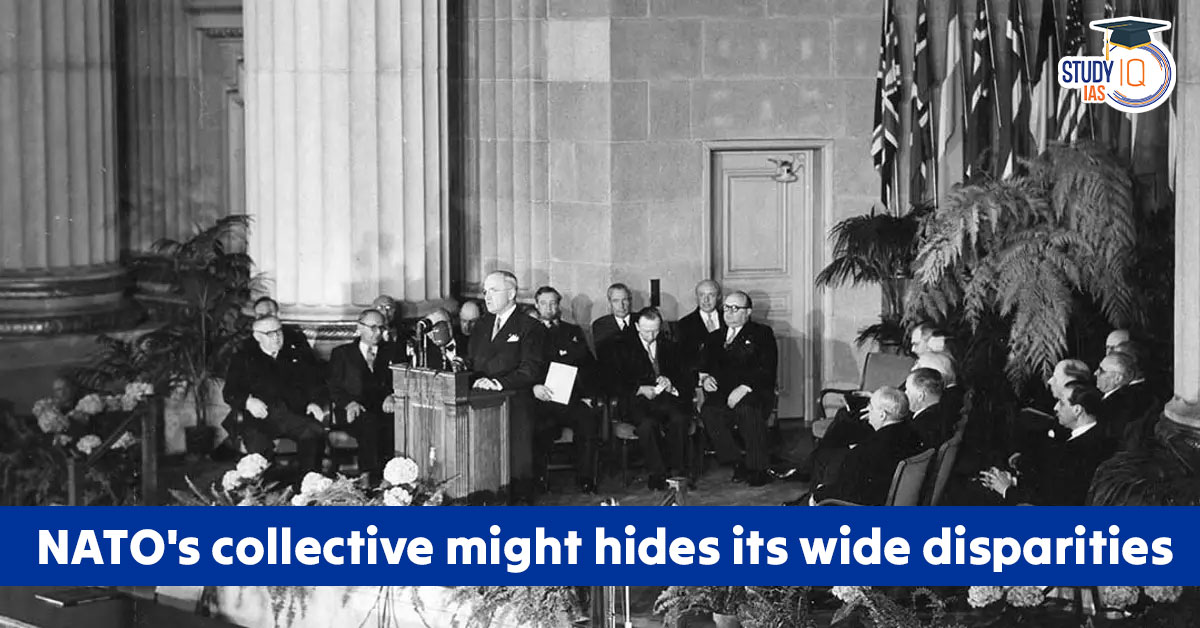
NATO is often projected as the world’s most powerful and cohesive military alliance. With 32 member countries, advanced weapon systems, and a history of successful deterrence, it symbolizes collective security. However, behind this image of unity lies a stark reality: NATO’s strength is overwhelmingly dependent on the United States. Its so-called “collective might” masks deep economic, military, and strategic disparities among its members.
This imbalance has serious implications for global geopolitics, European security, and the future credibility of the alliance.
NATO: An Alliance with Unequal Pillars
The North Atlantic Treaty Organization (NATO) was established in 1949 with three major objectives:
-
To deter Soviet expansionism
-
To prevent the revival of militaristic nationalism in Europe
-
To promote political and strategic integration among Western nations
While NATO achieved these goals during the Cold War, the internal structure of power gradually became highly asymmetric. Today, NATO functions less like an equal partnership and more like a system anchored by a single superpower.
Economic Disparities: The US vs the Rest of NATO
The economic foundation of military power reveals the depth of inequality inside NATO.
-
In 2014:
-
US GDP: ~$17.6 trillion
-
Rest of NATO combined: ~$20.5 trillion
-
-
By 2025:
-
The US economy alone became larger than the combined GDP of all other NATO members
-
The US economy now exceeds the rest of NATO by around 13%
-
Over the last decade:
-
The US added about $13 trillion to its GDP
-
The rest of NATO together added only about $6 trillion
This shows that NATO’s growing economic strength is not collective; it is largely American. Europe’s economic stagnation, especially in major economies like Germany and the UK, has weakened its ability to independently sustain large-scale military power.
Military Spending: America as NATO’s Backbone
The imbalance becomes even more visible in defence expenditure.
-
The US accounts for:
-
Nearly 70% of NATO’s total military spending
-
About 40% of NATO’s total military personnel
-
Even though NATO members pledge to spend 2% of GDP on defence:
-
In absolute terms, European contributions remain far smaller than the US
-
America spends significantly more per soldier, per aircraft, and per operation
This gives the US:
-
Dominance in strategic planning
-
Greater command influence
-
Control over advanced capabilities like missile defence, cyber warfare, intelligence, and logistics
In practical terms, NATO’s operational strength is built on American infrastructure.
Per Capita Power Gap
Economic inequality also reflects at the societal level:
-
The average American citizen is roughly twice as economically prosperous as the average citizen of other NATO countries.
-
This translates into:
-
Higher tax capacity
-
Greater tolerance for defence spending
-
Better long-term sustainability of military commitments
-
Thus, US dominance is not only national but also societal.
Burden-Sharing: A Persistent NATO Dilemma
One of the most persistent problems in NATO is unequal burden-sharing.
European countries depend heavily on the US for:
-
Nuclear deterrence
-
Intelligence and surveillance
-
Strategic airlift
-
Missile defence systems
This creates political friction:
-
American leaders often question why US taxpayers should shoulder Europe’s defence
-
This tension was visible during Donald Trump’s presidency but exists across political lines
NATO’s credibility becomes vulnerable to shifts in US domestic politics.
Greenland Example: Symbol of Power Asymmetry
Discussions about Greenland’s strategic importance underline NATO’s internal power hierarchy:
-
Greenland belongs to Denmark, a NATO member
-
Yet its strategic value is primarily defined by US military interests
-
This highlights how even sovereign NATO allies can become secondary actors in strategic decision-making
It reflects how NATO’s internal diplomacy is shaped by power disparities.
Why “Collective Might” is Misleading
NATO appears powerful because:
-
It aggregates multiple countries
-
It represents a vast geographic and demographic span
But in reality:
-
One country supplies:
-
The majority of funding
-
The majority of military hardware
-
The global operational reach
-
Strategic leadership
-
So NATO is less:
“32 equal partners”
and more:
“One superpower with many dependent allies.”
Strategic Implications
1. NATO’s Stability Depends on the US
If American political will weakens, NATO’s deterrence collapses rapidly.
2. Europe’s Strategic Vulnerability
Europe lacks:
-
Strategic autonomy
-
Independent nuclear deterrence capacity (except France)
-
Full-spectrum military readiness
3. Opportunities for Rivals
Russia and China can exploit:
-
NATO’s internal imbalance
-
Political divisions inside the US
-
European dependence on American power
What the Future Demands
For NATO to remain credible:
-
Europe must invest more in:
-
Defence industries
-
Joint military capabilities
-
Strategic autonomy
-
Otherwise, NATO risks becoming:
A military alliance in name, but a US security umbrella in practice.
Conclusion
NATO’s “collective might” hides a fundamental reality: the alliance is structurally unequal. The United States dominates its economy, military power, strategic vision, and global reach. While NATO remains formidable, its power is not truly collective. It is centralized.
Until this imbalance is addressed, NATO will continue to be strong in appearance, but fragile in political sustainability.
 Navigating Uncharted Waters: What Next f...
 Astronaut Reentry Explained: How Spacecr...
 Missile Interceptors Explained: Role in ...











 WhatsApp





