
Table of Contents
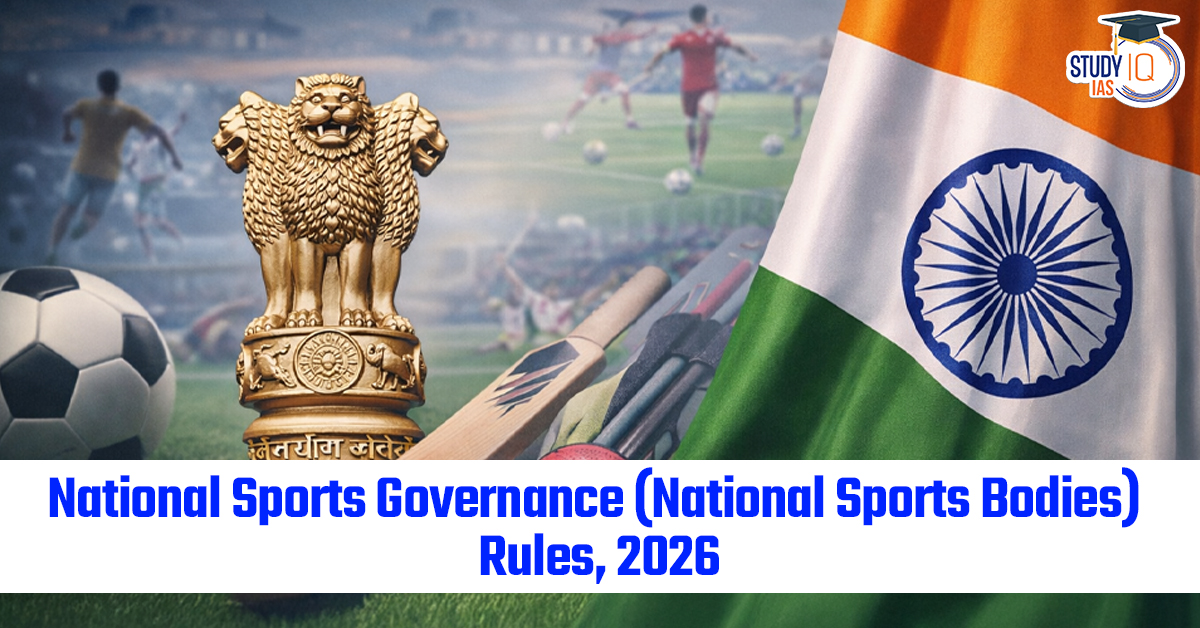
The notification of the National Sports Governance (National Sports Bodies) Rules, 2026 under the National Sports Governance Act, 2025 marks a major reform in India’s sports administration. These Rules seek to institutionalise transparency, professionalism, inclusivity and athlete-centric governance by clearly defining the structure, composition, election procedures and accountability mechanisms of National Sports Bodies and Regional Sports Federations.
Background: National Sports Governance Act, 2025
The Act provides the statutory foundation for modernising sports governance in India.
Its core objective is to ensure:
-
Professional management
-
Financial transparency
-
Democratic functioning
-
Athlete-first governance
It establishes and regulates:
-
National Olympic Committee
-
National Paralympic Committee
-
National Sports Federations
-
Regional Sports Federations
All bodies are mandated to follow uniform governance norms in line with both national priorities and international sporting standards.
Purpose of the National Sports Governance Rules, 2026
The Rules operationalise the 2025 Act by laying down:
-
Institutional framework for governance
-
Composition of decision-making bodies
-
Election procedures
-
Disqualification norms
-
Registration and monitoring mechanisms
They aim to eliminate arbitrariness and ensure predictable, rule-based functioning of sports institutions.
Composition of Sports Bodies
General Body
The Rules mandate that every National Sports Body must have a democratically constituted General Body.
Key provisions include:
-
Inclusion of at least four Sportspersons of Outstanding Merit (SOMs)
-
50% of SOMs must be women, ensuring gender balance
-
Representation of athletes as decision-makers rather than mere participants
This is a major step towards athlete empowerment and inclusive governance.
Executive Committee
The Executive Committee functions as the main policy-implementing authority.
It is required to:
-
Reflect balanced representation
-
Include athletes and women members
-
Operate under clearly defined roles and tenure limits
This prevents concentration of power and promotes collective decision-making.
Sportspersons of Outstanding Merit (SOMs): Institutional Recognition
The Rules formally integrate athletes into governance by:
-
Guaranteeing minimum representation in the General Body
-
Making women athletes central to governance structures
-
Shifting from administrator-dominated to athlete-driven governance
This aligns with global best practices seen in bodies like the IOC.
Election Reforms and Democratic Functioning
The Rules provide for:
-
Transparent and time-bound elections
-
Clear eligibility and disqualification criteria
-
Independent monitoring of election processes
National Sports Election Panel
A new institutional mechanism is created:
-
The National Sports Election Panel
-
Responsible for supervising and validating elections
-
Ensures impartiality, fairness and compliance with statutory norms
This addresses long-standing concerns of manipulation and conflict of interest in sports elections.
Registration and Updating of Affiliate Units
The Rules mandate:
-
Mandatory registration of all affiliate units with the National Sports Board
-
Periodic updating of records
-
Maintenance of transparency in membership and affiliations
This creates a reliable national database of sports institutions and prevents fake or inactive bodies from influencing governance.
Disqualification and Ethical Governance
The Rules lay down disqualification criteria to:
-
Prevent conflicts of interest
-
Check financial irregularities
-
Stop monopolisation of power
-
Ensure moral and administrative integrity
This strengthens credibility and accountability of sports institutions.
Alignment with International Standards
The Rules harmonise Indian sports governance with:
-
International Olympic Committee (IOC) principles
-
International federation norms
-
Global best practices in sports administration
This improves India’s standing in international sports governance.
Significance of the 2026 Rules
Promotes Athlete-Centric Governance
For the first time, athletes become structural participants in decision-making.
Strengthens Gender Equality
Mandatory 50% representation of women SOMs marks a progressive shift.
Enhances Transparency
Election oversight, registration systems and financial discipline reduce corruption.
Professionalises Sports Administration
Clear rules reduce arbitrariness and political interference.
Builds Trust in Institutions
Predictable and accountable governance increases public and athlete confidence.
Challenges in Implementation
-
Resistance from existing power structures
-
Capacity building of athletes for governance roles
-
Need for strict enforcement mechanisms
-
Coordination between Centre, states and federations
Way Forward
-
Training programmes for athlete-administrators
-
Digital governance platforms
-
Independent audit and monitoring systems
-
Public disclosure of governance and financial reports
Conclusion
The National Sports Governance (National Sports Bodies) Rules, 2026 represent a paradigm shift in India’s sports administration. By embedding transparency, democracy, athlete participation and gender equality into institutional structures, the Rules move Indian sports governance from personality-driven control to rule-based professionalism. If implemented effectively, they can transform India’s sporting ecosystem into a truly modern, inclusive and globally credible system.
Sharing is caring!
 Navigating Uncharted Waters: What Next f...
 Astronaut Reentry Explained: How Spacecr...
 Missile Interceptors Explained: Role in ...








 WhatsApp





