
Table of Contents
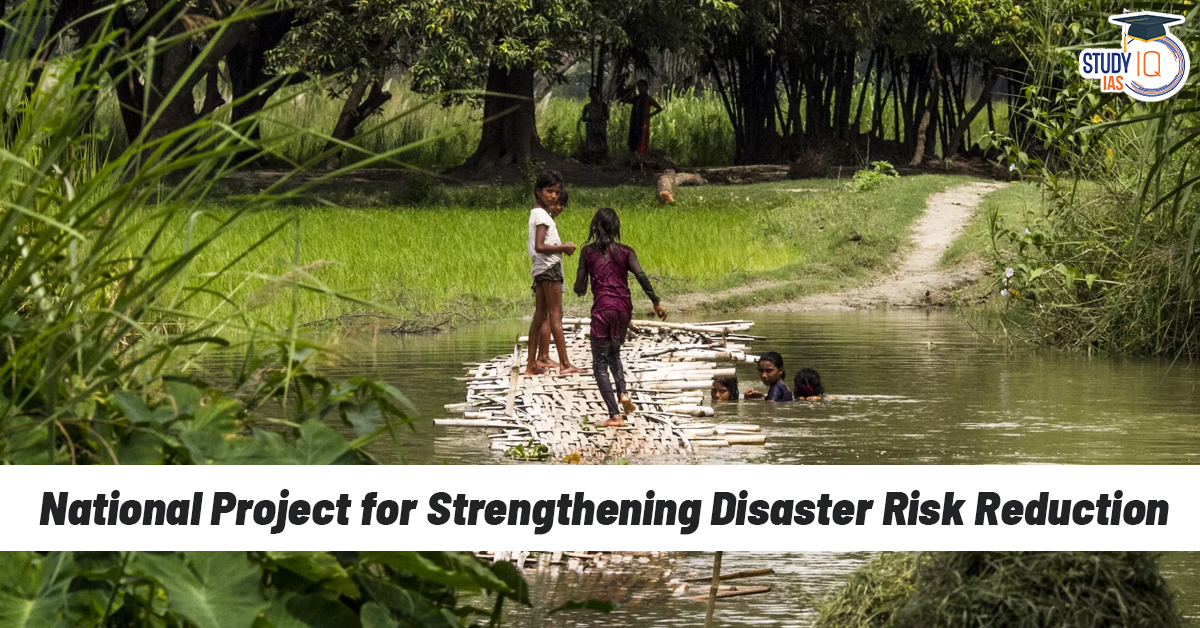
The National Project for Strengthening Disaster Risk Reduction (DRR) is a major initiative approved by the Ministry of Panchayati Raj (MoPR) in partnership with the National Disaster Management Authority (NDMA) to enhance community-based disaster resilience at the grassroots level. With a total financial outlay of ₹507.37 crore, the project aims to integrate disaster risk reduction into local governance and development planning through Panchayati Raj Institutions (PRIs).
Announced in December 2025, the project seeks to create cluster-based Model Gram Panchayats across disaster-prone regions of India, showcasing long-term mitigation strategies and strengthening preparedness against natural hazards such as floods, cyclones, droughts, earthquakes, and landslides.
Objectives of the National DRR Project
The project is designed to achieve the following objectives:
-
Mainstream Disaster Risk Reduction (DRR) into Panchayat-level planning
-
Strengthen the institutional capacity of Panchayati Raj Institutions
-
Promote community participation and ownership in disaster management
-
Develop replicable, disaster-resilient Gram Panchayat models
-
Improve coordination between local, district, and state-level authorities
Financial Outlay and Coverage
Budget Allocation
-
Total Outlay: ₹507.37 crore
Geographic Scope
-
20 States
-
81 disaster-prone districts
-
20 Gram Panchayats per district cluster
-
20 Model Gram Panchayats (one in each State)
The project focuses on districts that face recurrent and high-intensity disasters, ensuring targeted interventions where vulnerability is highest.
Concept of Model Gram Panchayats
A key innovation of the project is the creation of Model Gram Panchayats that function as demonstration units for effective disaster mitigation.
Key Features:
-
One Model GP per State
-
Hazard-specific focus (e.g., flood, cyclone, drought, earthquake, landslide)
-
Long-term, end-to-end mitigation planning
-
Disaster-proofing of infrastructure and services
-
Scalable and replicable for adoption by other Panchayats
States can later replicate these models using State Disaster Mitigation Funds (SDMFs).
Hazard-Specific Disaster Mitigation Approach
The project adopts a multi-hazard framework, addressing region-specific risks such as:
-
Floods and Flash Floods
-
Cyclones and Coastal Erosion
-
Droughts
-
Earthquakes
-
Landslides
-
Ecosystem-based hazards
This ensures that mitigation strategies are locally relevant and scientifically grounded.
Cluster-Based Implementation Strategy
To maximise impact, the project follows a cluster-based approach, where:
-
Gram Panchayats are geographically contiguous
-
Mitigation outcomes are visible and measurable
-
Resources and expertise are shared efficiently
-
Disaster-resilient practices spread organically across Panchayats
This approach enhances both efficiency and sustainability.
Institutional Strengthening and Capacity Building
A major pillar of the project is capacity building at all levels:
-
Training of elected Panchayat representatives
-
Capacity enhancement of Panchayat functionaries
-
Skill development for master trainers and community volunteers
-
Awareness generation through Information, Education and Communication (IEC) campaigns
These measures aim to create permanent institutional capacity at the grassroots level.
Role of Digital Platforms
The Ministry of Panchayati Raj will leverage its digital platforms to support disaster planning and monitoring:
-
eGramSwaraj – integration of disaster management planning and expenditure tracking
-
Gram Manchitra – spatial planning and risk mapping
-
Real-time data sharing and decision-support tools for Panchayats
Digital integration will improve transparency, accountability, and coordination.
Integration with Panchayat Development Planning
The project builds upon the Disaster Management Plan of MoPR (DMP-MoPR) released in March 2022.
Key integrations include:
-
Preparation of Village- and Panchayat-level Disaster Management Plans
-
Alignment with Gram Panchayat Development Plans (GPDPs)
-
Mainstreaming DRR into routine development activities
This ensures disaster resilience is not treated as a separate function but as a core governance responsibility.
Significance of the National DRR Project
Governance Impact
-
Strengthens local self-government
-
Improves last-mile disaster preparedness
Social Impact
-
Protects lives and livelihoods
-
Builds community confidence and awareness
Economic Impact
-
Reduces disaster-related losses
-
Promotes cost-effective mitigation over post-disaster relief
Conclusion
The National Project for Strengthening Disaster Risk Reduction marks a paradigm shift in India’s disaster management strategy by placing Panchayati Raj Institutions and communities at the centre of resilience-building. By combining local planning, digital governance, capacity building, and hazard-specific mitigation, the project lays the foundation for a resilient rural India capable of withstanding future disasters.
 Shaheed Diwas 2026: History, Significanc...
 Mahad Satyagraha 1927, History and Signi...
 Punjab–Rajasthan River Dispute: Raviâ€...











 WhatsApp





