
Table of Contents
Context
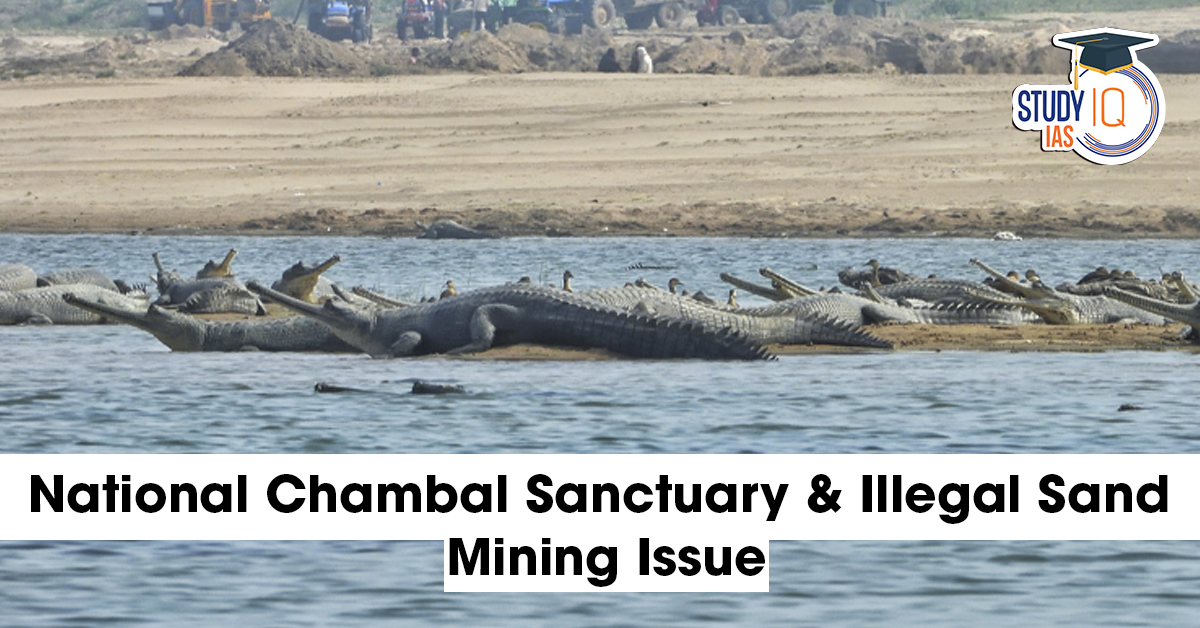
The Supreme Court has taken suo motu cognisance of rampant illegal sand mining in the National Chambal Sanctuary, emphasizing the threat to the critically endangered gharials and the river’s lotic ecosystem.
National Chambal Sanctuary
- Location: Situated at the trijunction of Rajasthan, Madhya Pradesh, and Uttar Pradesh.
- Jurisdiction: It is India’s first and only tri-state riverine protected area.
- Length: Covers a 600-km stretch of the 960-km Chambal River.
- Eco-Sensitive Zone: Notified to protect the fragile riverine habitat.
- Key Biodiversity: The sanctuary is a “lotic” (moving water) ecosystem and serves as a vital breeding spot for several threatened species:
- Gharials (Gavialis gangeticus): Critically Endangered (IUCN). It is the primary habitat for this fish-eating crocodile.
- Gangetic River Dolphins: Endangered (IUCN); India’s National Aquatic Animal.
- Red-Crowned Roof Turtle: Critically Endangered.
- Other Fauna: Marsh Crocodile (Muggers), Smooth-coated Otters, Indian Skimmer (Vulnerable), Sarus Crane, and Black-necked Storks.
- Threats
- Habitat Destruction: Mining destroys the sand banks which are essential nesting sites for gharials and turtles.
- River Morphology: It alters the river’s flow, degrades water quality, and reduces the water-retaining capacity of the riverbed.
- Ecological Impact: Even in areas where the government has attempted to “relocate” gharials for safety, the mining mafia has encroached upon the new habitats.
- Seasonal Aggravation: Unlike other rivers, the Chambal’s sand banks remain exposed nearly year-round due to low rainfall/floods, allowing the “sand mafia” to operate throughout the year.
CROCODILES OF INDIA
| Feature | Gharial | Mugger (Marsh) | Saltwater (Estuarine) |
| IUCN Status | Critically Endangered | Vulnerable | Least Concern |
| WPA 1972 | Schedule I | Schedule I | Schedule I |
| Physical Feature | Long, thin snout; males have a bulbous “Ghara” at the tip. | Broad snout; looks most like a typical crocodile. | Largest reptile on Earth; very broad snout. |
| Primary Habitat | Clean, deep flowing rivers (Freshwater only). | Lakes, rivers, and even man-made tanks/reservoirs. | Brackish water, mangroves, and coastal areas. |
| Key Locations | Chambal River (stronghold), Girwa, Gandak, and Son rivers. | Found across India (e.g., Vishwamitri River, Gujarat). | Bhitarkanika (Odisha), Sundarbans, and A&N Islands. |
| Diet | Primarily Piscivorous (Fish-eater). | Opportunistic (Fish, birds, mammals). | Apex predator (Will hunt anything, including sharks). |
|
Read More Notes |
|
| Environment Notes | Art and Culture Notes |
| Science and Tech | History Notes |
| Geography Notes | Indian Polity Notes |
| General Knowledge | International Relation |
|
Explore StudyIQ Courses |
|
 The Transgender Persons (Protection of R...
 WASH (Water, Sanitation, and Hygiene) Se...
 Vairamuthu Wins Jnanpith Award 2026: Tam...






 WhatsApp





