
Table of Contents
Context
American scientist Toby Kiers has been awarded the Tyler Prize for Environmental Achievement for her pioneering research that reveals how vast underground fungal networks regulate plant health, nutrient exchange, and Earth’s climate systems.
About Mycorrhizal Systems
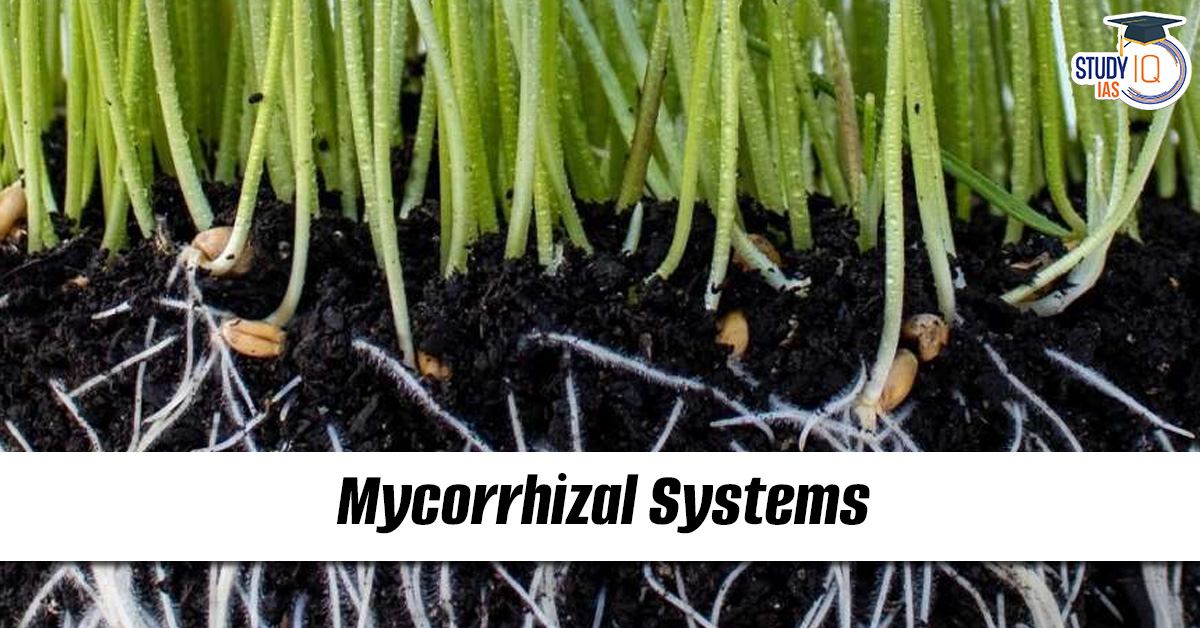
- Mycorrhizal networks are symbiotic associations between fungi and plant roots.
- These fungi form extensive underground webs that connect plants across ecosystems, enabling the exchange of nutrients, water, and chemical signals.
- Toby Kiers’ research has shown that these networks are not passive conduits but economically strategic systems, where fungi and plants actively trade resources like carbon, nitrogen, and phosphorus
Examples of Mycorrhizal Systems
| Type of Mycorrhiza | Plant Examples | Fungal Examples | Key Features |
| Arbuscular Mycorrhiza (AM / Endomycorrhiza) | Wheat, Rice, Maize, Sunflower, Legumes | Glomus, Rhizophagus, Acaulospora | Most widespread type; penetrates root cells; crucial for phosphorus uptake; dominant in croplands & grasslands |
| Ectomycorrhiza (ECM) | Pine (Pinus), Oak (Quercus), Eucalyptus, Birch | Amanita, Boletus, Laccaria, Russula | Forms sheath around roots (does not enter cells); common in forests; improves nitrogen & water uptake |
| Ericoid Mycorrhiza | Tea, Blueberry, Rhododendron, Heather (Erica) | Rhizoscyphus, Oidiodendron | Adapted to acidic, nutrient-poor soils; important in hill & heath ecosystems |
| Orchid Mycorrhiza | Orchids (Vanilla, Dendrobium, Orchis) | Rhizoctonia-like fungi | Essential for seed germination; orchids depend on fungi for early growth |
| Arbutoid Mycorrhiza | Strawberry tree (Arbutus) | Russula, Amanita | Intermediate form between ecto- and endomycorrhiza; found in Mediterranean ecosystems |
| Ectendomycorrhiza | Willow, Poplar | Wilcoxina | Combines features of ecto- and endomycorrhiza; occurs in stressed or disturbed soils |
Significance of Mycorrhizal Systems
- Climate regulation: Mycorrhizal fungi store large quantities of carbon in soils, making them critical for climate change mitigation.
- Ecosystem stability: They enhance plant resistance to drought, disease, and nutrient stress.
- Biodiversity conservation: Underground networks support diverse plant communities by redistributing nutrients.
- Rethinking agriculture: Insights challenge chemical-intensive farming and promote soil-centric, regenerative practices.
India’s Potential
- India’s forests, grasslands, and agro-ecosystems host rich but under-studied fungal diversity crucial for soil fertility and crop resilience.
- Mycorrhizal fungi can significantly support climate-smart agriculture, especially in drought-prone and degraded regions.
- Integrating fungal ecology aligns with national priorities such as sustainable agriculture, soil health cards, natural farming, and land restoration under climate commitments.
| Tyler Prize |
|
 Navigating Uncharted Waters: What Next f...
 Astronaut Reentry Explained: How Spacecr...
 Missile Interceptors Explained: Role in ...











 WhatsApp





