
Table of Contents
Context
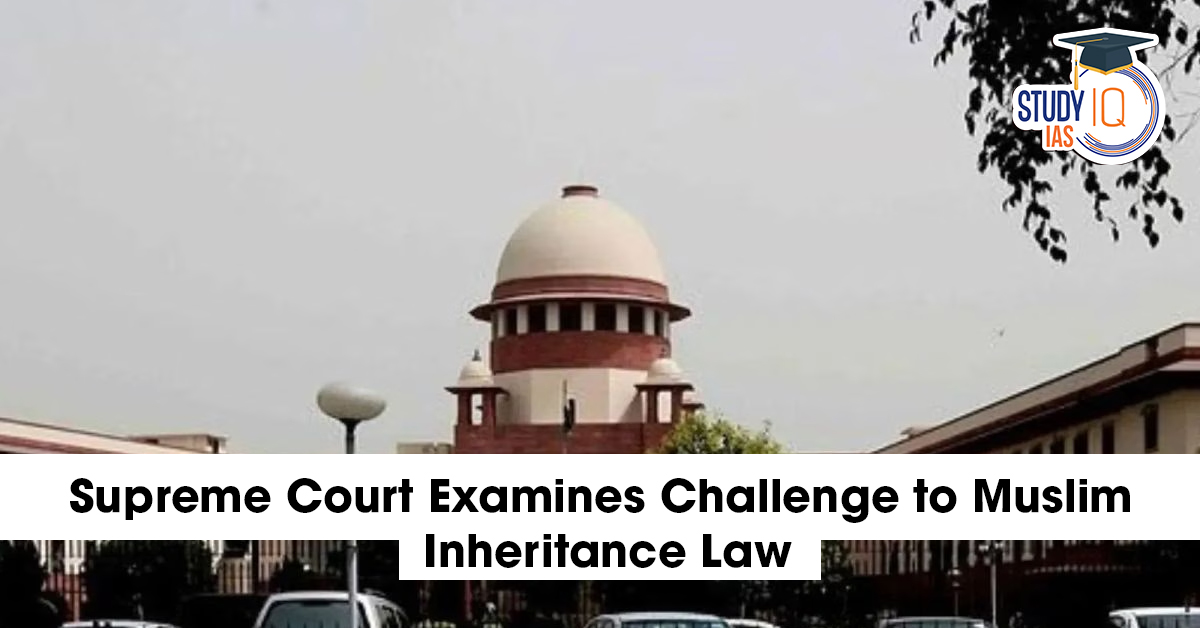
- The Supreme Court of India is considering a plea challenging provisions of the Muslim Personal Law (Shariat) Application Act, 1937 related to inheritance.
- The petition argues that the law gives Muslim women a smaller share of inheritance than men, which may violate constitutional principles of equality.
What is the case before the Supreme Court?
|
Arguments before the Court |
| ● Claim of Discrimination: Senior advocate Prashant Bhushan contended that the current legal framework results in unjust discrimination against Muslim women in inheritance matters, as it prescribes unequal property shares compared to male heirs.
● Suggested Alternative: The petitioner argued that if the disputed provisions of the Shariat Act are invalidated, inheritance matters for Muslims could instead be governed by the Indian Succession Act, 1925, which provides a secular legal framework for succession. ● Reference to Earlier Judicial Precedent: The plea cited the landmark case of Mary Roy vs State of Kerala, where the Supreme Court struck down discriminatory provisions in the Travancore Christian Succession Act, 1916 to ensure equal inheritance rights for Christian women. Concerns raised by the Supreme Court ● Possibility of a Legal Vacuum: The Court observed that striking down key provisions of the Shariat Act without introducing an alternative framework could create uncertainty regarding the rules governing Muslim inheritance. ● Risk to Existing Rights: The bench also cautioned that removing the current legal structure might unintentionally weaken or reduce the rights that Muslim women presently enjoy under existing provisions. ● Role of Parliament: The bench led by Surya Kant indicated that reforms in personal laws may be more appropriately undertaken by Parliament through legislation rather than solely through judicial intervention. |
Muslim Inheritance Law in India
- Governing Framework: Muslim personal laws in India are mainly governed by the Muslim Personal Law (Shariat) Application Act, 1937. The legal framework draws its principles from Islamic sources such as the Quran, Hadith (sayings and actions of Prophet Muhammad), and established customary practices.
- Scope of the Law: The Act regulates several aspects of personal life among Muslims, including marriage, divorce, inheritance, succession, and charitable matters. It also addresses maintenance and family-related obligations.
Key Aspects of Muslim Personal Law
- Marriage (Nikah)
- Under Islamic law, marriage is treated as a civil contract between a man and a woman. For a marriage to be valid, it must involve:
- A clear offer and acceptance between the parties.
- Competent individuals, meaning both parties must be of sound mind and have attained puberty.
- Presence of witnesses to the agreement.
- Divorce
- Muslim personal law recognises several forms of divorce:
- Talaq: divorce initiated by the husband.
- Khula: divorce initiated by the wife.
- Mubarat: divorce by mutual consent.
| Shayara Bano vs Union of India case |
| The practice of instant triple talaq was invalidated by the Supreme Court in 2017 in the Shayara Bano vs Union of India case. |
- Inheritance
- Muslim inheritance law divides heirs into different categories, with 12 principal classes of legal heirs recognised under traditional rules. Property distribution generally follows predetermined shares. For example, a daughter’s share is typically half of that of a son in comparable circumstances.
- Succession
- Relatives are classified as:
- Sharers: individuals entitled to fixed portions of the estate.
- Residuaries: heirs who inherit the remaining property after the fixed shares have been distributed.
- These provisions apply in cases of both intestate succession and testamentary succession.
- Maintenance (Nafkah)
- Islamic law places a duty on individuals to financially support their spouses, children, and dependent relatives. Maintenance usually includes provision for essential needs such as food, clothing, and shelter.
- Adoption and Guardianship
- Unlike Hindu personal law, Islamic law does not recognise adoption in the same formal legal sense. However, guardianship and custody of children are recognised, and specific rules determine the rights and responsibilities of guardians.
- Renunciation of Faith and Legal Implications
- Individuals born into the Muslim community remain governed by Shariat law even if they renounce their faith, unless they formally declare their intention to opt out under the 1937 Act. However, opting out may create a legal gap in matters of inheritance and succession because the Indian Succession Act, 1925 excludes Muslims from its scope in most cases.
- Exclusions and Special Situations
- Special Marriage Act: Muslims who marry under the Special Marriage Act, 1954 are not governed by Muslim personal law in matters of succession.
- Goa: The personal laws under the Shariat Act do not apply in Goa, where a uniform civil code operates for all residents regardless of religion.
- Certain Regions and Property: In cases involving immovable property located in West Bengal, Chennai, and Bombay, testamentary succession for Muslims may fall under the Indian Succession Act, 1925.
|
Read More Notes |
|
| Environment Notes | Art and Culture Notes |
| Science and Tech | History Notes |
| Geography Notes | Indian Polity Notes |
| General Knowledge | International Relation |
|
Explore StudyIQ Courses |
|
 IEA Agrees to Release 400 Million Barrel...
 Black Rain Crisis in Iran: Causes, Envir...
 Anna Mani: Pioneer of Indian Meteorology...










 WhatsApp





