
Table of Contents
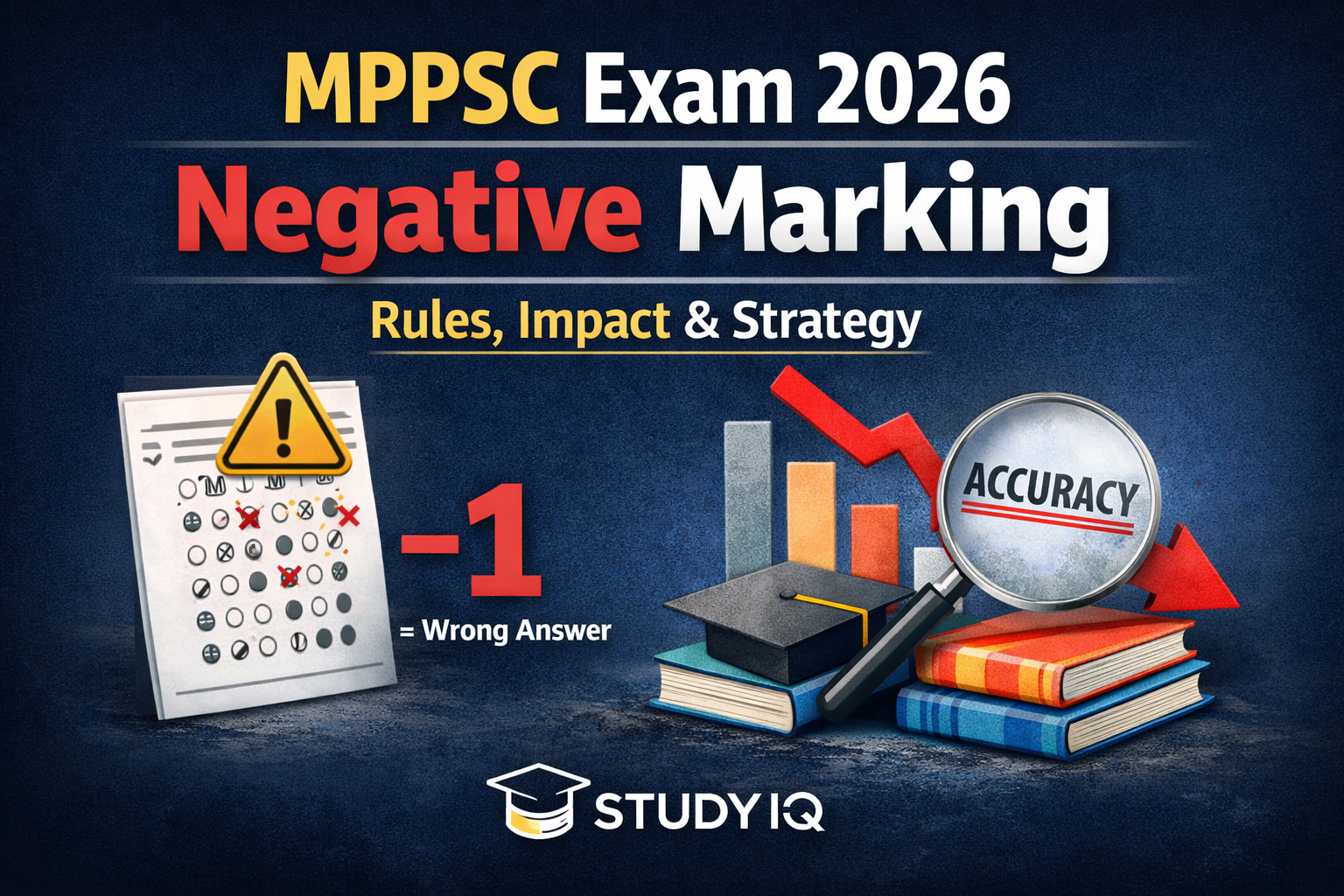
The Madhya Pradesh Public Service Commission (MPPSC) has introduced negative marking for the first time in the MPPSC State Service Examination (SSE) 2026, bringing a fundamental change in the way the Preliminary examination will be evaluated. This reform has far-reaching implications for cut-offs, preparation strategy, and the overall competitiveness of the exam.
While the syllabus remains unchanged, the evaluation mechanism has become stricter, making accuracy, conceptual clarity, and smart decision-making the key determinants of success.
MPPSC Exam 2026: Negative Marking Rules Explained
As per the latest MPPSC Notification 2026, the following negative marking rules apply to the Preliminary Examination:
-
Each question carries 3 marks
-
1/3rd negative marking for every wrong answer
(i.e., 1 mark deducted per incorrect response) -
No penalty for unattempted questions
-
Negative marking applies to both GS Paper 1 and GS Paper 2 (CSAT)
-
Prelims remains qualifying in nature, but mistakes now directly reduce scores
Marking Formula
Final Score = (3 × Correct Answers) − (1 × Wrong Answers)
This system aligns MPPSC with national-level exams such as UPSC and UPPSC.
What Will Be the Impact of Negative Marking on MPPSC Cut-Offs?
Cut-Offs Will Come Down Significantly
In previous years, MPPSC Prelims cut-offs often reached 80–85%, largely due to unrestricted attempts and guesswork. With negative marking now in place, such inflated scores are unlikely.
Experts predict cut-offs to drop sharply, possibly settling in the 55–65% range, depending on exam difficulty.
Accuracy Becomes More Important Than Attempts
MPPSC has shifted from an attempt-maximisation model to an accuracy-driven selection process.
-
Every wrong answer now cancels the benefit of correct answers
-
High attempts without clarity will reduce net scores
Candidates who attempt fewer but correct questions will have a clear advantage.
End of “Tukka” and Blind Guessing
The era of blind guessing (tukka) is effectively over.
Earlier:
-
Elimination-based guesses could boost scores
-
Even partially prepared candidates could compete
Now:
-
Blind guesses lead to negative returns
-
Half knowledge becomes risky
-
Skipping questions is often the smarter choice
This makes MPPSC 2026 a discipline-based examination, not a gamble.
Advantage for Conceptually Strong Aspirants
Negative marking strongly benefits candidates who:
-
Possess clear conceptual understanding
-
Revise static subjects thoroughly
-
Are strong in MP-specific General Knowledge
-
Know when not to attempt a question
Such aspirants will face less artificial competition and a more realistic merit list.
MPPSC 2026 Strategy Under Negative Marking
To succeed under the new evaluation system, aspirants must rethink their approach.
Focus on Selective Mastery
-
Master 70–75% of the syllabus deeply
-
Avoid superficial coverage of 100% topics
Prioritise High-Accuracy Areas
-
MP History, Geography, Tribes, and State Schemes
-
Static GS topics with predictable questions
Smart Attempt Strategy in Exam Hall
-
Attempt questions only when at least two options can be confidently eliminated
-
Avoid emotional or pressure-based attempts
-
Remember: Skipping is safer than guessing
Mock Tests for Risk Management
-
Use mock tests to practise:
-
Controlled attempts
-
Decision-making under pressure
-
Final Takeaway
The introduction of negative marking in MPPSC Exam 2026 marks a decisive move toward fairness, seriousness, and merit-based selection. It will:
✔ Lower cut-offs
✔ Reduce randomness
✔ Eliminate blind guessing
✔ Reward clarity, discipline, and preparation depth
MPPSC 2026 is no longer about attempting more—it is about attempting right.
 MPPSC Syllabus 2026, Check Prelims and M...
 MPPSC Notification 2026 Out: Apply Onlin...
 MPPSC Exam Calendar 2026 Released: Check...












 WhatsApp





