
Table of Contents
Context
- The renewed U.S.–Iran confrontation has placed missile defence systems at the centre of modern warfare.
What is Missile Defence?
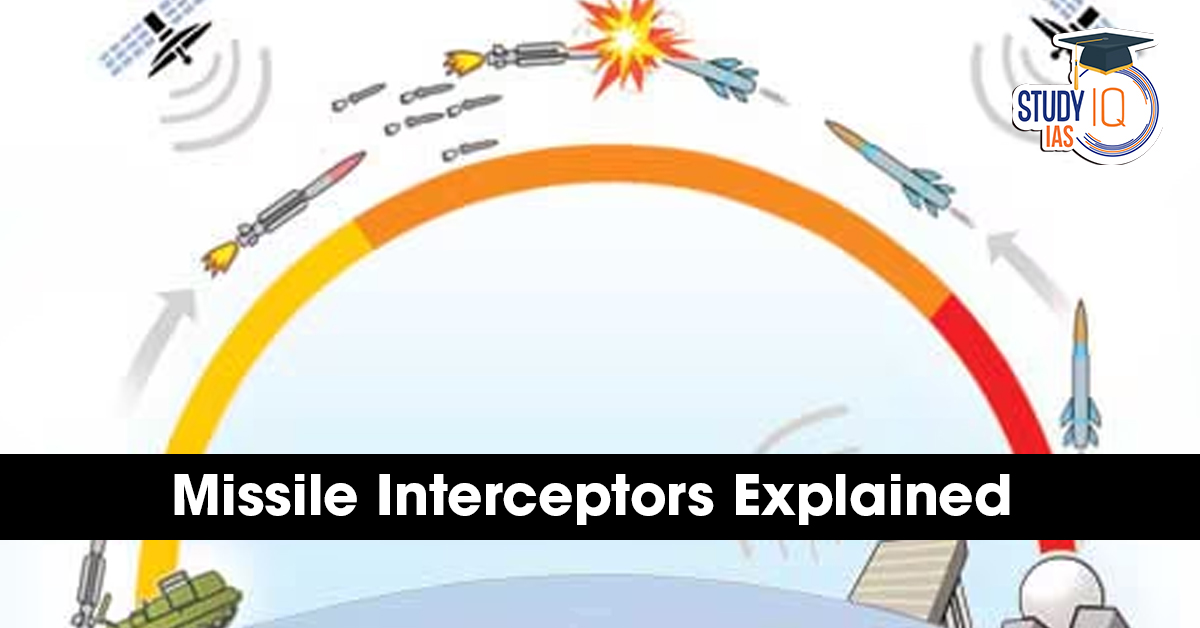
- Missile defence refers to a layered military system designed to detect, track, and destroy incoming missiles before they strike their targets. Core Components are:
- Sensors: Satellites and ground-based radars detect launches and track trajectory.
- Command & Control: Computers and operators assess the threat and decide response.
- Interceptors: Defensive missiles launched to neutralise incoming threats.
- Missile defence systems operate across different phases of flight:
- Boost Phase: Immediately after launch (rarely intercepted).
- Midcourse Phase: While the missile travels in space.
- Terminal Phase: Final descent toward target.
- Layered defence increases interception probability by engaging threats at multiple stages.
|
How Interceptors Work |
| ● Detection and Tracking: Radars emit radio waves that bounce off objects in the sky. Computers analyse reflected signals to calculate speed, altitude, and direction.
● Target Lock and Launch: Once identified as hostile, the system “locks” onto the target. An interceptor missile is launched from a ground battery or naval platform. ● Guidance and Final Engagement: Interceptors are guided via: ○ Ground radar updates ○ Onboard seekers (radar/infrared) ● There are two primary kill mechanisms: ○ Proximity-fuse warheads: Explode near target, destroying via shrapnel. ○ Hit-to-kill technology: Direct collision using kinetic energy (e.g., THAAD, PAC-3). ● Modern systems like THAAD intercept ballistic missiles outside the atmosphere, while systems like Patriot operate in the terminal phase. |
Cost Factor: The Economics of Interception
Missile defence is technologically advanced but extremely expensive. Approximate Costs:
- Patriot PAC-3 MSE interceptor: ~$4 million per missile.
- THAAD interceptor: ~$12–15 million per missile.
- SM-3 interceptor: ~$10–20 million per missile.
- Iron Dome Tamir interceptor: ~$50,000 per shot.
Iran’s strategy often involves saturation attacks — launching large numbers of relatively cheap missiles and drones to exhaust expensive interceptors. This creates a strategic imbalance:
- Cheap offensive missiles vs. expensive defensive interceptors.
- Limited interceptor stockpiles.
- Slow manufacturing replenishment (often 1–2 years).
Hence, rationing interceptors becomes critical in prolonged conflicts.
How Strong is Iran’s Air & Missile Defence Network?
Iran operates a layered and mobile air defence network, combining indigenous systems and imported Russian platforms.
- Majid System Short-range defence platform primarily targeting drones and low-altitude aerial threats.
- Bavar-373 (Sayyad-4B): Iran’s long-range air defence system capable of engaging aircraft and ballistic missiles at ~300 km; forms the top defensive layer and is often compared to the S-300.
- Sevom-e-Khordad: Mobile medium-range SAM system designed to intercept fighter jets, drones, and cruise missiles; valued for rapid relocation after launch.
- Arman BMD System: Designed to counter short- and medium-range ballistic missiles with 360° radar coverage, strengthening Iran’s missile defence shield.
- Tor-M1 Russian-origin short-range system protecting key sites against precision-guided bombs, cruise missiles, and low-flying aircraft.
|
Read More Notes |
|
| Environment Notes | Art and Culture Notes |
| Science and Tech | History Notes |
| Geography Notes | Indian Polity Notes |
| General Knowledge | International Relation |
|
Explore StudyIQ Courses |
|
 Navigating Uncharted Waters: What Next f...
 Astronaut Reentry Explained: How Spacecr...
 World Wildlife Day 2026: Theme, Signific...











 WhatsApp





