

Table of Contents
Middle Income Trap
- The middle-income trap is a situation where a country that attains a certain income gets stuck at that middle-income level and is unable to transition to a high-income level.
Or
- The World Bank defines middle-income economies as those with incomes between $1,136 and $13,845 per capita.
Or
- The middle-income trap refers to the stagnation of income per capita when economies reach about 11% of U.S. per capita income levels.
Key Factors Contributing to the Middle-Income Trap
- Diminishing Returns to Capital: As countries grow, the returns on additional investments in physical capital tend to decline, making it harder to sustain high growth rates.
- Exhaustion of Cheap Labour: The initial advantages of low labour costs diminish as wages rise, leading to increased unit labour costs that can hinder competitiveness.
- Premature Deindustrialization: Many middle-income countries experience a decline in manufacturing at lower income levels than before, limiting their ability to drive growth through industrialization.
- Insufficient Quality of Human Capital: A lack of skilled labour can impede innovation and productivity growth.
- Failure to Invest in Education and Training: Early growth often relies on labour-intensive industries rather than productivity-driven sectors, leading to a skills mismatch in the economy.
- Weak Institutions: Ineffective governance and institutions may not support an adaptive economy capable of fostering innovation and competition.
- Misallocation of Resources: Distorted incentives can lead to talent misallocation, where individuals are not employed in roles that maximise their potential contributions to the economy.
- Inflation and Credit Bubbles: High inflation rates and speculative investments can destabilise economies, making it difficult for them to maintain growth momentum.
- Lack of Access to Finance: Limited access to venture capital and advanced financial instruments can stifle innovation and entrepreneurship.
- Increased Competition: Middle-income countries often find themselves squeezed between low-wage competitors from poorer nations and high-tech innovators from wealthier countries.
- Trade Frictions and Geopolitical Tensions: Current global economic uncertainties add further burdens on middle-income economies, complicating their ability to compete internationally.
| Key Highlights of the World Development Report 2024 |
Middle Income Trap:
Global Economic Impact:
Per Capita Income Disparity:
Challenges and Risks:
|
Challenges for India
Wealth Concentration and Inequality
- The influence of billionaires in India’s economy has grown significantly, and there is a perception that they are closely aligned with political power.
- The state is seen as unable (or unwilling) to push for high rates of domestic investment from these billionaires.
- The manufacturing sector has stagnated, and India is experiencing a reversal in structural transformation, with a growing share of the population returning to low-productivity agriculture post-pandemic.
Wage Growth Discrepancy
- Despite India’s projected real GDP growth of around 7%, nominal wage growth has lagged behind.
- The Periodic Labour Force Survey (PLFS) indicates that nominal wages for regular workers grew by only 5% between April and June 2023-24, and for casual workers, by 7%.
- With inflation at 5%, wage earners have seen minimal to no real wage growth, hindering broader participation in the economy’s growth.
- A lack of wage growth limits consumption demand, which in turn, slows down overall economic progress.
Democracy and Growth
- Both South Korea and Chile had authoritarian governments when they transitioned to high-income economies.
- South Korea’s military government suppressed labour unions to promote capital accumulation, and Chile’s democratic government was overthrown in favour of a military dictatorship led by General Augusto Pinochet.
- India must not adopt the wrong lessons from these countries by compromising democracy in pursuit of economic growth.
- Policy must focus on maintaining a democratic ethos while promoting growth through state intervention.
Way Forward
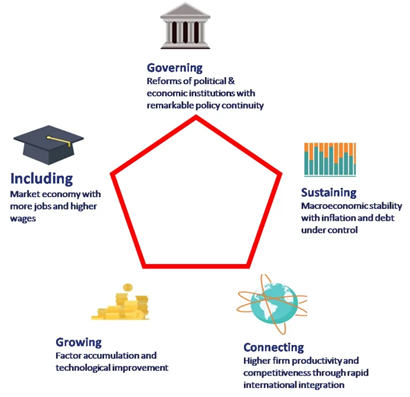
- The 3i Approach: The World Development Report 2024 emphasises a three-pronged strategy known as the “3i” approach:
- Investment: Increasing capital investments in various sectors.
- Infusion: Ensuring the adoption of new global technologies.
- Innovation: Creating an environment conducive to domestic innovation.
- These strategies require responsive state policies to navigate modern economic challenges effectively
- Pursue Liberal Economic Policies: Focus on policies that support private sector growth and entrepreneurship.
- Develop Low-Skilled Manufacturing: Encourage sectors like electronics assembly and apparel to create jobs and boost exports.
- Example: South Korea and Taiwan’s success through export-oriented manufacturing.
- Build Industrial Clusters: Develop clusters with plug-and-play infrastructure, similar to China and Vietnam.
- Address cost disabilities in power, logistics, financing, and labour productivity.
- Enhance Female Labor Force Participation: Implement policies to increase FLFPR to levels seen in other rapidly growing economies.
- Avoid Protectionist Policies: Resist high import tariffs to prevent inefficiencies and maintain competitiveness in exports.
- Example: Impact of tariffs on mobile phone manufacturing.
- Minimum Government, Maximum Governance: Reduce bureaucratic red tape and improve ease of doing business to encourage private investment.

 Daily Current Affairs PDF 2026: Download...
 What Is Digital Hawala? How Crypto, Fint...
 Chiapas, Mexico: Place in News | Interna...













 WhatsApp





