
Table of Contents
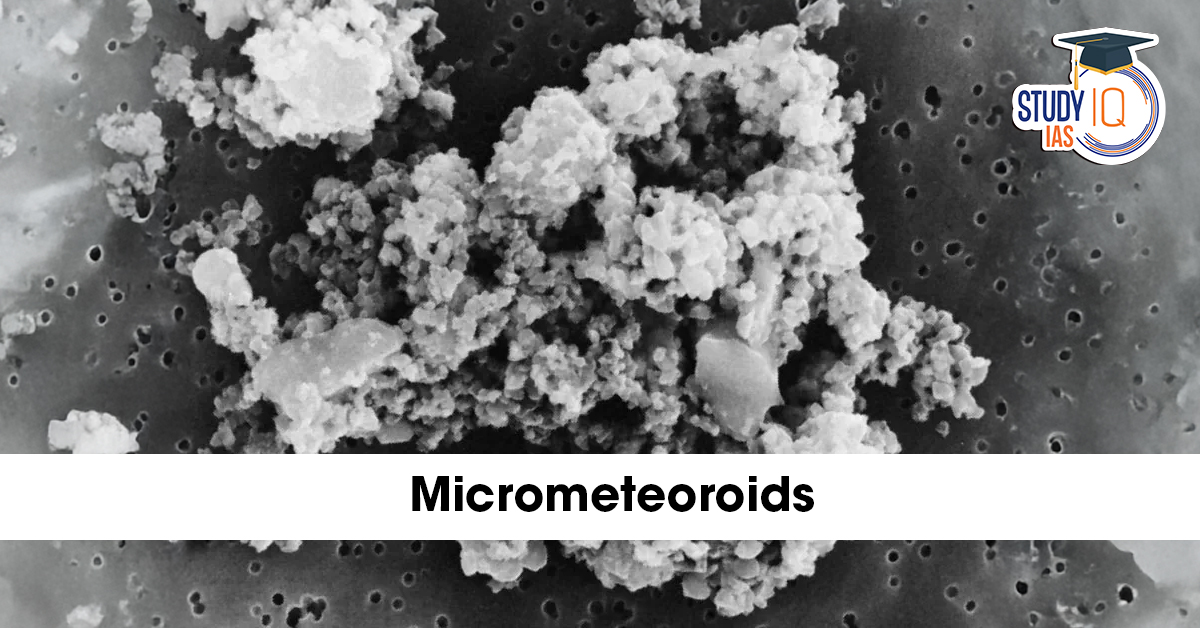
Micrometeoroids are among the smallest yet most dangerous objects in space. Invisible to the naked eye and often no larger than grains of sand, these high-speed particles travel through space at velocities capable of piercing spacecraft walls, damaging satellites, and endangering astronaut lives.
With recent incidents highlighting the vulnerability of spacecraft in Earth’s orbit, micrometeoroids have emerged as a critical challenge for space safety and sustainable exploration.
What Are Micrometeoroids?
Micrometeoroids are extremely small natural particles of rock or metal that move through space. They are typically smaller than one millimetre in size but carry enormous kinetic energy due to their exceptionally high speeds.
Despite their microscopic size, micrometeoroids can cause serious damage when they collide with spacecraft or satellites.
Origin and Formation of Micrometeoroids
Micrometeoroids are formed through natural cosmic processes, mainly from:
-
Collisions between asteroids in the asteroid belt
-
Dust released from comets as they approach the Sun
-
Fragmentation of meteoroids during their journey through space
These particles travel across the solar system and occasionally intersect Earth’s orbital path.
Where Are Micrometeoroids Found?
-
Present throughout interplanetary space
-
Slightly higher concentration near Earth due to its gravitational attraction
-
Continuously bombard Earth’s atmosphere, though most burn up before reaching the surface
In space, however, there is no atmospheric protection, making spacecraft highly vulnerable.
Key Characteristics of Micrometeoroids
1. Extremely High Velocity
-
Travel at speeds ranging from 11 km/s to 72 km/s
-
Even a particle smaller than a millimetre can strike with the energy of a bullet
2. Natural and Unavoidable
-
Unlike human-made space debris, micrometeoroids cannot be removed or controlled
-
Their trajectories are unpredictable
3. Small Size, High Impact
-
Micrometeoroids can:
-
Puncture spacecraft surfaces
-
Erode solar panels
-
Damage sensitive instruments
-
4. Difficult to Detect
-
Too small to be tracked by ground-based radar systems
-
Risk assessment relies on statistical probability models
Difference Between Micrometeoroids and Space Debris
| Feature | Micrometeoroids | Space Debris |
|---|---|---|
| Origin | Natural (asteroids, comets) | Human-made |
| Size | Mostly microscopic | Ranges from tiny fragments to large satellites |
| Control | Uncontrollable | Can be mitigated through policy and design |
| Tracking | Not trackable | Larger debris is trackable |
Impact of Micrometeoroids on Space Missions
Threat to Astronaut Safety
-
Even a tiny impact can:
-
Breach spacecraft walls
-
Damage life-support systems
-
-
Space stations are particularly vulnerable due to long mission durations
Damage to Satellites
-
Can degrade:
-
Solar panels
-
Communication antennas
-
Optical sensors
-
-
Leads to reduced satellite lifespan and performance
Increased Mission Costs
-
Requires heavy shielding
-
Adds weight, increasing launch costs
-
Demands continuous risk modelling and design upgrades
How Spacecraft Are Protected from Micrometeoroids
Whipple Shielding
-
Multiple layers designed to:
-
Break incoming particles
-
Disperse their energy before reaching critical structures
-
Advanced Materials
-
Use of aluminium alloys, Kevlar, and composite materials
Design Orientation
-
Spacecraft surfaces most exposed to motion receive extra protection
Challenges in Mitigating Micrometeoroid Risks
-
Cannot be eliminated or reduced at the source
-
Increasing number of space missions raises exposure
-
Long-duration human missions face cumulative damage risks
Importance of Studying Micrometeoroids
Understanding micrometeoroids is essential for:
-
Designing safer spacecraft
-
Planning long-term missions to the Moon and Mars
-
Ensuring astronaut safety
-
Sustaining future space exploration activities
Conclusion
Micrometeoroids may be tiny, but their impact on space missions is enormous. As humanity expands its presence in space, underestimating these natural high-speed particles could lead to catastrophic failures.
Robust spacecraft design, continuous research, and advanced protective technologies are essential to ensure that micrometeoroids do not become a limiting factor in the future of space exploration.
 One Lakh Crore Urban Challenge Fund Appr...
 The Administrative Challenge of Scale in...
 Administrative Scorecards’ for Secreta...











 WhatsApp





