
Table of Contents
Context
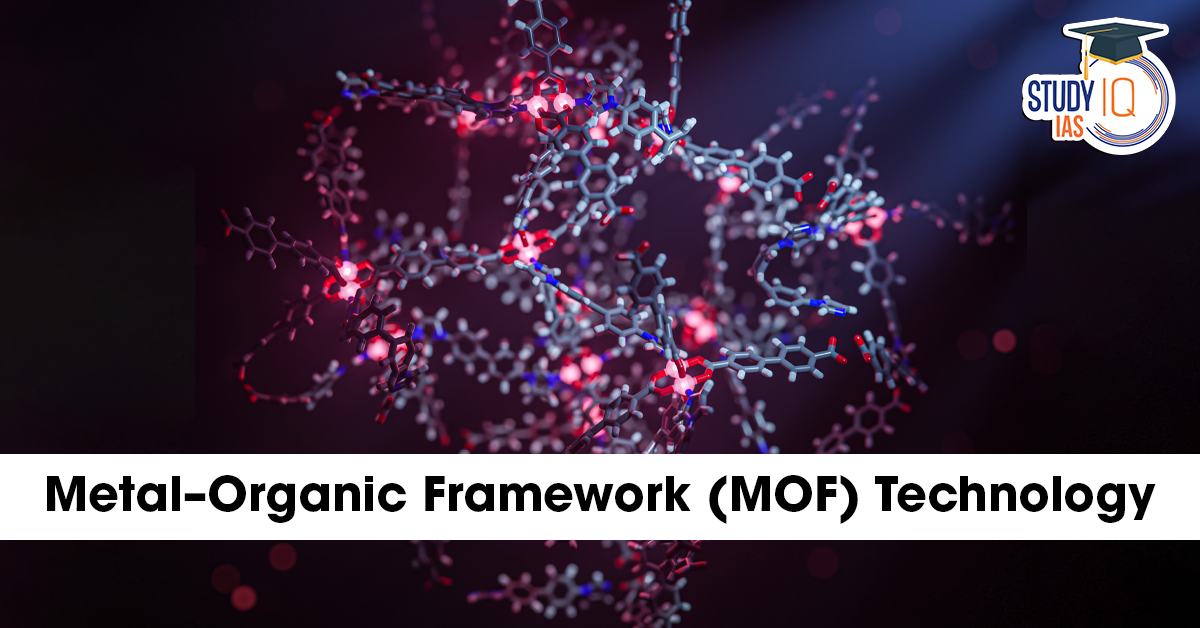
- Metal–Organic Frameworks (MOFs) are a new class of highly porous crystalline materials that have gained major attention for applications such as air dehumidification, gas storage, carbon capture, and atmospheric water harvesting. Their extremely high surface area and tunable pore structures allow them to adsorb large quantities of gases or water molecules efficiently.
|
About Metal–Organic Frameworks (MOFs) |
| ● Hybrid Coordination Materials: MOFs are crystalline compounds formed by metal ions or clusters linked with organic molecules, creating a stable three-dimensional porous network.
● Ultra-Porous Structure: The internal structure of MOFs contains nanometre-scale pores, giving them extremely large internal surface areas that allow adsorption of gases and water vapour. ● Tunable Molecular Architecture: Scientists can modify the metal nodes and organic linkers, enabling precise control over pore size, adsorption behaviour, and chemical properties of MOFs. ● High Adsorption Capacity: Because of their porous architecture, MOFs can capture large quantities of molecules such as water vapour, carbon dioxide, or hydrogen, making them promising materials for environmental technologies. |
Major Applications of MOF Technology
- Air Dehumidification and HVAC Systems: MOFs are used as advanced desiccants in heating, ventilation, and air-conditioning systems, improving humidity control and reducing energy use.
- Atmospheric Water Harvesting: MOF-based materials can extract water directly from air, even in low-humidity environments such as deserts, producing usable water.
- Carbon Capture Technologies: The porous structure of MOFs can selectively capture carbon dioxide from industrial emissions, making them promising for climate-change mitigation.
- Hydrogen Storage for Energy Systems: MOFs are being studied for hydrogen storage in clean energy technologies, where the porous structure can store large volumes of hydrogen gas.
- Industrial Environmental Control: Industries such as pharmaceutical manufacturing, electronics fabrication, and food processing require precise humidity control, which MOF-based systems can provide efficiently.
Challenges in MOF Technology
- High Production Cost: Large-scale synthesis of MOFs can be complex and expensive, limiting widespread industrial adoption.
- Material Stability Issues: Some MOFs may degrade under extreme humidity, high temperatures, or long-term operation, requiring improved material engineering.
- Scaling and Manufacturing Challenges: Converting MOF powders into durable industrial structures such as coatings, pellets, or rotors remains a major engineering challenge.
Future Potential of MOF Technology
- Next-Generation Cooling and HVAC Systems: MOFs could enable high-efficiency cooling systems that separate humidity control from temperature control, reducing energy consumption.
- Sustainable Water Production: Atmospheric water harvesting using MOFs could provide drinking water in water-scarce regions, especially deserts.
- Advanced Environmental Technologies: Integration with heat pumps, adsorption chillers, and smart climate-control systems may create new energy-efficient environmental control technologies.
|
Read More Notes |
|
| Environment Notes | Art and Culture Notes |
| Science and Tech | History Notes |
| Geography Notes | Indian Polity Notes |
| General Knowledge | International Relation |
|
Explore StudyIQ Courses |
|
 The Transgender Persons (Protection of R...
 WASH (Water, Sanitation, and Hygiene) Se...
 Vairamuthu Wins Jnanpith Award 2026: Tam...









 WhatsApp





