
Table of Contents
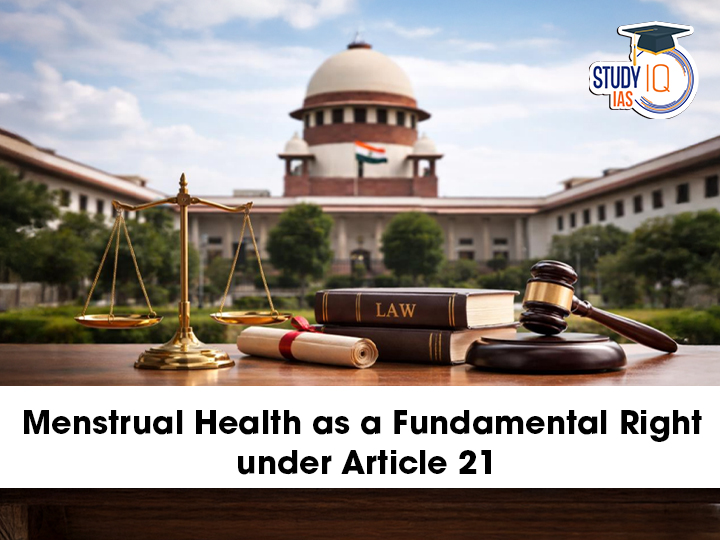
Menstrual health has long been on the outside of constitutional debate, consigned to the private realm and plagued by silence, stigma, and institutional neglect. In a groundbreaking decision, the Supreme Court of India has declared categorically that the right to menstrual health is an inherent component of the right to life under Article 21 of the Constitution. The Court has elevated menstrual health from a humanitarian concern to a justiciable constitutional entitlement by issuing extensive directives to ensure free access to biodegradable sanitary napkins and hygienic, gender-segregated restroom facilities in schools. This decision, delivered in Dr. Jaya Thakur v. Government of India and Ors. (2026 LiveLaw (SC) 94), highlights a significant constitutional moment. It places menstruation within the contexts of dignity, equality, physical autonomy, education, and substantive justice, while putting legally binding obligations on the state. This essay examines the decision in depth, situates it within the larger evolution of menstrual rights law, investigates the rising discourse on menstrual leave, and provides comparative foreign perspectives.
Constitutional Recognition of Menstrual Health under Article 21
Article 21 of the Constitution provides the right to life and personal liberty, which has been interpreted by courts to include dignity, privacy, health, bodily autonomy, and reproductive rights. The Supreme Court’s decision that menstruation health is an element of Article 21 is consistent with this evolving jurisprudence. The Court ruled that the inaccessibility of menstrual hygiene management (MHM) measures degrades a girl child’s dignity by subjecting her to humiliation, exclusion, and unnecessary suffering. The Court concluded that privacy is inextricably linked to dignity, and it imposes both negative and positive obligations on the State. In the absence of safe and sanitary menstrual facilities, adolescent girls are forced to engage in risky behaviors or drop out of school entirely, breaching bodily autonomy and decisional freedom. The decision echoes earlier constitutional principles laid down in Justice K.S. Puttaswamy v. Union of India (2017), which recognised privacy as intrinsic to dignity and autonomy, and Suchita Srivastava v. Chandigarh Administration (2009), which affirmed reproductive autonomy as part of Article 21.
Substantive Equality and Article 14: Menstruation as a Structural Disadvantage
Under Article 14, the Court pursued substantive equality while rejecting formal ideas of equal treatment. It argued that menstruation, when combined with poverty, disability, and social stigma, results in multilayer disadvantage. Menstruating female children who cannot afford menstrual absorbents face disadvantage on numerous axes, including comparisons to girls who can afford such items, comparisons to male or non-menstruating counterparts, and, in cases involving disability, the intersection of gender and disability. The denial of basic enabling conditions transforms biological reality into structural exclusion, reinforcing gender inequity. Drawing on the notion of substantive equality stated in Navtej Singh Johar v. Union of India (2018) and AnujGarg v. Hotel Association of India (2008), the Court emphasized the State’s commitment to eradicate structural barriers rather than simply providing formal access.
Menstrual Health and Right to Education under Article 21A
The Court defined the right to education as a “multiplier right,” allowing for the exercise of other fundamental rights. Article 21A and the Right of Children to Free and Compulsory Education Act, 2009 (RTE Act) mandate not just formal admission, but also meaningful participation and completion of education. The Court ruled that free education covers any expenses that impede a child’s capacity to pursue an education, including menstrual hygiene supplies. Schools that fail to comply with legislative rules risk losing recognition, whereas state-run institutions are held accountable for infractions. This view supports previous verdicts, such as AvinashMehrotra v. Union of India (2009), which highlighted safe and enabling educational environments as essential to the right to education. “The right to education as a human right does not merely demand parity between genders but further requires equality of opportunity in the enjoyment of that right for all. Inaccessibility of MHM measures perpetuates a systemic exclusion and discrimination that impacts the admission or continuation of girl children in school.”
Judicial Directions: From Policy to Enforced Obligations
The Supreme Court provided thorough, pan-India guidelines mandating:
- All schools have functional, gender-segregated restrooms with water connectivity.
- Infrastructure that prioritizes privacy and accessibility, including for children with impairments;
- Free provision of Oxo-biodegradable sanitary napkins that meet ASTM D-6954 criteria;
- Establishment of menstrual hygiene management corners stocked with emergency supplies;
- Environmentally responsible disposal methods in accordance with the Solid Waste Management Rules. By applying Article 142, the Court assured instant enforceability, closing the gap between policy intent and constitutional conformity.
The Supreme Court today emphasized the importance of male teachers and school staff, as well as men in general, in preventing an ecosystem of stigma linked with menstruation, allowing adolescent girls to participate in school and have access to other opportunities. It stated that even if schools have gender-segregated restrooms and access to menstrual hygiene management, but menstruation is not considered as a taboo by the school and its ecology, infrastructural measures will be ineffective. “All that we are trying to convey is that, men have a multifaceted role in menstrual hygiene and awareness for school-going adolescent girls. On one hand, male teachers can integrate accurate, stigma-free information into lessons. At the same time, the staff would be responsive towards maintaining cleanliness and hygiene in toilets. On the other hand, peers and classmates would be empathetic and helpful.”
While remarking that the right to menstrual hygiene is enshrined in Article 21, a panel comprising Justice JB Pardiwala and Justice R Mahadevan ruled that menstruation should not be spoken in hushed whispers. Young guys should be informed about biological reality. “Menstruation should not be something that is only discussed in whispers. It is critical that boys learn about the biological reality of menstruation. Unaware of the condition, a male student may harass a menstrual girl child, discouraging her from attending school. In this setting, the obligation has been assigned to male teachers. They must be sensitive to the requirements of the girl child. “For example, a request to use the restroom or an unexpected need to leave the classroom must be treated with sensitivity rather than dismissal or invasive questioning.” To summarize, we would say that ignorance promotes insensitivity, while knowledge breeds empathy. It said that menstrual health is a shared obligation, not only a woman’s issue. As a result, awareness must extend beyond girls to include boys, parents, and instructors. “When menstruation is freely discussed in schools, it is no longer considered a source of shame. It is recognized for what it is: a biological fact. Needless to say, it must be viewed as a collaborative endeavor rather than a constitutional mandate.” The Court directed states and union territories to offer free sanitary pads to girls in colleges and to install gender-segregated restrooms in government and private institutions.
Menstrual Leave: Emerging Claims and Constitutional Debate
The recognition of menstruation health under Article 21 inevitably brings up the issue of menstrual leave. Menstrual leave policies seek to reflect physiological reality while reducing job or educational disadvantages. Critics say that such rules risk propagating stereotypes or exclusion, whilst supporters see them as necessary accommodations for real equality. The menstrual leave law in India is still relatively new. In Union of India v. M. Selvakumar (Madras HC, 2023), the Court noted menstrual health concerns but did not mandate leave. However, the current decision’s emphasis on dignity, bodily autonomy, and health enhances the constitutional foundation for future claims. Several Indian states have implemented menstruation leave policies. Since 1992, Bihar has offered female employees two days of menstruation leave each month. In 2023, Kerala will allow students at state-run universities to take menstruation leave. Odisha extended menstruation leave to female government employees in 2024. These developments indicate an increasing awareness of menstruation as a workplace and educational equity issue.
International Comparative Perspectives
Menstrual rights are becoming more widely recognized in global labor, education, and human rights frameworks. Japan has required menstrual leave since 1947. Menstrual leave is provided by labor legislation in South Korea, whereas it is permitted for the first two days of menstruation in Indonesia. In 2023, Spain became the first European country to implement paid menstruation leave as part of public healthcare policy. International human rights organizations, including as the UN Human Rights Council and the CEDAW Committee, have emphasized the importance of menstrual health in achieving gender equality, education, and health rights. The Supreme Court’s decision matches Indian constitutional law with worldwide trends.
Role of the Judiciary: From Silence to Structural Transformation
The judiciary’s role in achieving menstrual justice has shifted from silence to active constitutional action. Earlier interventions, such as Indian Young Lawyers Association v. State of Kerala (Sabarimala case),prioritised physical autonomy and gender equality. The current ruling applies these concepts to ordinary institutional settings such as schools. Justice Pardiwala’sconcluding words emphasise the judgment’s moral and social relevance, addressing not only legal stakeholders but also classrooms, families, and society as a whole. The Court viewed absenteeism, humiliation, and silence as systemic failures rather than individual flaws. Before parting, Justice Pardiwala, who has authored the judgment, said: “This pronouncement is not just for stakeholders of the legal system. It is also meant for classrooms where girls hesitate to ask for help. It is for teachers who want to help but are restrained due to a lack of resources. And it is for parents who may not realise the impact of their silence, and for society to establish its progress as a measure in how we protect the most vulnerable. We wish to communicate to every girlchild who may have become a victim of absenteeism because her body was perceived as a burden when the fault is not hers.”
Conclusion
The Supreme Court’s decision that menstrual health is a fundamental right under Article 21 represents a watershed event in Indian constitutional law. By including dignity, equality, education, and physical autonomy into menstrual health law, the Court has rewritten the State’s obligations to adolescent females. This decision establishes a solid constitutional foundation for future discussions around menstrual leave, workplace accommodation, and broader reproductive justice. It represents a transition from considering menstruation as a private inconvenience to seeing it as a public, constitutional issue that necessitates structural solutions. In doing so, the Court confirms that a society’s progress is evaluated not by abstract principles, but by how it protects its most vulnerable citizens. Menstrual justice, which was formerly silenced, is now firmly embedded in the Constitution’s promise of dignity, equality, and life itself.
|
Read More Notes |
|
| Environment Notes | Art and Culture Notes |
| Science and Tech | History Notes |
| Geography Notes | Indian Polity Notes |
| General Knowledge | International Relation |
|
Explore StudyIQ Courses |
|
 Trial by Social Media: Public Shaming, D...
 Governors’ Address to State Legislatur...
 Mandating Prior Approval for Corruption ...







 WhatsApp





