
Table of Contents
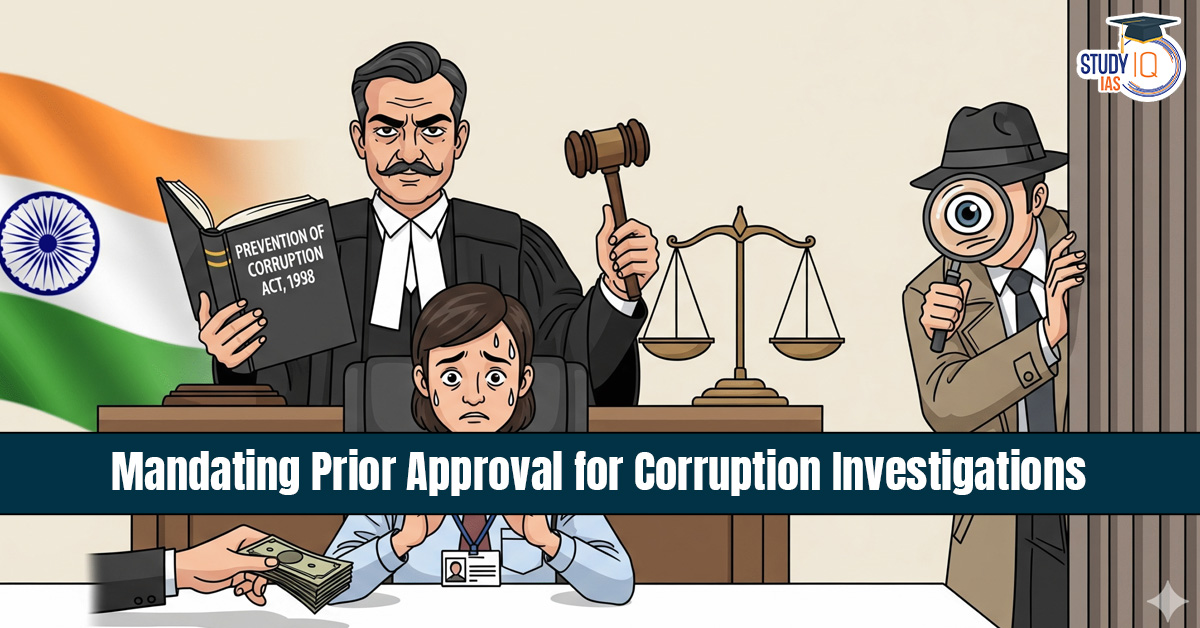
The Prevention of Corruption Act, 1988 (PCA) serves as a fundamental legislative framework in India for addressing corruption in public life. The Act aims to uphold integrity in governance and public administration by criminalising bribery, abuse of official authority, and unlawful enrichment by public officials. Recent judicial discourse has highlighted significant constitutional and institutional concerns regarding specific amendments to the Act, especially Section 17A, which requires prior approval from the government or competent authority before commencing any investigation against a public servant for alleged offences committed in the execution of official duties.
Justice Ujjal Bhuyan of the Supreme Court, addressing the International Legal Conference hosted by the Supreme Court Advocates-on-Record Association in January 2026, delivered a critical assessment of Section 17A, remarking that the requirement “may not be appropriate” as it essentially confers a veto over investigations and poses a risk of concealing high-level corruption. His remarks hold particular importance in light of the divided decision of the Supreme Court about the legitimacy of Section 17A and overarching apprehensions regarding the abuse of specialised criminal provisions like the Prevention of Money Laundering Act, 2002 (PMLA).
The Prevention of Corruption Act: Historical Context and Development
The PCA was enacted in 1988, integrating and superseding previous anti-corruption laws, including the Prevention of Corruption Act of 1947. The purpose was to enhance legal frameworks to address corruption among public officials, acknowledging corruption as a significant menace to democratic government, the rule of law, and public confidence.
The PCA first concentrated on offences like the acceptance of gratification beyond legal remuneration (Section 7), criminal misconduct by public officials (Section 13), and abetment. The Act mandated prior sanction for prosecution under Section 19, a measure designed to shield honest public personnel from baseless or harassing charges.
The 2018 amendment to the PCA represented a substantial transformation. Among other modifications, it established Section 17A, which requires prior authorisation before an investigation may begin if the alleged offence relates to decisions or recommendations made by a public servant in the discharge of official duties.
Section 17A of the PCA: Content and Objective
Section 17A stipulates that no police officer may initiate any inquiry or investigation into an offence purportedly committed by a public servant under the PCA without prior approval from the relevant government or authority.
The articulated justification for Section 17A was to safeguard bureaucrats and decision-makers from the “fear of investigation” that could hinder administrative decision-making. Critics contend that the provision goes beyond mere protection and threatens to become a mechanism of impunity.
Justice Ujjal Bhuyan’s Criticism: Prior Approval as a Form of Veto Authority
Justice Ujjal Bhuyan’s comments address the core of this issue. He noted that necessitating prior consent before an investigation may effectively constitute a “virtual veto” of the forthcoming inquiry. He cautioned that such a process may establish a structure that limits investigative agencies from addressing significant corruption cases, especially involving powerful public figures.
Justice Bhuyan emphasised a systemic risk: investigating authorities might pursue minor offenders while allowing major perpetrators to evade accountability. This analysis reveals a profound constitutional concern: whether the law, rather than serving as a deterrent to corruption, has started to shield power from accountability.
Justice Bhuyan said, “Prima facie, I am of the view, as a student of law, that seeking the prior approval of the competent authority, before you want to investigate itself, may not be appropriate. This will virtually amount to vetoing an impending investigation. We will end up going after the small fish and letting the big players out of the net.”
The Divided Opinion on Section 17A: Constitutional Discrepancies
Justice Bhuyan’s remarks should be considered in conjunction with the recent divided ruling of the Supreme Court regarding the legality of Section 17A.
Perspective of Justice B.V. Nagarathna
Justice Nagarathna declared Section 17A unconstitutional, noting that it unfairly protects corrupt public officials and erodes the rule of law. She underscored that corruption investigations necessitate independence at the first stage and that executive oversight diminishes public trust.
Justice K.V. Viswanathan’s Perspective
Justice Viswanathan took a balanced approach by interpreting Section 17A narrowly. He suggested that prior approval should be granted by independent constitutional or statutory entities, such as the Lokpal or Lokayukta, rather than by the government, to minimise executive influence while maintaining a protection mechanism.
The divided verdict illustrates the constitutional conflict between administrative efficiency and accountability.
The Judicial Function in Maintaining Investigative Independence
Justice Bhuyan’s remarks reinforce the judiciary’s position as the paramount protector of constitutional principles. By challenging the authority of administrative oversight in investigations, he coincides with established legal principles that underscore independent inquiry as a fundamental aspect of the right to life and personal liberty under Article 21 of the Constitution.
In Vineet Narain v. Union of India (1998), the Supreme Court determined that investigating bodies must operate independently of external influences. In Manohar Lal Sharma v. Principal Secretary (Coal Block Allocation Case), the Court emphasised that corruption investigations should be unaffected by political influences.
“At the end of the day, when we apply the principles of law, there cannot be a multiplicity of views in the Supreme Court. The very existence of the Supreme Court is for upholding personal liberty and human rights. The Supreme Court is not established to justify executive actions denying liberty or violation of human rights. That is not the reason for the existence of the Supreme Court. Once everybody understands this and puts this in place, there can be divergence of views among 34 judges, but there cannot be divergence of views on the very fundamentals on which our legal system exists. Once this is done, all other peripheral things will fall in place. Credibility of our institution will increase. Then people ouside our country will not hesitate to extradite people to be prosecuted in this country. Once we do this, all countries around the world will take note of this. All we need to do is keep aside our political or ideological views and stick to constitutional principles.”
Requirement for a Social Audit of the PCA
Justice Bhuyan’s request for a social audit of the Prevention of Corruption Act is notably important. A social audit entails assessing whether the law has fulfilled its intended goals or resulted in unforeseen effects.
The inadequate conviction rates in corruption cases, extended investigations, and recurrent claims of selective prosecution cast significant doubt on the effectiveness of the existing framework. Justice Bhuyan’s proposal prompts policymakers and the judiciary to consider whether the amended PCA achieves an appropriate equilibrium between protection and accountability.
Analogies with PMLA: Issues of Excessive Reach and Misapplication
Justice Bhuyan criticised the Prevention of Money Laundering Act and cautioned against its capricious implementation. Subsequent to the Supreme Court’s ruling in Vijay Madanlal Choudhary v. Union of India (2022), the PMLA has obtained significant coercive authority, encompassing arrest and property attachment.
Justice Bhuyan recognised that money laundering jeopardises economic sovereignty but cautioned against the habitual application of the PMLA in commonplace circumstances. His remarks align with judicial apprehensions articulated in Nikesh Tarachand Shah v. Union of India (2017), wherein strict bail conditions were annulled for contravening Article 21, albeit subsequently reinstated with amendments.
Bail, Personal Liberty, and Article 21
Justice Bhuyan emphasized a widespread fallacy that conflates bail with acquittal. He observed that under the PMLA, the maximum sentence is typically seven years; nonetheless, individuals frequently remain imprisoned for three or four years before trial, despite conviction rates being under six per cent.
He emphasised that the legality of an arrest is separate from its need, reiterating accepted jurisprudence. This notion was essential in his analysis of the Arvind Kejriwal case, as he deemed the arrest unlawful, underscoring that the authority to arrest should be employed judiciously and with justification.
Discriminatory Inquiries and Deterioration of Public Confidence
Justice Bhuyan’s caution on selective or targeted inquiries under special statutes like the PCA and PMLA addresses a significant legitimacy issue. The legitimacy of the legal system is significantly compromised when prosecutions seem dependent on political affiliation or opportunistic timing.
The Supreme Court has consistently affirmed that the principle of equality before the law, as stipulated in Article 14, necessitates the non-arbitrary application of criminal law. Selectivity undermines the intent of special legislation and erodes public trust in democratic institutions.
“These are serious offences and they must be investigated and prosecuted. But it should not appear that the investigation is selective or targeted. If that happens, then the very purpose of having the special legislation is lost. People will give lot many examples. They have their own record, that for various reasons, though somebody is accused in a serious white collar offence, he is not being prosecuted because at the right moment, he has shifted sides. This is a serious thing that everyone needs to look at. Can the agencies be permitted to be selective? This issue will have to be dealt with by the Court.”
Conclusion: Prioritising Constitutional Principles Above Executive Expediency
Justice Ujjal Bhuyan’s comments signify a principled judicial intervention amidst the increasing executive authority and diminishing avenues for accountability. His analysis of Section 17A of the PCA highlights a crucial constitutional issue: whether anti-corruption legislation is employed to eradicate corruption or to regulate it.
The Prevention of Corruption Act holds a crucial position in India’s legal framework. Its validity, however, hinges on its conformity to constitutional principles, investigative independence, safeguarding of human liberty, and equality under the law. Justice Bhuyan aptly underscores that the judiciary must guarantee that special laws serve as instruments of justice rather than control.
Ultimately, preserving the rule of law necessitates steadfast commitment to constitutional values, rather than procedural obstacles that protect authority. As India faces intricate governance and accountability difficulties, the judiciary’s role in maintaining institutional integrity is not just significant but essential.
 Trial by Social Media: Public Shaming, D...
 Governors’ Address to State Legislatur...
 Transferring Judges and the Integrity of...









 WhatsApp





