
Table of Contents
Artificial Intelligence is reshaping economies, governance systems, security structures, and everyday life. As AI systems become more powerful and autonomous, the question is no longer just about innovation—but about responsibility.
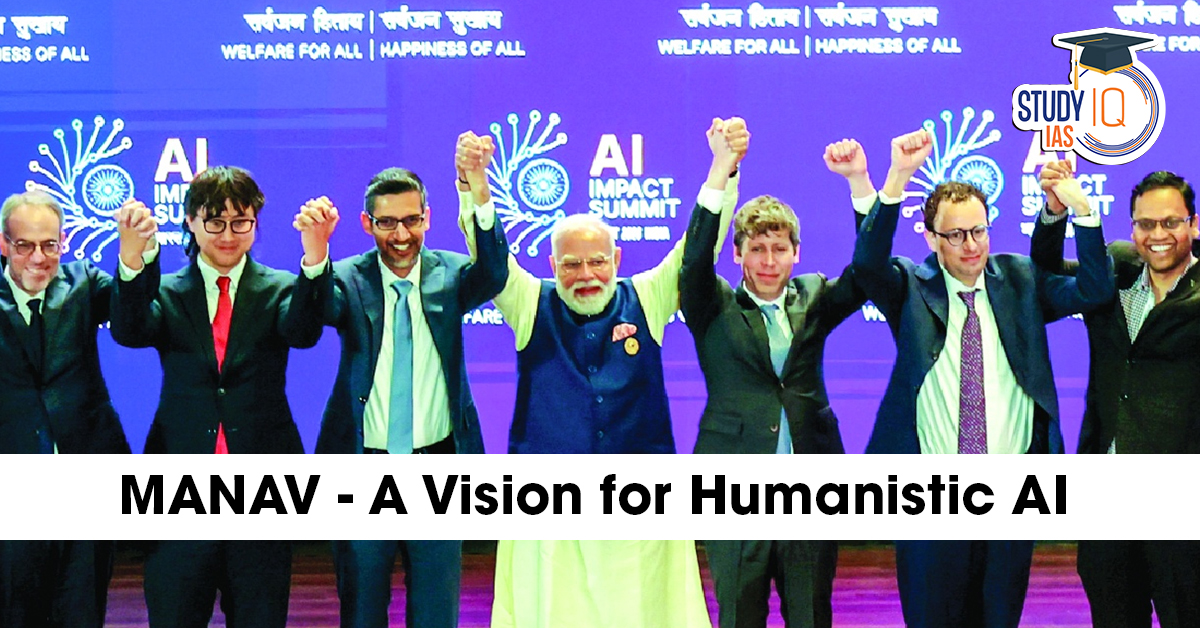
At the India AI Impact Summit, Prime Minister Narendra Modi unveiled MANAV – A Vision for Humanistic AI, a comprehensive framework designed to guide ethical, accountable, inclusive, and sovereign AI development.
The word MANAV means human, symbolizing India’s commitment to keeping human welfare at the center of technological advancement.
What is MANAV – A Vision for Humanistic AI?
MANAV is an acronym representing five core pillars of AI governance:
| Letter | Principle | Meaning |
|---|---|---|
| M | Moral & Ethical Systems | AI must be rooted in ethical standards and human values |
| A | Accountable Governance | Transparent rules and strong oversight |
| N | National Sovereignty | Data ownership and digital autonomy |
| A | Accessible & Inclusive | AI must benefit all sections of society |
| V | Valid & Legitimate | AI systems must be lawful and verifiable |
The MANAV framework aims to balance technological innovation with regulatory safeguards to ensure AI serves humanity rather than disrupts it.
Why Humanistic AI is Essential Today
AI systems today influence:
-
Financial decisions
-
Healthcare diagnostics
-
Recruitment processes
-
Law enforcement tools
-
Social media content
-
National security frameworks
With this influence come risks such as algorithmic bias, misinformation, privacy violations, job displacement, and cybersecurity threats.
The MANAV Vision responds to these challenges by proposing a human-first model of AI governance.
The Five Pillars Explained in Detail
1. Moral and Ethical Systems
AI must operate under clearly defined ethical guidelines. This includes:
-
Fairness and non-discrimination
-
Transparency in algorithms
-
Protection of human rights
-
Responsible AI training practices
Ethical AI ensures technology enhances dignity and equality rather than undermining them.
2. Accountable Governance
AI systems cannot operate in a regulatory vacuum. Accountable governance implies:
-
Clear legal frameworks
-
Regulatory institutions for AI oversight
-
Algorithm audits and transparency mechanisms
-
Defined liability in case of harm
This builds trust among citizens and businesses.
3. National Sovereignty
Data is the fuel of AI. The principle “Whose data, his right” reflects digital sovereignty.
Key elements include:
-
Data protection laws
-
Strategic AI infrastructure
-
Reduced dependence on foreign AI monopolies
-
Protection of sensitive national data
This ensures that technological progress does not compromise national autonomy.
4. Accessible and Inclusive AI
AI should not become a tool controlled by a few corporations or nations. Instead, it must:
-
Empower rural communities
-
Support small businesses and startups
-
Improve education and healthcare access
-
Bridge the digital divide
Inclusive AI promotes equitable development and social justice.
5. Valid and Legitimate Systems
For AI to be trustworthy, it must be:
-
Legally compliant
-
Technically verifiable
-
Secure and reliable
-
Transparent in deployment
Legitimacy strengthens public confidence in AI systems.
India’s Emerging Role in Global AI Governance
The unveiling of the MANAV Vision at the India AI Impact Summit marks India’s growing influence in global AI discussions.
As the first major AI summit hosted in the Global South, the event emphasized:
-
International cooperation
-
Shared AI safety standards
-
Ethical global frameworks
-
Representation of developing nations in AI governance
India’s model presents a balanced path between heavy regulation and unregulated technological expansion.
Human–AI Co-Creation: The Future of Work and Society
The MANAV Vision recognizes that the world is entering a phase where:
-
Humans and intelligent systems co-create
-
AI augments productivity
-
Automation reshapes employment patterns
-
Digital literacy becomes essential
Instead of replacing humans, AI should amplify human potential.
Focus on Child Safety and Social Responsibility
A key highlight of the vision is safeguarding vulnerable groups, especially children.
This involves:
-
Safe AI design standards
-
Responsible generative AI usage
-
Prevention of harmful digital content
-
Ethical data practices
AI must remain socially guided and family-safe.
Strategic and Economic Implications
The MANAV Vision strengthens India’s position as:
-
A responsible AI innovator
-
A trusted digital partner globally
-
A hub for AI startups and research
-
A leader in inclusive digital development
It also supports:
-
Digital public infrastructure
-
Skilled workforce development
-
Research and innovation ecosystems
-
Economic competitiveness
Alignment with “AI for Humanity”
The vision aligns with India’s civilizational philosophy of:
“Sarvajana Hitaya, Sarvajana Sukhaya” – Welfare for all, happiness for all.
By integrating ethical values into technological development, MANAV ensures AI contributes to social harmony and sustainable progress.
Challenges in Implementation
While the vision is comprehensive, successful implementation requires:
-
Institutional capacity building
-
Skilled AI professionals
-
Strong cybersecurity frameworks
-
International coordination
-
Continuous ethical monitoring
The collaboration of government, industry, academia, and civil society will be essential.
Conclusion
MANAV – A Vision for Humanistic AI represents India’s forward-looking and balanced approach to artificial intelligence governance. By combining ethics, accountability, sovereignty, inclusivity, and legitimacy, the framework ensures AI remains aligned with human values.
As AI becomes central to the 21st-century global order, the MANAV Vision offers a guiding roadmap for responsible, inclusive, and human-centric technological progress.
Artificial Intelligence must remain human at its core — and MANAV ensures exactly that.
 50 Years of the Bonded Labour System (Ab...
 UN Probe Finds “Hallmarks of Genocideâ...
 Geneva to Host 2027 AI Impact Summit: Gl...











 WhatsApp





