
Table of Contents
Context
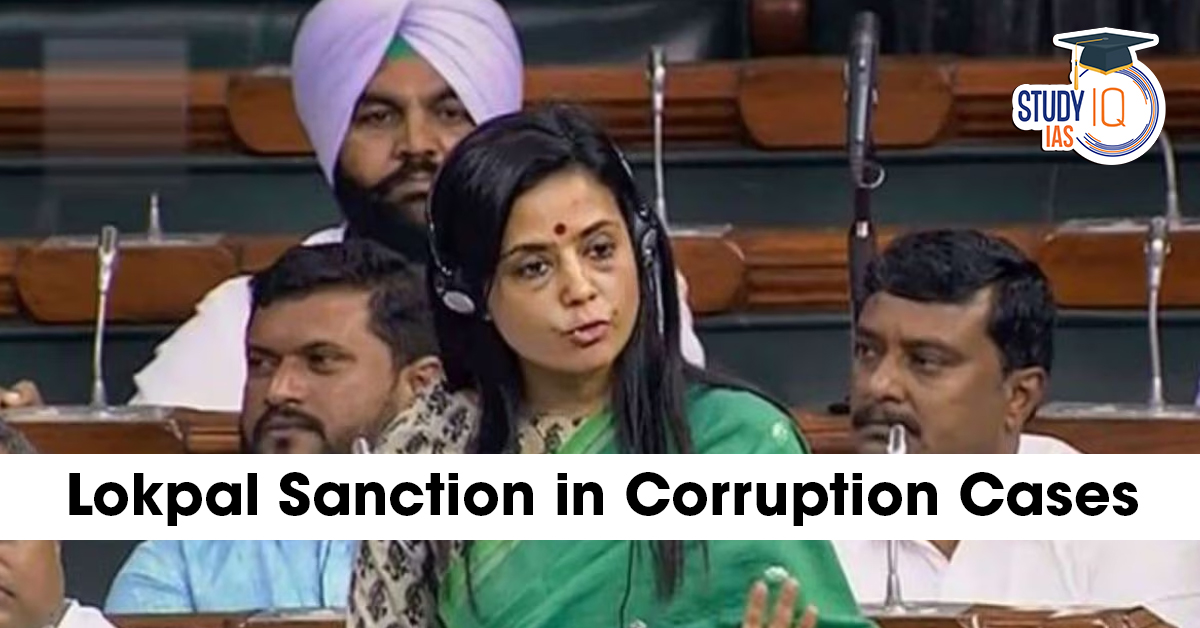
The Supreme Court of India has agreed to examine the procedure followed by the Lokpal of India for granting sanction in corruption cases. The issue arose after the Delhi High Court criticised the Lokpal’s interpretation of the law while dealing with allegations against Trinamool Congress MP Mahua Moitra.
Establishment
- Statutory body: The Lokpal of India was established under the Lokpal and Lokayuktas Act, 2013.
- Purpose: It functions as a national anti-corruption authority that examines complaints against public officials and ensures accountability in public administration.
Mandate and Functions
- Core responsibility: The Lokpal investigates allegations of corruption against public functionaries under the central government.
- Legal basis of complaints: Complaints must relate to offences under the Prevention of Corruption Act, 1988.
Organisational Structure
Composition
- Members: The Lokpal consists of a Chairperson and up to eight Members, of which four must be Judicial Members.
- Representation requirement: At least 50% of the Members must belong to SC, ST, OBC, minority communities, or be women, ensuring diversity in the institution.
Eligibility of Chairperson
- The Chairperson can be:
- A former Chief Justice of India,
- A former judge of the Supreme Court, or
- An eminent person meeting the eligibility criteria defined in the Act.
- Judicial Members: Judicial members must be either former judges of the Supreme Court or former Chief Justices of High Courts.
Appointment of Members
Selection Process
- The Chairperson and Members are appointed by the President of India based on the recommendation of a Selection Committee consisting of:
- The Prime Minister (Chairperson)
- The Speaker of the Lok Sabha
- The Leader of Opposition in the Lok Sabha
- The Chief Justice of India or a judge nominated by him/her
- One eminent jurist
Tenure and Service Conditions
- Term: Five years or until attaining the age of 70 years, whichever is earlier.
- Remuneration:
- The Chairperson receives salary and allowances similar to the Chief Justice of India.
- Members receive benefits equivalent to those of Supreme Court judges.
Jurisdiction of Lokpal
Public Functionaries Covered
The Lokpal has authority to examine corruption complaints against:
- The Prime Minister, Union Ministers, and Members of Parliament.
- Central government officials belonging to Groups A, B, C, and D.
Institutions and Organisations
Its jurisdiction also extends to:
- Boards, corporations, societies, and autonomous bodies created by law or funded by the government.
- Trusts and societies receiving foreign contributions above ₹10 lakh.
Filing of Complaints
- Open access: Any individual can file a complaint in the prescribed format if it concerns corruption by a public servant.
Inquiry and Investigation Process
Preliminary Inquiry
- Upon receiving a complaint, the Lokpal may order a preliminary inquiry through its Inquiry Wing or another agency.
Investigation by Agencies
- If there is a prima facie case, the matter may be referred to the Central Bureau of Investigation for detailed investigation.
Role of Vigilance Authority
- Complaints related to central government officials may also be referred to the Central Vigilance Commission for examination.
Special Provisions Regarding the Prime Minister
| Restricted Areas of Inquiry
● The Lokpal cannot investigate allegations against the Prime Minister relating to: ○ International relations ○ National security ○ Public order ○ Atomic energy ○ Space matters Approval Requirement ● Any inquiry against the Prime Minister can begin only after approval by two-thirds of the full Lokpal bench. |
Powers of the Lokpal
Oversight of Investigative Agencies
- The Lokpal has supervisory powers over the Central Bureau of Investigation in cases referred by it.
- Investigating officers handling such cases cannot be transferred without Lokpal’s approval.
Investigative Powers
- It can authorise search and seizure operations in corruption cases.
- Its Inquiry Wing enjoys powers similar to those of a civil court during investigations.
Administrative Actions
- The Lokpal may recommend the transfer or suspension of officials involved in corruption allegations.
- It can also issue directions to prevent the destruction of evidence during inquiries.
Asset Recovery
- In certain situations, the Lokpal may order confiscation of assets obtained through corrupt practices.
Annual Report to the President
- Under the Act, the Lokpal submits an annual report to the President of India describing its activities and findings.
The report is subsequently presented before both Houses of Parliament, ensuring legislative oversight.
|
Read More Notes |
|
| Environment Notes | Art and Culture Notes |
| Science and Tech | History Notes |
| Geography Notes | Indian Polity Notes |
| General Knowledge | International Relation |
|
Explore StudyIQ Courses |
|
 The Transgender Persons (Protection of R...
 WASH (Water, Sanitation, and Hygiene) Se...
 Vairamuthu Wins Jnanpith Award 2026: Tam...







 WhatsApp





